

Google
might have come late to the cloud game and it might be a distant third compared
to Amazon Web Services and Microsoft Azure, but Google Cloud is making up for
lost time thanks to the killer app that GenAI has become. And while Nvidia is
the dominant full stack player out there when it comes to hardware, which is
why its revenues and profits have exploded, Nvidia’s Nemotron models are not anywhere
as popular as Google Gemini, OpenAI GPT, or Anthropic Claude.
Here’s
the funny bit. Google never really believed in raw infrastructure clouds. The original
cloud services from Google – Compute Engine and App Engine – abstracted all of
that infrastructure away to make infrastructure easier, invisible. More like
the Borg and Omega platform that internal Google programmers had access to. And
customers didn’t care.
But
here we are, more than a decade later, and IT organizations have learned to stop
hugging their physical and virtual servers and they are perfectly happy to use
APIs for Google’s Gemini model as well as to train their models and run their
inference against Google’s vast global fleet of GPUs and TPUs. Which is why Google
Cloud is growing faster than either AWS or Azure in the first quarter. The customers
have finally caught up to the Google vision, and there are customers who are
choosing the full Google stack for the GenAI, from the raw iron up through data
services and inference engines.
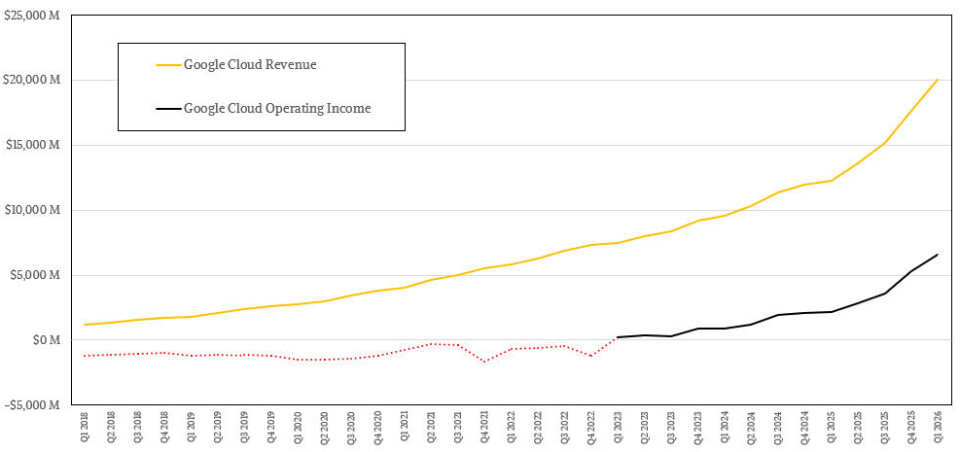
Building
a cloud has not been easy for Google, and it lost a lot of money on it in the
early years, as the chart above shows. But now, Google Cloud is as large as all
of Google was a decade ago – and Google Cloud is more profitable by a factor of
1.25X compared to the entirety of Google was back then. It is arguable that
Google is the best company in the history of IT in terms of building hyperscale
infrastructure and running it efficiently, and that is showing up in the
operating income for Google Cloud. It just took a bit of time for Google to get
there and for IT shops to catch up to the culture that the search engine and
advertising giant was peddling.
The
bad news if you are a competitor of Google’s is that the search engine business
and the various other advertising businesses at the company (YouTube and
network advertising) are collectively doing well. Search revenues were up 19
percent to $60.4 billion, YouTube advertising was up 11 percent to $9.9
billion, while network advertising was off 4 percent to $7 billion. The
subscriptions, platforms, and devices business, which includes Pixel phones,
YouTube Music, Google One, and other services, rose by 19 percent to $12.4
billion. So, despite all the grief that comes as we use chattybots to do
searches, these businesses are still growing, and growing faster than you might
think possible.
It
is not clear how many subscribers Google has for its flagship Gemini model, but
the company did say that its “first party models” – meaning its own Gemini models
served out as APIs, as well as Lyria, Nano Banana, Veo, and Gemma – processed
an average of 16 billion tokens per minute in the March quarter, up 60 percent from
10 billion tokens per minute in the Q4 2025 quarter. By our math and what
Google said about its averages, that means it processed 917.3 trillion tokens against
Gemini on behalf of customers in Q3 2025, with 1,310.4 trillion tokens in Q4
2025 and 2,050.6 trillion tokens in Q1 2026.
Presumably
the Google Gemini App division pays Google Cloud for the use of TPUs, just like
any other customer does. (Albeit at an attractive price, I suspect.) Google does
not talk about how many tokens it is generating for customers using Nvidia or
AMD GPUs. But Sundar Pichai, the company’s chief executive officer, said on a
call with Wall Street analysts that in the past twelve months, 330 customers on
Google cloud had processed over 1 trillion tokens each, and 35 of these had
broken through the 10 trillion token barrier. The use of the BigQuery tabular
database in conjunction with Gemini has grown by 30X in the past year as well
as companies see the benefits of a completely unified Google AI stack, from TPU
up through Gemini and the
Gemini Enterprise Agent Platform (an enhanced version of what was formerly known
as Vertex AI) that wraps around it.
This
is the driving force for the phenomenal growth that Google saw in its eponymous
cloud in the first quarter, and its enormous revenue backlog of $462 billion – about
half of which will be recognized within the next two years – is why Wall Street
did not freak out when Google talked about spending somewhere between $180
million and $190 million this year on capital expenses. The lack of such a
revenue backlog is why Meta Platforms took a shellacking when it was going to
spend on that order of magnitude.
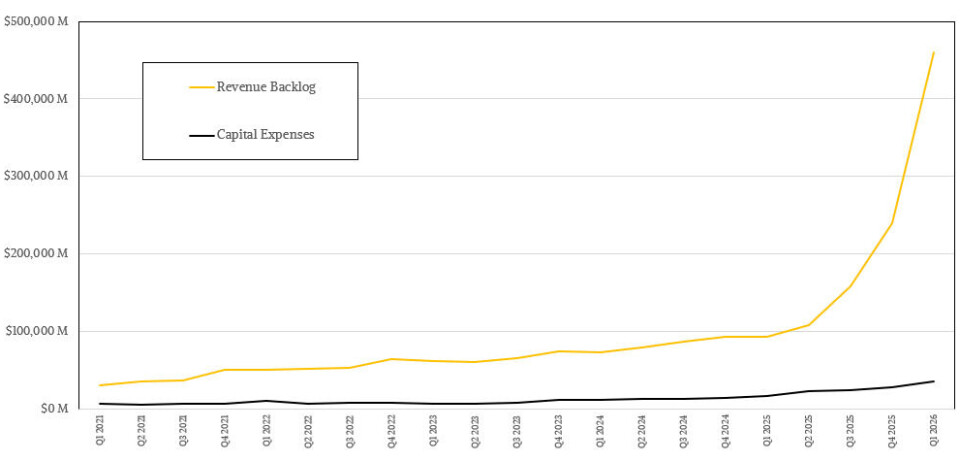
As
you can see, the capex has to rise to keep pace with the backlog, which is not
dominated by model builder OpenAI, whose revenue streams and operating losses
are something to worry about when you are planning three, four, or five years
into the future.
Google
Cloud is finally hitting its stride, and I think part of the reason is that
full stack integration. So does the company’s CEO.
“Google
Cloud is differentiated because we are the only provider to offer first party
solutions across the entire enterprise AI stack,” Pichai said on the call. “Our
growth in revenue, operating margin, and backlog highlights this
differentiation. Our Enterprise AI solutions have become our primary growth
driver for Cloud for the first time. In Q1, revenue from products built on our
gen AI models grew nearly 800 percent year over year. We are winning new
customers faster, with new customer acquisition doubling compared to the same
period last year. We are seeing strong deal momentum, doubling the number of
$100 million to $1 billion deals year on year, and signing multiple billion
dollar plus deals. And we are deepening relationships with existing customers.
Customers outpaced their initial commitments by 45 percent, accelerating over
last quarter.”
To
put the numbers on it, Google Cloud had revenues of just a tad over $20 billion,
up 63.4 percent year on year and up 13.4 percent sequentially. (That is more
than double the
growth of Amazon Web Services in the same Q1, but AWS is almost twice as
large as Google Cloud.) If current growth rates persist, Google Cloud would
catch AWS, with each having more than $82 billion in revenues by Q1 2029.
Google can certainly afford to invest to underpin that level of cloud revenue.
But as I said higher up in this story, the important thing is that Google Cloud
is showing better profitability, with operating income up by more than a factor
of 3X year on year to $6.6 billion, which was up 24.2 percent sequentially. Some
prior investments in infrastructure are clearly paying off.
As Q1 2026 came to an end, Google had shelled out
$35.67 billion in capital expenses, and the company said that about 60 percent
was for servers and 40 percent was for networking and datacenters. This ratio
has held for the past five quarters that Google has been talking about it.
