

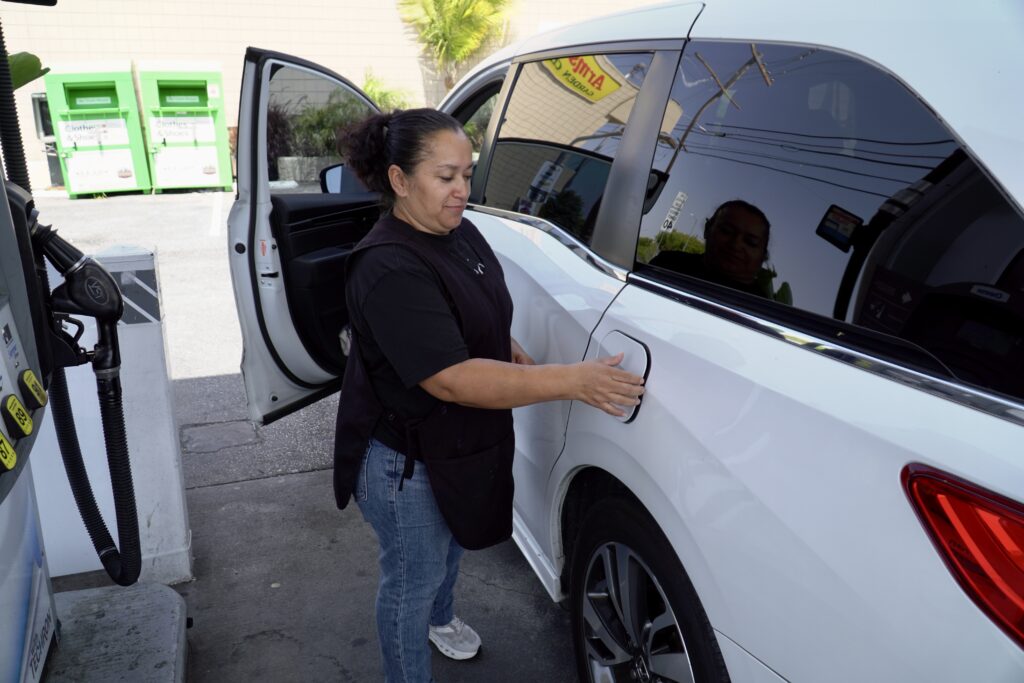
LOS ANGELES—At a Chevron station where the gas pump had a $6.49 cash price, Veronica Cervantes listed the concessions she’s made to afford the skyrocketing price of gasoline over the last two months.
“I don’t go out as much as I did. When I go places nearby, I go walking. I don’t shop,” Cervantes, 54, of nearby Compton, said in Spanish on Thursday.
“I go once a month to Tijuana, to see my family. My mom, my dad, my brother. I used to go up to three times a month,” Cervantes, who cleans homes for a living, added before putting back her nozzle.
Frustrations over high gas prices, for drivers nationwide and especially in California, are escalating as the United States’ war in Iran presses on.
The average price of regular gas in the U.S. hit $4.30 a gallon on Thursday, up 27 cents from a week prior, according to data from AAA, the motor club. A new high since the war began, the price was up $1.12 a gallon from this point last year.
The station Cervantes pumped at charged people paying with a credit card $6.59 a gallon for regular unleaded. One gas station in LA reached $8.71 a gallon.
With its average gas prices surpassing $6 a gallon as of Thursday, California stood out from the rest of the U.S. on AAA’s map outlining the country’s fuel prices.
“The biggest driver of the high price of gasoline right now is the war,” said Severin Borenstein, a professor of business administration and public policy at the University of California, Berkeley.
“The main reason gas costs so much is oil costs so much,” he said. “Every $1 per barrel increase in the price of crude oil [on average] translates to two-and-a-half cents at the pump.”
Iran’s major response to bombing by the U.S. and Israel has been to block shipping in the Strait of Hormuz, through which about 20 percent of the world’s oil passes. That’s the biggest driver of the steeply increasing prices at the pump.
“The blockage of the Strait of Hormuz has raised prices in the world oil market, and that’s affecting everyone,” Borenstein said.
In terms of energy, the war in Iran has cost Americans more than $29 billion and counting since Feb. 28, according to data from the Watson School of International and Public Affairs at Brown University.
“If you tell me when the war is going to be over,” Borenstein said, “I can tell you when the price is going to go down.”
Alfred Estrella wasn’t happy to hear that.
The 43-year-old pulled up after Cervantes to the LA gas station at the corner of South Sepulveda Blvd. and West 76th St.
“This is crazy,” said Estrella, after seeing the $6.49 price. “It wasn’t like that yesterday. Not even close.”
Estrella, who works in dialysis and typically fills up there, drives about 85 miles round trip on his work days. The cost of his commute adds up quickly.
Drivers are dropping $70, sometimes more than $80 dollars, to fill all the way up at the station.
For environmental groups, the latest headaches over gas prices have only brought to the forefront what they call the country’s outsized reliance on fossil fuels and impacts of broader decisions from the Trump administration to hinder shifts toward clean energy alternatives.
“For Californians already paying some of the highest gas prices in the country, this administration is making the problem worse by making electric vehicles harder to afford, shutting down offshore wind projects that could bring cheap clean power and good union jobs to California’s coast, and helping fossil fuel companies expand [liquefied natural gas] terminals so domestic oil and gas can be shipped overseas for higher profits,” Miguel Miguel, director of the nonprofit Sierra Club California, said Thursday.
Labor unions, including the State Building and Construction Trades Council of California, which represents more than 450,000 workers, say that the cost increases point to the problem with relying on fuel from overseas.
The war “and the scarcity it is creating, and the resulting escalating fuel costs, should encourage support of in-state production until we are no longer dependent on fossil fuels,” said council president Chris Hannan in a statement.
This story is funded by readers like you.
Our nonprofit newsroom provides award-winning climate coverage free of charge and advertising. We rely on donations from readers like you to keep going. Please donate now to support our work.
But UC Berkeley’s Borenstein said the state’s high gas prices can’t solely be blamed on the war.
He outlined a variety of reasons the price of gas has been high historically in California, including an excise tax higher than those in most other parts of the U.S., state environmental fees for its cap-and-trade program for greenhouse gas emissions and the state’s use of cleaner-burning gasoline. An explainer on his institute’s website details one more reason: a “mystery gasoline surcharge” that began in 2015, over which the state launched an investigation.
In Mono County, which has the highest average gas prices of any county in California, the price on Friday was $6.97 a gallon.
“Yeah, it’s been getting some press lately,” said Jennifer Kreitz, a Mono County supervisor. “It’s part of the local culture. Almost like, this is what we deal with.”
Mono County is governed by a five-member board of supervisors who can do little about gas prices.
“That’s not something we can dabble in,” Kreitz said, noting that a nearby gas station in the county had recently reached $7.19 a gallon. “That’s bigger than our policies, bigger than our purses.”
Gas prices there are likely distinctly high because the county—which stretches over more than 3,000 square miles between the Sierra Nevada mountains and the Nevada border—is rural, with a population of just about 13,000 people. Less gas sells per pump there, experts and officials said.
Kreitz, getting in her car for a trip, said locals know the drill by now.
“Fill up in Nevada before you come home,” she said.
About This Story
Perhaps you noticed: This story, like all the news we publish, is free to read. That’s because Inside Climate News is a 501c3 nonprofit organization. We do not charge a subscription fee, lock our news behind a paywall, or clutter our website with ads. We make our news on climate and the environment freely available to you and anyone who wants it.
That’s not all. We also share our news for free with scores of other media organizations around the country. Many of them can’t afford to do environmental journalism of their own. We’ve built bureaus from coast to coast to report local stories, collaborate with local newsrooms and co-publish articles so that this vital work is shared as widely as possible.
Two of us launched ICN in 2007. Six years later we earned a Pulitzer Prize for National Reporting, and now we run the oldest and largest dedicated climate newsroom in the nation. We tell the story in all its complexity. We hold polluters accountable. We expose environmental injustice. We debunk misinformation. We scrutinize solutions and inspire action.
Donations from readers like you fund every aspect of what we do. If you don’t already, will you support our ongoing work, our reporting on the biggest crisis facing our planet, and help us reach even more readers in more places?
Please take a moment to make a tax-deductible donation. Every one of them makes a difference.
Thank you,

Reporter, California
Steven Rodas is an environmental and climate reporter for Inside Climate News based in Southern California. He previously reported on the environment in New Jersey, covering energy, pollution, wildlife and development. Steven’s work has appeared in several publications including NJ.com/The Star Ledger, hMAG, The Jersey Journal and The Hudson Reporter. He worked as a copywriter at Google. Steven has a master’s degree from Syracuse University’s S.I. Newhouse School Of Public Communications. He is fluent in English and Spanish (and welcomes your tips).
