

It should have been a victory lap for Jared Isaacman. The Nasa administrator was in Washington DC for what he surely hoped would be a celebration with lawmakers and the US president, little more than two weeks after the successful conclusion of the first human journey around the moon in more than half a century.
Instead, last week began with some difficult questions in Congress about the Trump administration’s unpopular plan to slash the space agency’s budget. It ended at the White House with the president appearing to poke fun at his prominent ears, watched by four bemused Artemis II astronauts waiting in vain for any question about their historic mission.
There could have been no better illustration of how Donald Trump has tarnished the aftermath of Nasa’s greatest moment in five decades, and is singularly focused on dismantling the agency’s science programs even as he urges it to plant a Stars and Stripes flag back on the moon before he leaves office in January 2029. At least part of Trump’s hostility to Nasa’s science programs appears to stem from his animus towards the agency’s role in climate research.
Yet, even as Trump tries for the second time in two years to slash almost a quarter of the Nasa budget, he finds himself opposed by a powerful and united space community determined not to let him dictate the Artemis legacy.
On Thursday, in an act of deep disobedience, the Republican-led House commerce, justice, and science subcommittee snubbed Trump’s 2027 $18.8bn budget request for Nasa – a 23% cut on 2026 funding – and advanced its own $24.4bn plan that would keep alive the science projects the president is looking to kill.
It came after Isaacman himself appeared before House and Senate committees last week to defend the Trump proposal, insisting that Nasa can do more with less, including building its hugely ambitious $20bn moonbase by the end of the decade.
“Nasa’s successful Artemis II mission around the moon was an inspiring reminder that we must remain ahead of global competition – and that same vision is reflected throughout this bill,” Hal Rogers, the Kentucky congressman and committee chair, said in a statement.
In the Senate, the Maryland Democrat Chris Van Hollen, ranking member of the chamber’s science appropriations subcommittee, told Isaacman he had similar concerns.
“Everyone in this room knows that without space science, there is no space exploration. Without space science, there is no new planetary discovery. Without space science, there is no Nasa,” Van Hollen said.
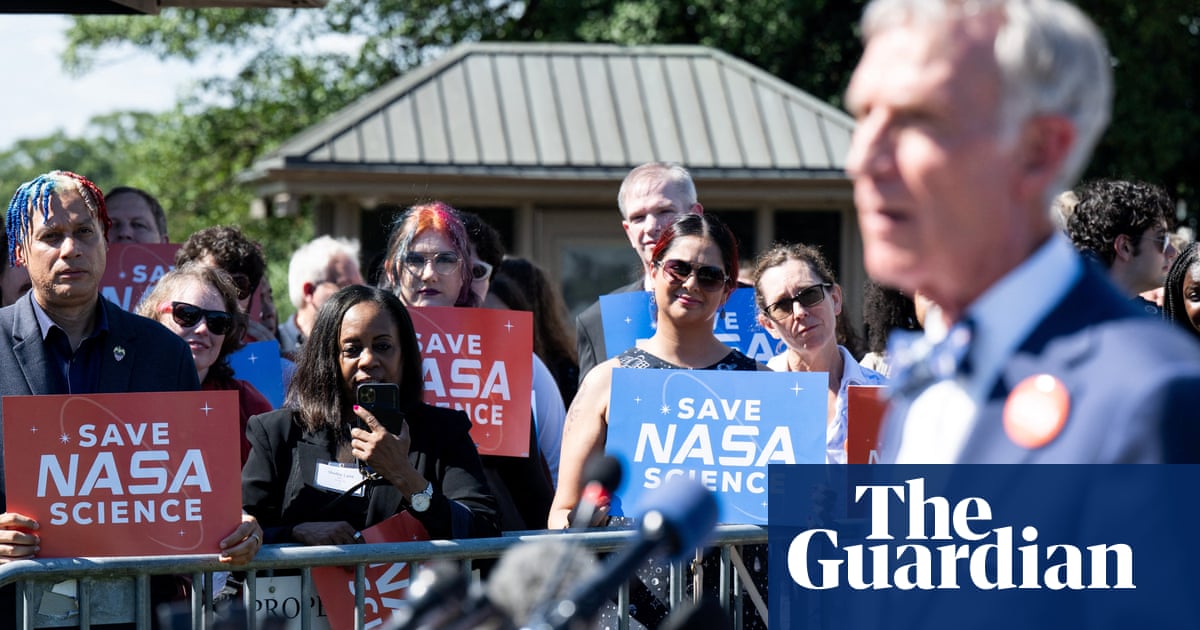
Those fighting outside Congress to save Nasa’s budget are encouraged by the lawmakers’ resistance, and confident that ultimately Trump’s proposal, including a 46% cut for science, will fall, following the same fate as his near-identical 2026 request did in January.
They are, however, dismayed to have to be fighting the same battle again so soon.
“It will be won again, because, respectfully, members of Congress and the Senate have no time for this,” said Bill Nye, television’s “Science Guy”, and chief ambassador for the Planetary Society.
“The expression they use is this budget is dead on arrival. But I will say, as a taxpayer and voter, let alone space advocate, it’s inefficient to have the office of management and budget (OMB) proposing to cut Nasa by over a fifth, and cut science by almost half, and then everybody has to push back and reconfigure. It’s just a waste of time.”
Nye, and the Planetary Society, have resurrected their online Save Nasa Science campaign, and say the administration’s argument that resources need to be cut from science missions to help fund human spaceflight, and beat China back to the moon, is bogus.
“You can’t fly humans without knowing the topography of the moon, and the subtle gravitational variations in the moon, and you want to know what the regolith is made of,” he said.
“What has happened historically is robots go first. The Surveyor spacecraft landed on the moon to make sure that a human landing craft would not sink into the dust. If somebody ever goes to Mars, the same will be true. The robots go first.
“Many more discoveries are made per dollar, per euro, per yuan, in robotic exploration than human space flight.”
Other experts agree that getting to Mars, the ultimate goal of the Artemis program that Trump has claimed as his own (despite significant advances occurring during the Biden administration), will be nearly impossible if his cuts are enacted.
“If this funding trajectory is not reversed, Nasa’s Mars programs will face severe and irreversible harm, jeopardizing the US’ ability to land spacecraft on the surface of Mars, not just in the near future, but for decades to come,” four Democratic senators, including the former space shuttle and international space station astronaut Mark Kelly, wrote to Van Hollen and the Kansas Republican Jerry Moran, the Senate subcommittee’s chair.
Don Platt, head of aerospace, physics and space sciences at Florida Institute of Technology, and a former Nasa engineer and manager, agreed.
“I do expect further backlash this year in Congress,” he said. “Nasa has a broad level of support, and made a good decision when Nasa facilities were established around the country.
“It means many regions are concerned with Nasa’s budget. Cuts will damage the nation’s ability to lead in science. There’s still a great deal about Mars, and even the space weather environment on the way to and from Mars, to be learned before we can safely do a human Mars mission.”
Platt’s point about nationwide support for Nasa resonated with Nye, who said the country’s desire to see its space agency not only succeed, but lead the world in scientific and spaceflight achievements, transcended politics.
“States that are very conservative, Texas, Alabama, Louisiana, Florida, these have tremendous space interest … we launch rockets from Florida,” he said.
“Meanwhile, by long tradition, you have California Technical Institute, and the applied physics lab, which is part of Johns Hopkins, in states that had senators that really supported this kind of investment. So those are blue states that are very invested in Nasa, and then there are red states that are very invested in Nasa.
“Everybody supports Nasa, and I like to say Nasa is the best brand the US has. [But] you can’t be a leader in human spaceflight if you’re not a leader in science.”
Isaacman, Nye said, was “playing the hand he was dealt” by trying to defend the cuts to “an audience of one”: Trump.
“So he’s got to manage this, he’s got to manage getting humans to the moon and back, and he’s got to manage the budget cuts,” he said.
“But I’ll just tell you objectively, cutting science is not in the United States’ best interest. While we’re all sitting here, China is going hard and fast and doing extraordinary things, and they’re going to land people on the moon in 2030.
“I won’t say we are just sitting on our hands, but we are fighting these kooky budget battles over and over.”
