

In hospitals across Nigeria and much of sub-Saharan Africa, children with severe diarrhea arrive daily. Clinicians act quickly to prevent dehydration and eventual death, though they aren’t always successful. And in most cases, no test confirms the underlying cause, leaving treatment decisions to be made without a clear diagnosis. “Most of the time, we just treat,” virologist Margaret Oluwatoyin Japhet says. “We do not really know what caused the infection because diagnosis is difficult.”
Japhet is working to change that. At Obafemi Awolowo University in Nigeria, she is developing a rapid diagnostic kit designed to quickly identify the cause of diarrhea in children. Rotavirus is the most common cause of severe diarrheal diseases in infants and young children worldwide according to the World Health Organization, and a major contributor to the burden Japhet’s work aims to address through improved diagnostics.
Despite vaccines, rotavirus remains a major threat to children’s lives, particularly in sub-Saharan Africa. In 2016, it caused an estimated 128,500 deaths globally in children under five, with over 100,000 deaths occurring in sub-Saharan Africa alone, according to the latest most comprehensive data available. “Every child that is born will have one or three episodes of rotavirus in their lifetime,” Japhet says. In Nigeria, rotavirus accounts for nearly half of all diarrhea-related hospitalizations in children under 5 and contributes to an estimated 48,000 deaths annually. Vaccination coverage remains uneven across the region, with access gaps and incomplete uptake limiting protection for many children.
Without widespread testing, tracking outbreaks, assessing vaccine effectiveness and understanding why some children become severely ill remain a persistent challenge. Japhet has developed a low-cost diagnostic kit that can detect rotavirus that cause severe diarrhea. Her kit works without requiring complex machinery or extensive training. She describes it as a tool that “should be something that works with the minimum,” especially in resource-limited settings. The kit has already undergone proof-of-concept and pilot testing in clinical settings, with findings reported in a peer-reviewed journal.
Such point-of-care diagnostics could be a game changer for diarrheal disease surveillance and outbreak response, where delays in laboratory confirmation often hinder timely action, other experts say.
Built for the frontlines
Current rotavirus diagnostic methods rely on laboratories with power, refrigeration, trained personnel and stable supply chains — resources that many Nigerian hospitals lack. “In developed countries, when people are producing kits, they already have it at the back of their mind that there is electricity, that there is a refrigerator, that there is a freezer,” Japhet says. “But in Nigeria, you can count how many homes even have a mini freezer.”
When something is created with local challenges in mind, it can do wonders. Take the oral polio vaccine: “You do not even need a normal refrigerator,” Japhet says. “You can just carry a cold box, and you are able to give it.”
Previous efforts to create low-cost rotavirus detection tools have often struggled to move beyond the laboratory because they assumed the presence of resources often unavailable in much of sub-Saharan Africa. “That is what we are trying to avoid,” Japhet says.
Her test, tailored for low-resource settings, uses cotton swabs and nanobeads coated with antibodies, proteins that recognize the virus. A user dips the prepared cotton swab into a stool sample, then into a solution containing the antibody-coated nanobeads. When rotavirus is present, it binds to the antibodies, causing the nanobeads to attach and the swab to turn blue. The kit can be stored in a cooler at about 4° Celsius.
“It is easy and almost mess-free,” Japhet says. “You do not need trained personnel. You can just tell somebody, even a high school student, ‘This is how it works. Put this inside, put that, and then look at the color change.’”
Existing rapid diagnostic kits often miss children with low levels of virus in the body partly because of the tests’ limited sensitivity and specificity. Japhet and colleagues tested their new method against two commonly used methods for rotavirus diagnosis and found that their kit performed comparably to or even better than existing tests in detecting infections, including those with low virus levels. For example, when the researchers pitted their kit against a standard diagnostic method called ELISA, the new kit exhibited 88 percent sensitivity, meaning it correctly identified most of the infected children, while ELISA showed just 60 percent sensitivity, Japhet and colleagues reported in Methods and Protocols in 2025.
And her test has been validated in real clinical settings. “We collected samples from children with diarrhea in three different hospitals and checked our kit against [other] methods,” she explains. “We did not just produce the kit and leave it in the lab.”
Chukwubike Chinedu, a rotavirus specialist at the University of Nigeria Teaching Hospital, is impressed with Japhet’s creation: “An innovative kit is coming,” he says. If optimized, “it could help detect rotavirus in children who might otherwise go undiagnosed.” Japhet’s kit is faster and easier to use than ELISA or other common methods, he says. Notably, it can be used at a child’s bedside, offering rapid results without the need for laboratory infrastructure. However, the test cannot detect all rotavirus types. Because of this, it may not fully replace other diagnostic tests, he says.
Once she gets a steady supply of antibodies, Japhet expects the kit to be affordable enough for local clinics and district hospitals. However, moving toward full rollout will require funding. The kit also needs to be produced steadily and perform consistently, regardless of the setting. Wider deployment will depend on securing the necessary partnerships to support these efforts.
Africa’s fight against rotavirus
Ensuring that diagnostic tools reach the children who need them remains a challenge, Chukwubike notes. “Having a reliable test is one thing, but making sure it is available where it matters — rural clinics, district hospitals and resource-limited settings — is equally critical,” he says.
ELISA is still the standard diagnostic test for rotavirus, but post-pandemic disruptions have caused cost and supply challenges, limiting access to routine testing in many low-resource settings and creating gaps in surveillance and outbreak monitoring. Simple test kits like Japhet’s could help fill this gap by pairing a well-designed, low-cost detection method with vaccinations. And yet, testing is not a substitute for prevention, Japhet says.
Japhet’s research contributed evidence that helped introduce the rotavirus vaccine into Nigeria’s national immunization program in 2022. Rotavirus vaccinations are now offered in most African countries. Thirty-eight out of 47 countries across the World Health Organization African region had introduced the vaccine by 2023, though many children do not receive all of the recommended doses needed for complete protection.
Testing, however, is still a key component in the fight against rotavirus. While vaccination has significantly reduced severe disease, it cannot fully eliminate transmission, making additional tools like testing essential. “Without testing, health systems lack the data needed to understand how rotavirus is behaving,” Japhet says. “Detection helps identify outbreaks, track circulating strains and evaluate how well vaccines are working on the ground.”
Preparing the next generation
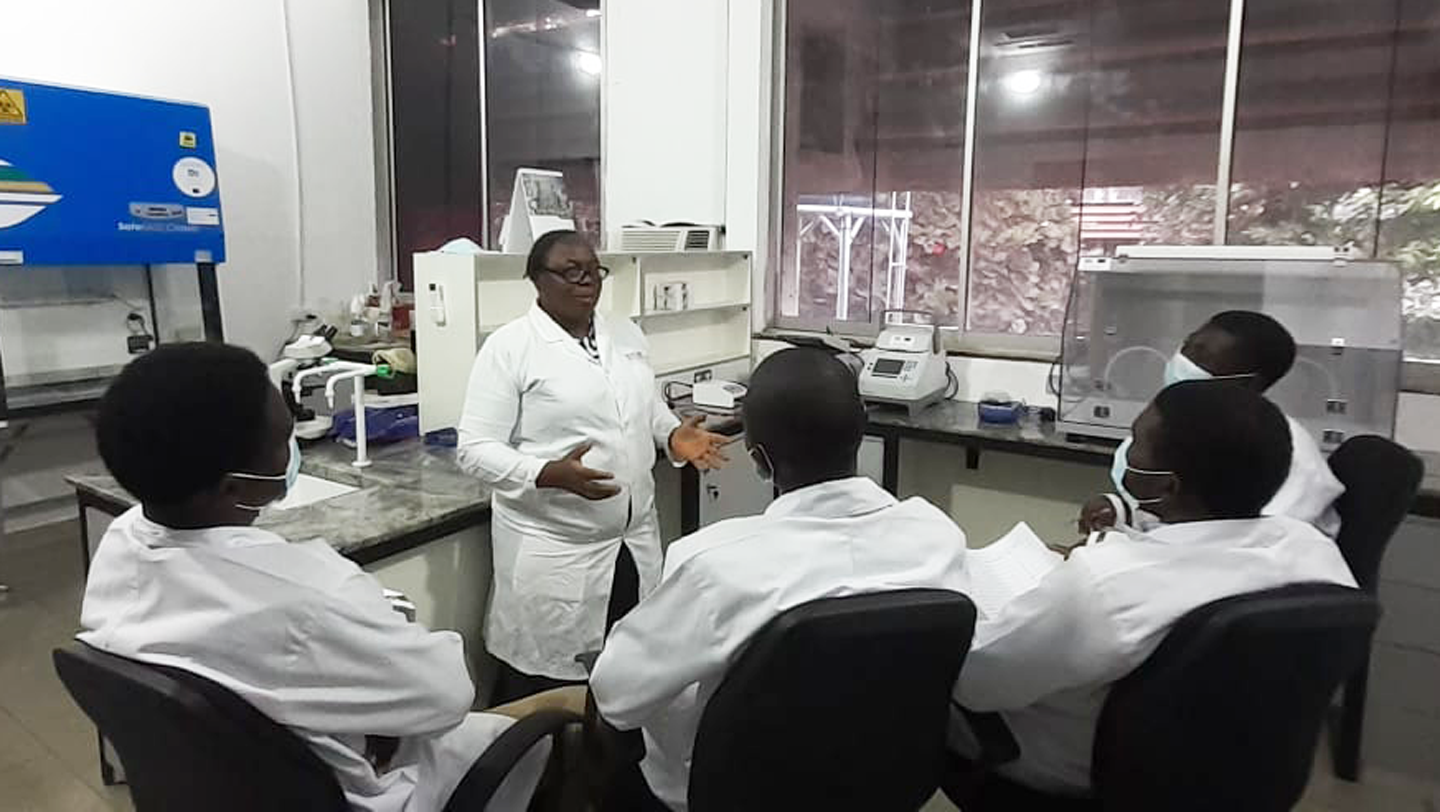
Japhet’s influence extends far beyond her laboratory bench. She has built a molecular research lab in Nigeria and trained a new generation of scientists tackling infectious diseases in low-resource settings.
Adebola Owolabi first encountered Japhet as an undergraduate at Obafemi Awolowo University and quickly recognized her as more than a course instructor. “She believed in my potential, and that made all the difference,” Owolabi recalls.
After graduation, Owolabi remained in Japhet’s lab as a research assistant, gaining hands-on experience in study design, data interpretation and advanced pathogen-detection techniques. “Scientific curiosity, resilience and ambition were expected in her lab,” Owolabi says. The experience strengthened her scientific confidence and made her U.S. graduate school applications more competitive. Owolabi is now a Ph.D. student at SUNY Upstate Medical University in Syracuse.
Temiloluwa Omotade, another student of Japhet’s, recalls late nights spent in the lab with Japhet guiding him and others through experiments. “She doesn’t give up easily,” Omotade says, noting that even when initial attempts failed, Japhet remained committed to finding solutions.
Beyond technical instruction, Japhet modeled rigorous scientific integrity, emphasizing honest reporting and careful problem-solving, Omotade says. Working under her supervision taught him to identify gaps in research and think critically about innovative ways to address them, shaping the way he approaches scientific challenges today as a Ph.D. student at the University of New Mexico in Albuquerque.
Through her mentorship, Japhet cultivates both technical skill and professional resilience in her students, preparing them to tackle Africa’s health challenges. At the same time, she is coming up with scientific answers to persistent health problems. But scaling the technology beyond the research stage will require additional investment and partnerships. “Viruses are organisms you cannot put aside,” she says. “We need researchers who are prepared and equipped so that when outbreaks happen, we already have solutions.”
