
LIVE NEWS
  • Watch NASA’s new Mars helicopter rotor break the speed of sound (video)
  • Venezuela Extradites Billionaire Tycoon Alex Saab to U.S.
  • Solana Foundation president calls meme coins a production test net
  • Week in review: Cisco patches SD-WAN 0-day, unpatched Microsoft Exchange Server flaw exploited
  • One of the market’s hottest trades is everything AI can’t replace
  • As war displaces millions in DR Congo, new schools offer children hope beyond violence — Global Issues
  • Tech exports sustain strong growth – ING
  • Senators introduce bill to abolish military draft agency
Prime Reports
  • Home
  • Popular Now
  • Crypto
  • Cybersecurity
  • Economy
  • Geopolitics
  • Global Markets
  • Politics
  • See More
    • Artificial Intelligence
    • Climate Risks
    • Defense
    • Healthcare Innovation
    • Science
    • Technology
    • World
Prime Reports
  • Home
  • Popular Now
  • Crypto
  • Cybersecurity
  • Economy
  • Geopolitics
  • Global Markets
  • Politics
  • Artificial Intelligence
  • Climate Risks
  • Defense
  • Healthcare Innovation
  • Science
  • Technology
  • World
Home»Science»Watch NASA’s new Mars helicopter rotor break the speed of sound (video)
Science

Watch NASA’s new Mars helicopter rotor break the speed of sound (video)

primereportsBy primereportsMay 17, 2026No Comments3 Mins Read
Share Facebook Twitter Pinterest LinkedIn Tumblr Reddit Telegram Email
Watch NASA’s new Mars helicopter rotor break the speed of sound (video)
Share
Facebook Twitter LinkedIn Pinterest Email


NASA is testing the limits of future Mars aircraft as it works to develop a next-generation fleet of helicopters that will fly through the thin atmosphere of the Red Planet.

In March, engineers at NASA’s Jet Propulsion Laboratory (JPL) in Southern California completed tests on rotor designs that could be used to fly those drones, spinning the experimental helicopter blades fast enough for their tips to exceed Mach 1 (the speed of sound).

A total of 137 tests were performed inside a state-of-the-art chamber that can simulate Mars’ atmosphere by replacing the air with a low-density concentration of carbon dioxide. This work provided NASA with valuable data, which engineers say could increase the vehicle’s lift capability by 30%, allowing future Mars helicopters to carry heavier science instruments and bigger batteries over greater distances.


You may like

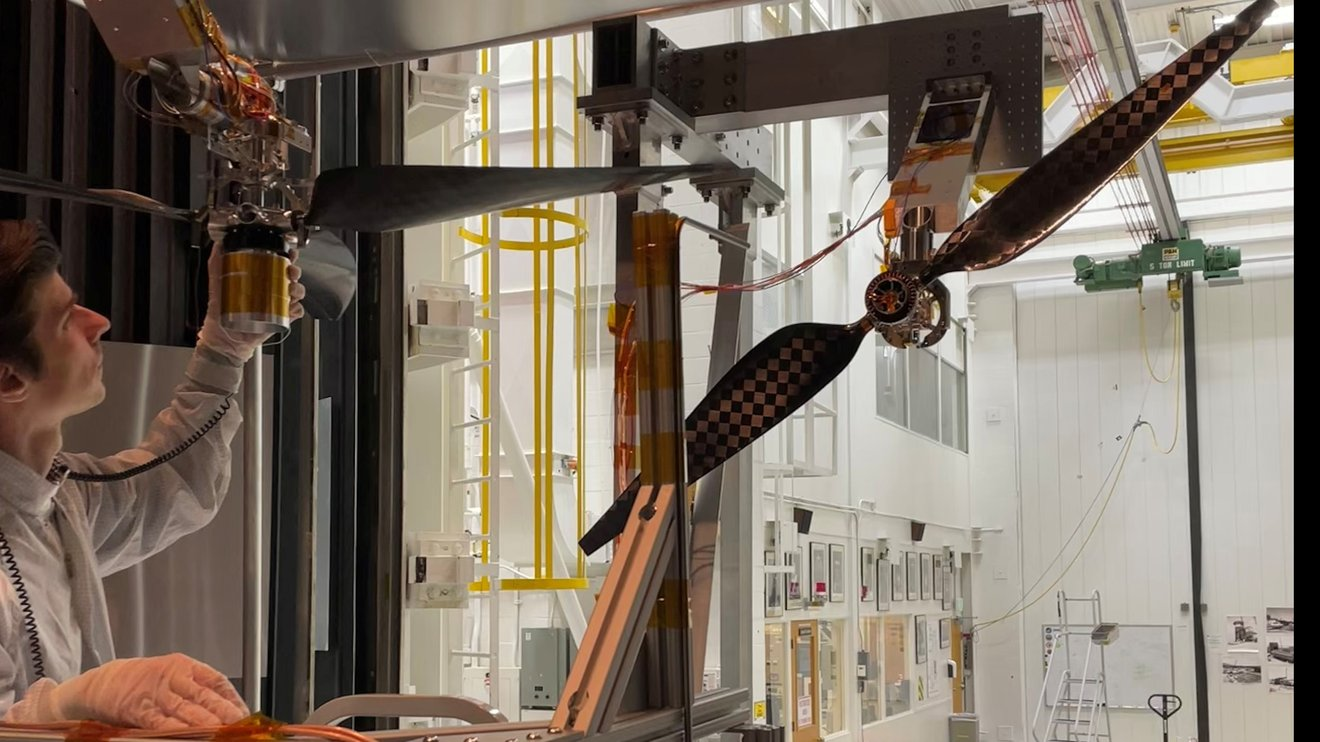
a helicopter rotor is secured on a test mount as someone on the left inspects.

Engineer Jaakko Karras inspects a next-generation Mars helicopter rotor blade prior to testing it at supersonic speeds in the Space Simulator at NASA’s Jet Propulsion Laboratory in November 2025. (Image credit: NASA/JPL-Caltech)

The first-ever aerodynamic flight on Mars was performed on April 19, 2021 by NASA’s Ingenuity helicopter, a prototype designed to determine if a helicopter could be effective in such a thin atmosphere. The little rotorcraft far exceeded mission managers’ expectations, completing a total of 72 flights over the course of nearly three years.

Ingenuity was not built to operate as a full science vehicle, but NASA’s next Mars helicopters are being designed to do just that. “NASA had a great run with the Ingenuity Mars Helicopter,” Al Chen, JPL’s Mars Exploration Program manager, said in a May 7 JPL statement. “But we are asking these next-generation aircraft to do even more at the Red Planet.”

Teams at JPL mounted a three-bladed rotor inside the modified chamber, which also blasted the blades with wind to simulate flight conditions. They spun the rotor at increasing speeds until its tips eventually reached Mach 1.08 without signs of damage.

Engineers also tested a longer, two-bladed rotor for SkyFall, a mission concept designed to send three next-generation Mars helicopters to the Red Planet in December 2028. The increased length of the two-bladed version allowed the rotor to reach the same near-supersonic speeds with fewer rotations per minute. Those tests collected data that are being integrated into the SkyFall mission team’s design specifications, according to the same statement.

Space

“The successful testing of these rotors was a major step toward proving the feasibility of flight in more demanding environments, which is key for next-gen vehicles,” Shannah Withrow-Maser, an aerodynamicist at NASA’s Ames Research Center in Silicon Valley, said in the statement.

The successful tests point toward a new class of Mars exploration vehicle, capable of carrying instruments over terrain that rovers may struggle to reach and that orbiters may be too far away to study.

Share. Facebook Twitter Pinterest LinkedIn Tumblr Email
Previous ArticleVenezuela Extradites Billionaire Tycoon Alex Saab to U.S.
primereports
  • Website

Related Posts

Science

‘We’re not ready’: US lags on pandemic preparedness after Covid, experts say | US news

May 17, 2026
Science

Rare plant makes comeback from brink of extinction

May 16, 2026
Science

Himalayan wolf-dog hybrids emerge as a threat to wolves and people

May 16, 2026
Add A Comment
Leave A Reply Cancel Reply

Top Posts

Global Resources Outlook 2024 | UNEP

December 6, 20258 Views

The D Brief: DHS shutdown likely; US troops leave al-Tanf; CNO’s plea to industry; Crowded robot-boat market; And a bit more.

February 14, 20265 Views

German Chancellor Merz faces difficult mission to Israel – DW – 12/06/2025

December 6, 20254 Views
Stay In Touch
  • Facebook
  • YouTube
  • TikTok
  • WhatsApp
  • Twitter
  • Instagram
Latest Reviews

Subscribe to Updates

Get the latest tech news from FooBar about tech, design and biz.

PrimeReports.org
Independent global news, analysis & insights.

PrimeReports.org brings you in-depth coverage of geopolitics, markets, technology and risk – with context that helps you understand what really matters.

Editorially independent · Opinions are those of the authors and not investment advice.
Facebook X (Twitter) LinkedIn YouTube
Key Sections
  • World
  • Geopolitics
  • Popular Now
  • Artificial Intelligence
  • Cybersecurity
  • Crypto
All Categories
  • Artificial Intelligence
  • Climate Risks
  • Crypto
  • Cybersecurity
  • Defense
  • Economy
  • Geopolitics
  • Global Markets
  • Healthcare Innovation
  • Politics
  • Popular Now
  • Science
  • Technology
  • World
  • About Us
  • Contact Us
  • Privacy Policy
  • Terms & Conditions
  • Disclaimer
  • Cookie Policy
  • DMCA / Copyright Notice
  • Editorial Policy

Sign up for Prime Reports Briefing – essential stories and analysis in your inbox.

By subscribing you agree to our Privacy Policy. You can opt out anytime.
Latest Stories
  • Watch NASA’s new Mars helicopter rotor break the speed of sound (video)
  • Venezuela Extradites Billionaire Tycoon Alex Saab to U.S.
  • Solana Foundation president calls meme coins a production test net
© 2026 PrimeReports.org. All rights reserved.
Privacy Terms Contact

Type above and press Enter to search. Press Esc to cancel.