

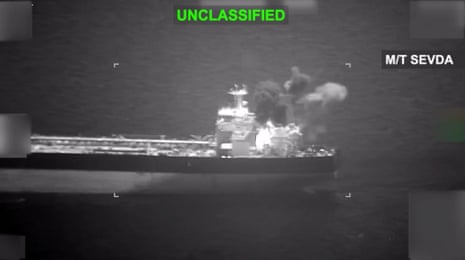
US fires on Iranian-flagged oil tankers it claims were trying to violate US blockade
The US Central Command (Centcom) claims it has struck two “unladen” Iranian-flagged oil tankers it said were attempting to violate the US blockade by entering an Iranian port on the Gulf of Oman.
“U.S. forces disabled M/T Sea Star III and M/T Sevda, May 8, prior to both vessels entering an Iranian port on the Gulf of Oman in violation of the ongoing U.S. blockade,” it said in a statement on social media.
Centcom claimed it had “disabled both tankers after firing precision munitions into their smokestacks”. The statement added that US forces had also disabled a third Iranian-flagged vessel on Wednesday. “All three vessels are no longer transiting to Iran.”

On Thursday Iran accused the US of violating the ceasefire by targeting two ships at the strait of Hormuz and attacking civilian areas. The US insisted it struck in retaliation.
Key events
US Treasury secretary Scott Bessent said that the department is prepared to take financial actions against those providing weapons to Iran’s military, in a statement shared by Reuters.
Bessent’s latest comments came after the US Treasury announced sanctions against 10 individuals and companies, including many based in China and Hong Kong.
“Under President Trump’s decisive leadership, we will continue to act to Keep America Safe and target foreign individuals and companies providing Iran’s military with weapons for use against U.S. forces,” said Bessent.
Mohammad Mokhber, an adviser to Iran’s supreme leader, said on Friday that having control over the strait of Hormuz is an asset “on the scale of an atomic bomb”.
“Indeed, having in one’s hands a position that allows you to influence the global economy with a single decision is a major opportunity,” he said.
The US Treasury has announced sanctions against 10 individuals and companies, including several in China and Hong Kong, for aiding efforts by Iran’s military to secure weapons and raw materials used to build Tehran’s Shahed drones.
The Treasury move, first reported by Reuters, comes days before Donald Trump plans to travel to China for a meeting with president Xi Jinping and as efforts to end the war in Iran have stalled.
These sanctions are part of a broader pressure campaign by the US against Iran’s ability to finance, manufacture, and transport military supplies.
Russian foreign minister Sergei Lavrov told his United Arab Emirates counterpart on Friday that US-Iran talks needed to be supported to prevent a resumption of hostilities in the Middle East.
“The Russian side emphasized the need to focus on supporting the ongoing negotiations between Iran and the USA,” a foreign ministry statement said of Lavrov’s telephone conversation with UAE foreign minister Sheikh Abdullah bin Zayed Al Nahyan.
The statement said Russia did not want “to jeopardize the prospects for stabilization by resuming hostilities.”
Qatar prime minister calls for Iran talks in meeting with Vance
Qatar’s prime minister called for renewed diplomacy on an agreement with Iran as he met with US vice-president JD Vance in Washington earlier.
Sheikh Mohammed bin Abdulrahman Al Thani met with Vance and discussed Pakistani-led efforts to broker a permanent peace amid a shaky ceasefire.
The Qatari prime minister “stressed the need for all parties to engage with the ongoing mediation efforts, to pave the way for addressing the root causes of the crisis through peaceful means and dialogue, leading to a comprehensive agreement that achieves lasting peace in the region,” the Qatari foreign ministry said on X.
US to mediate two days of talks between Israel and Lebanon next week
The United States will facilitate two days of “intensive talks” between Israel and Lebanon on 14-15 May, the US state department has said.
The talks will be aimed at establishing long-term border security, and reaching a “comprehensive”, lasting peace agreement to prevent further conflict, the state department said.
They will also seek to address Hezbollah’s ability to “entrench and enrich themselves”, which has allowed the group to “undermine the authority of the Lebanese state, and endanger Israel’s northern border”.
As we reported earlier, US secretary of state Marco Rubio met the Italian prime minister Giorgia Miloni in Rome on Friday at a moment of unusual strain between Trump and Italy, driven largely by the war against Iran.
Rubio also met with Pope Leo for a meeting he described as “cordial and important” and said he had explained the US position on Iran, in a fence-mending visit to Rome after sharp disagreements over the US-Israel war on Iran and Trump’s criticisms of the pontiff.
Here’s the clip.
US Central Command said in a post on X that its forces have redirected 57 commercial vessels and disabled 4 others to prevent them from entering or leaving Iranian ports.
Two of the disabled ships were oil tankers struck by a US navy jet earlier on Friday, Centcom said in an earlier update.
Israeli strikes kill five people in Lebanon, as Hezbollah fires rockets at northern Israel and Israeli military base
Lebanese authorities reported five people including a rescuer killed in fresh Israeli strikes.
The Lebanese health ministry said in a statement that an Israeli raid on the town of Toura in the southern Tyre district killed four people, including two women, and wounded eight others in a preliminary toll.
Lebanon’s civil defence said earlier that one of its members was killed in an Israeli attack on the south.
Meanwhile, Hezbollah has said it launched missiles at a military base in Israel earlier on Friday in response to Israeli attacks that killed a top commander.
In a statement, the Iran-backed militant group said the missiles targeted a base south of the Israeli city of Nahariya “in response to the Israeli enemy’s violation of the ceasefire, the targeting of Beirut’s southern suburbs and the attacks that affected villages and civilians in southern Lebanon”.
Air raid sirens had sounded earlier in several cities in northern Israel, according to the Israeli military, which said it “intercepted one launch, and the additional launches fell in open areas”, adding that no injuries were reported.
Israel has kept up its attacks on Lebanon despite a truce agreed last month, and its strike on the capital’s southern suburbs on Wednesday – its first there in nearly a month – killed a senior Hezbollah commander.
So, Donald Trump didn’t end up mentioning his war on Iran at the White House event earlier, but if you’re interested in what he did say, my colleague Shrai Popat covered it here:
The Qatari prime minister, Sheikh Mohammed bin Abdulrahman bin Jassim al-Thani, has arrived in Washington for meetings with US officials.
The US vice president, JD Vance, is meeting the Qatari prime minister this morning to discuss the negotiations with Iran, according to US outlet Axios. The Qataris are acting as a vital back channel between the US and Iran, an American official told Axios.
The US president, Donald Trump, is expected to deliver remarks outside of the White House shortly. Stick with us as we will be providing any relevant Iran news.
Iran warns against ‘adventurism and roguish behaviour’ after US strikes oil tankers
In a post on X, the Iranian foreign ministry spokesperson Esmail Baghaei warned against “adventurism and roguish behaviour” following reported US military attacks on Iranian vessels in the strait of Hormuz.
He said: “scheming and naive euphemisms such as ‘a light slap’ can do nothing to erase the profound disgrace born of narcissism, greed, reckless miscalculation, and lawless irresponsibility.”
“The consequences of this whimsical adventurism and roguish behaviour have now become clear to the entire world. Disjointed, delusional tweets no longer hold any sway over reality—though, as ever, “the deeper they sink into folly, the more inventive they become in justifying it.”
His comments came as the the US military also said it fired on two Iranian-flagged oil tankers earlier today apparently trying to bypass the ongoing US blockade of Iranian ports (see post at 15.59 for more details). Despite these attacks, the US expects a response today from Tehran on a proposal to end the US-Israeli war on Iran.
Lorenzo Tondo
Italy, alongside Spain, is the European country that has seen some of the largest pro-Palestinian demonstrations and protests against Israel’s wars in Gaza and Lebanon.
Last year, more than 2 million people took part in protests across 84 cities, with a general strike declared against the killing of civilians in Gaza. According to a recent YouTrend poll, nearly 60% of Italians disapprove of Israel’s actions in the Middle East.
The backlash between the two countries comes at a time of increasing unease among the Italian public about the broader implications of the conflict, particularly fears of economic fallout. Meloni, because of her closeness to Trump, is increasingly seen by some as complicit in this sense of looming instability.
Lorenzo Tondo
US secretary of state Marco Rubio met with Italian prime minister, Giorgia Meloni, on Friday as both sides seek to ease tensions after Donald Trump accused Italy of “lacking courage” for refusing to join attacks on Iran and threatened to withdraw US troops from the country.
The meeting, although cordial, does not appear to have eased the tensions between the two countries, which seem to have remained firmly entrenched in their respective positions.
Questioned why allies including Italy were not backing Washington’s efforts to confront Iran and re-open the Strait of Hormuz Rubio told reporters: ‘‘I don’t understand why anybody would not be supportive,” adding that countries needed “something more than just strongly worded statements” if they opposed Iran’s actions.’’
‘‘It was a frank dialogue between allies who defend their respective national interests while fully understanding how precious the unity of the West remains,’’ Meloni said at the end of the talks with the US secretary of state.
The Italian PM, whose political alliance and personal rapport with Trump had long been openly embraced – with the Italian leader saying earlier this year that she hoped he would one day receive the Nobel peace prize – has openly criticised the US president over the war with Iran, describing the US-Israeli strikes as “outside international law”.
Moreover, in Italy – a country long seen as a symbol of Catholicism – Trump’s attacks on Pope Leo, whom he accused of supporting nuclear weapons and described as “weak on crime” and “terrible on foreign policy”, have enraged Italian public opinion and forced Giorgia Meloni’s far-right government to distance itself from Washington.
“I find President Trump’s remarks about the Holy Father unacceptable,” Meloni said in a statement. “She is the one who is unacceptable,” Trump snapped, “because she doesn’t care if Iran has a nuclear weapon.”
US fires on Iranian-flagged oil tankers it claims were trying to violate US blockade
The US Central Command (Centcom) claims it has struck two “unladen” Iranian-flagged oil tankers it said were attempting to violate the US blockade by entering an Iranian port on the Gulf of Oman.
“U.S. forces disabled M/T Sea Star III and M/T Sevda, May 8, prior to both vessels entering an Iranian port on the Gulf of Oman in violation of the ongoing U.S. blockade,” it said in a statement on social media.
Centcom claimed it had “disabled both tankers after firing precision munitions into their smokestacks”. The statement added that US forces had also disabled a third Iranian-flagged vessel on Wednesday. “All three vessels are no longer transiting to Iran.”
On Thursday Iran accused the US of violating the ceasefire by targeting two ships at the strait of Hormuz and attacking civilian areas. The US insisted it struck in retaliation.
The internet blackout in Iran has entered its 70th day, according to internet monitoring group NetBlocks, as the regime continues one of the longest-running national internet shutdowns ever recorded. NetBlocks said in a social media post:
Today marks the 70th day of Iran’s internet blackout, with the incident now surpassing 1656 hours. Digital connectivity is vital in times of crisis, and limiting service harms those most in need – people with disabilities, students, small businesses and the general public.
Senior government officials are awarded “white” SIM cards granting them access to the global internet while the vast majority of the population remains completely cut off.
Under pressure to alleviate the economic harm the shutdown is causing, the government has been allowing less-restricted internet access to a small number of professions, businesses and regime-friendly journalists.
There was an earlier internet shutdown in January during nationwide protests, which helped obscure extreme violence against Iran’s population.
Lebanon’s national news agency is reporting that Israeli warplanes launched a series of raids targeting southern Lebanese towns and villages this afternoon. At least five people were killed in the attacks, according to the report.
The Israeli military, which is continuing to issue forced evacuation orders in southern Lebanon, said earlier that Hezbollah had launched rockets and mortar bombs toward its forces in southern Lebanon. No casualties were immediately reported.
The renewed Israeli war on Lebanon started when Hezbollah launched missiles at Israel on 2 March after the US-Israeli bombing of Iran in late February.
In its latest update, the Lebanese health ministry said since 2 March Israeli attacks have killed at least 2,727 people in Lebanon, including many women and children.
Israel has also established a “yellow line” in southern Lebanon where Israeli troops are active, comprising at least 55 villages. They have continued to demolish homes there -and the establishment of what is framed as a security zone has stoked fears of a long-term occupation.
The US Central Command claimed its forces were blocking 70 tankers from entering or leaving Iranian ports.
“These commercial ships have the capacity to transport over 166 million barrels of Iranian oil worth an estimated $13 billion-plus,” it said in a post on X.
The US navy has blockaded Iran’s ports since 13 April, choking off crucial revenues for the country that relies almost entirely on the strait of Hormuz to export its oil.
