
LIVE NEWS
  • Uranus and Neptune could be full of rocks, new study suggests
  • Death of man struck by Frontier Airlines plane ruled suicide by medical examiner | Denver
  • Mike Novogratz’s Galaxy and Sharplink Launch $125M Ethereum-Powered DeFi Yield Fund
  • New Exim BDAT Vulnerability Exposes GnuTLS Builds to Potential Code Execution
  • OpenAI’s Sam Altman takes the stand to fend off Elon Musk’s accusations he ‘stole a charity’ : NPR
  • Trump-Xi Beijing Meeting Sees China Hawks Take a Back Seat
  • Range holds as Malaysia outperforms – Commerzbank
  • Hegseth rethinking Army reforms, cuts to aviation
Prime Reports
  • Home
  • Popular Now
  • Crypto
  • Cybersecurity
  • Economy
  • Geopolitics
  • Global Markets
  • Politics
  • See More
    • Artificial Intelligence
    • Climate Risks
    • Defense
    • Healthcare Innovation
    • Science
    • Technology
    • World
Prime Reports
  • Home
  • Popular Now
  • Crypto
  • Cybersecurity
  • Economy
  • Geopolitics
  • Global Markets
  • Politics
  • Artificial Intelligence
  • Climate Risks
  • Defense
  • Healthcare Innovation
  • Science
  • Technology
  • World
Home»Science»Uranus and Neptune could be full of rocks, new study suggests
Science

Uranus and Neptune could be full of rocks, new study suggests

primereportsBy primereportsMay 12, 2026No Comments3 Mins Read
Share Facebook Twitter Pinterest LinkedIn Tumblr Reddit Telegram Email
Uranus and Neptune could be full of rocks, new study suggests
Share
Facebook Twitter LinkedIn Pinterest Email


Could Uranus and Neptune be full of rocks? One new study thinks so.

Uranus and Neptune are two planets that have historically been classified and thought of as “ice giants,” orbiting far out in the freezing edges of our solar system. But it’s possible that our understanding of these planets’ makeup could be totally off, and their atmospheres could be full of rocks, researchers suggest in a new study.

“We found out that both Uranus and Neptune have their outer shells made mostly of rocks (and hydrogen and helium gas),” study author Yamila Miguel of the Netherlands Institute for Space Research told Space.com. This “goes against the common belief that they are ice-giant planets.”


You may like

These two planets both have inner rocky cores surrounded by icy mantles enveloped by a thick atmosphere that has been thought to contain hydrogen, helium and methane gases as well as silicate clouds. In some high pressure areas, the gaseous atmosphere becomes fluid — but the results of this study suggest these atmospheres could also be littered with rocks.

This research team was inspired to take a closer look at Neptune and Uranus thanks to recent research which has suggested that objects in the trans-Neptunian region, an icy region beyond Neptune, are more rocky than icy. Previous studies have suggested objects like Pluto, comets, and Kuiper belt bodies indeed have rocky atmospheres, the new study’s researchers explained. “We thought, if those objects are made mostly of rocks, maybe Uranus and Neptune [are] as well?” Miguel said.

To get to their conclusions, the researchers modeled the composition of both Uranus and Neptune, simulating the planets’ envelopes (combined inner and outer atmosphere), mantles and cores. Based on conditions like temperature throughout each planet’s atmospheric envelopes, the team found the conditions would cause silicate clouds in certain areas of these atmospheres to condense into rocky material.

So, while Uranus and Neptune are known as ice giants, orbiting far from our sun in the outer reaches of the solar system, they’re rockier than you might expect an “ice” planet to be, at least according to this study.

Uranus and Neptune could be full of rocks, new study suggests

While “they might have quite some ice in their interiors,” Miguel said, “they are definitely not completely icy as we used to believe.”
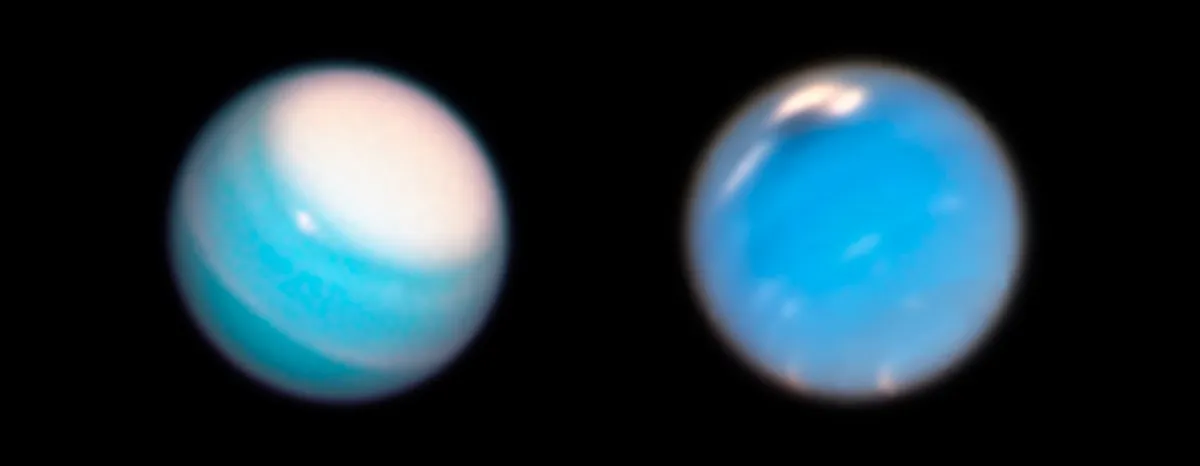
New Hubble observations of Uranus and Neptune track the planets' atmospheres.

Uranus (left) and Neptune (right) could have atmospheres full of rocks, according to new research. (Image credit: NASA, ESA, A. Simon (NASA Goddard Space Flight Center), and M.H. Wong and A. Hsu (University of California, Berkeley))

Miguel asserts that these new findings could even warrant a conversation about re-classifying these planets. “We should indeed change their classification so as not to be misleading,” they suggest. “Rather than ‘icy’ or ‘rocky,’ we should simply call them minor giants or something like that.”

To be clear, this new study isn’t a definitive new classification of these planetary giants. However, it does raise interesting questions about their makeup: Could their atmospheres really be full of rocks? Are there other major aspects of their composition that we haven’t yet uncovered? What other mysteries lie in the cold, far corners of our cosmic neighborhood?

This work was described in a study published May 5 in the journal Astronomy & Astrophysics.

Share. Facebook Twitter Pinterest LinkedIn Tumblr Email
Previous ArticleDeath of man struck by Frontier Airlines plane ruled suicide by medical examiner | Denver
primereports
  • Website

Related Posts

Science

Robert Smith obituary | Pharmacy and pharmacology

May 12, 2026
Science

Award for scientist who brought space to millions

May 12, 2026
Science

The story of the first human tool: the humble container

May 11, 2026
Add A Comment
Leave A Reply Cancel Reply

Top Posts

Global Resources Outlook 2024 | UNEP

December 6, 20258 Views

The D Brief: DHS shutdown likely; US troops leave al-Tanf; CNO’s plea to industry; Crowded robot-boat market; And a bit more.

February 14, 20265 Views

German Chancellor Merz faces difficult mission to Israel – DW – 12/06/2025

December 6, 20254 Views
Stay In Touch
  • Facebook
  • YouTube
  • TikTok
  • WhatsApp
  • Twitter
  • Instagram
Latest Reviews

Subscribe to Updates

Get the latest tech news from FooBar about tech, design and biz.

PrimeReports.org
Independent global news, analysis & insights.

PrimeReports.org brings you in-depth coverage of geopolitics, markets, technology and risk – with context that helps you understand what really matters.

Editorially independent · Opinions are those of the authors and not investment advice.
Facebook X (Twitter) LinkedIn YouTube
Key Sections
  • World
  • Geopolitics
  • Cybersecurity
  • Popular Now
  • Crypto
  • Artificial Intelligence
All Categories
  • Artificial Intelligence
  • Climate Risks
  • Crypto
  • Cybersecurity
  • Defense
  • Economy
  • Geopolitics
  • Global Markets
  • Healthcare Innovation
  • Politics
  • Popular Now
  • Science
  • Technology
  • World
  • About Us
  • Contact Us
  • Privacy Policy
  • Terms & Conditions
  • Disclaimer
  • Cookie Policy
  • DMCA / Copyright Notice
  • Editorial Policy

Sign up for Prime Reports Briefing – essential stories and analysis in your inbox.

By subscribing you agree to our Privacy Policy. You can opt out anytime.
Latest Stories
  • Uranus and Neptune could be full of rocks, new study suggests
  • Death of man struck by Frontier Airlines plane ruled suicide by medical examiner | Denver
  • Mike Novogratz’s Galaxy and Sharplink Launch $125M Ethereum-Powered DeFi Yield Fund
© 2026 PrimeReports.org. All rights reserved.
Privacy Terms Contact

Type above and press Enter to search. Press Esc to cancel.