

With the evening moon appearing as a crescent phase for much of this upcoming week, we now have an opportunity to view some of the fainter sky objects that now occupy our spring evening sky.
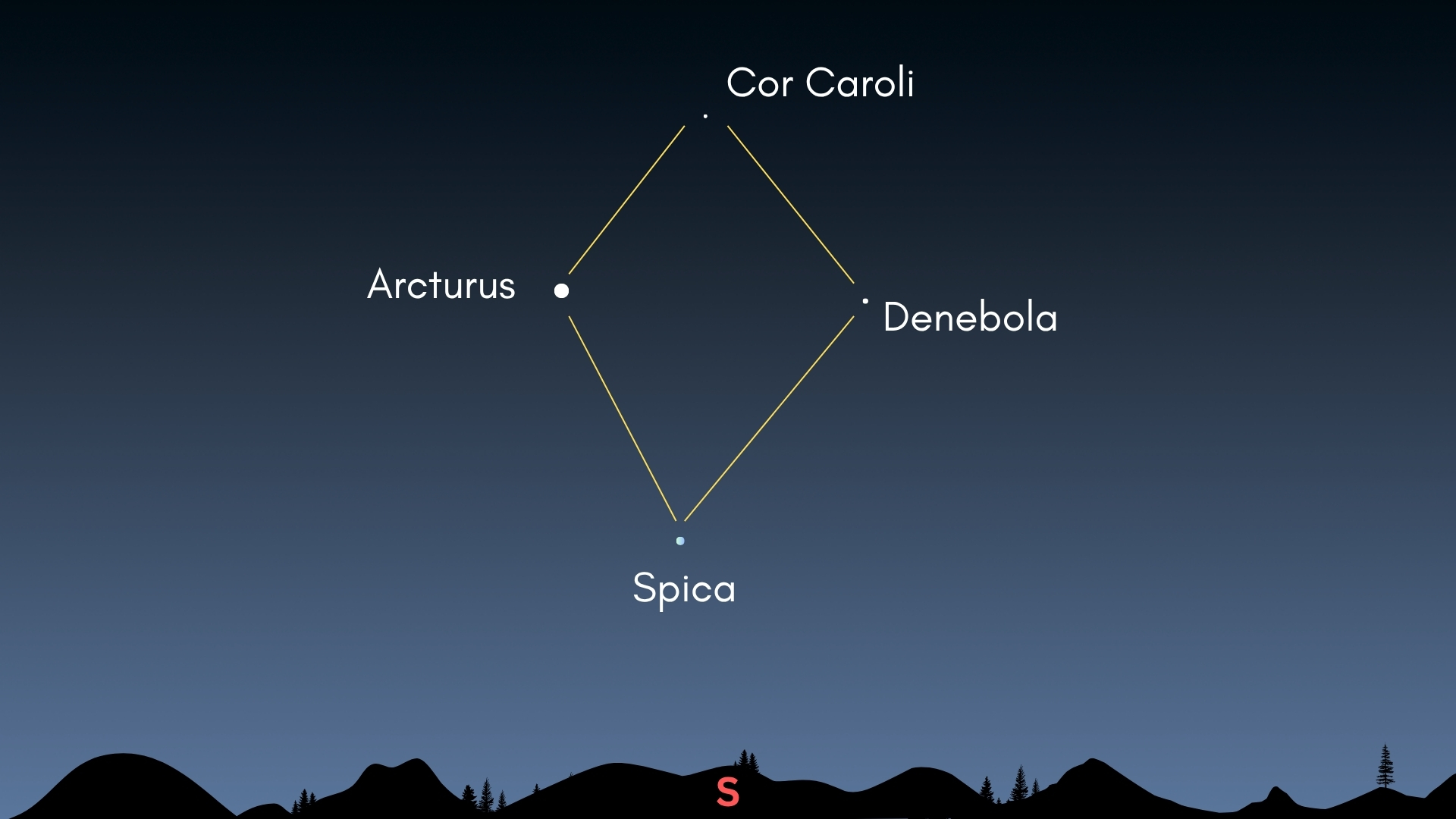
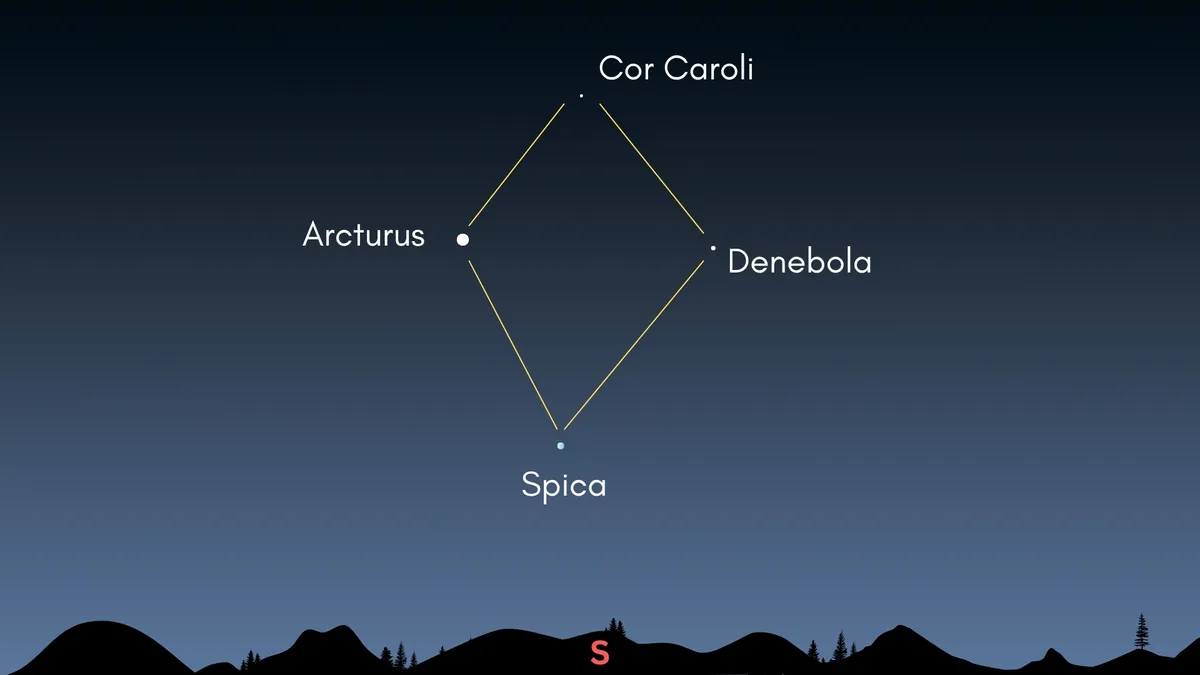
Looking high overhead and toward the south just after nightfall, there is a broad star pattern formed by four stars. The near-third magnitude star, Cor Caroli (in the constellation of Canes Venatici the Hunting Dogs), is the faintest of the four that comprise a large diamond frame that can be found high in the sky and due south at around 10 p.m. local daylight time. The other stars in the diamond are second magnitude Denebola (marking the tail of Leo, the Lion), first magnitude Spica (the spike of wheat in the hand of Virgo) and zero-magnitude Arcturus (in Boötes the Herdsman).
In his popular constellation guide, “The Stars — A new Way to See Them,” author Hans A. Rey (1898-1977) called it the “Virgin’s Diamond,” after the constellation of Virgo, though others refer to it simply as “The Great Diamond.”
But it’s not sanctioned. . .
Of course, the Diamond is not an official constellation but is an asterism. The constellations shown on modern star atlases are all officially approved by the International Astronomical Union (I.A.U.), but while constellations are official, asterisms are not. An asterism is often defined as a noteworthy or striking pattern of stars within a constellation, but that is not always the case. The Big Dipper is not a constellation itself, but an asterism which is part of the larger constellation of Ursa Major, the Great Bear.
Some might wonder why the constellation patterns differ from other similarly designed charts and are not standardized. The two main reasons are that different people see constellations in different ways and that, as far as astronomy today is concerned, constellations are not considered star pictures but as specific sky areas. The official constellation boundaries were drawn up in 1930. Before that time, no two atlases agreed as to the limits, and much confusion resulted.
So, while the Diamond is not “official,” it still is recognized as a landmark star pattern of the spring season.
And even here, some see this pattern differently. If, for example, we don’t include Cor Caroli, then the Diamond becomes “The Spring Triangle.”
Stellar stats
Here are some noteworthy details about each star, going from brightest to faintest:
Arcturus: A brilliant star that sparkles with a golden yellow or topaz hue, it is the brightest star in the constellation Boötes the Bear Driver. In late spring and early summer, Arcturus is usually the first star you see after sunset, soaring high in the southern sky. It ranks as the fourth brightest star in the sky and is a giant, fully 26 times the diameter of the sun and 170 times as luminous.
Its main claim to fame is that it opened Chicago’s Century of Progress Exposition of 1933 by shining on a photoelectric cell and moving through space at 76 miles (122 km) per second, which means that over the centuries, it changes its place in the sky more rapidly than any of the other bright stars.
Spica: In Greek and Roman tradition, the constellation of Virgo was identified with the goddess of justice, Astraea, who ruled the world during the fabled Golden Age. In the old allegorical star books, the goddess holds some spikes of wheat in each hand and her brightest star — Spica — glows in one of the ears of grain hanging from her left hand. Spica is the 16th brightest star in the sky and is 250 light-years away. It is not one star but two, positioned so close to one another that they are egg-shaped rather than spherical, and can only be separated by their spectra; the two components orbit each other every four days. The primary star is about 20,000 times more luminous than our sun, while the secondary is only about 2,300 times as luminous.
Denebola: The second-brightest star in the zodiacal constellation of Leo, its name is shortened from Deneb Alased, from the Arabic phrase ðanab al-asad “tail of the lion,” as it represents the lion’s tail. It is relatively close at a distance of 36 light-years, and rather young as most stars go, with an age estimated at less than 400 million years (compared to 5 billion for the sun). In terms of size and mass, it’s about 1.8 times greater than the sun and 13 times more luminous. It also spins rapidly on its axis, resulting in a shape resembling an oblate spheroid.
Cor Caroli: known as “the Heart of Charles.” A popular story is that the star was named by Edmund Halley in honor of King Charles II of England. This was supposedly done at the suggestion of the court physician Sir Charles Scarborough, who claimed that “. . . it shone with a special brilliance on the eve of the King’s return to London on May 29, 1660.” However, upon delving deeper into this star’s history, it is found that this star’s original name was “Cor Caroli Regis Martyris,” honoring the executed Charles I.

A veritable megalopolis of star cities
At first glance, The Great Diamond appears to encompass a rather dull region of the sky. The Diamond itself appears around as wide as the Big Dipper and about twice as long. In the upper right part of the Diamond is the faint fuzz of stars belonging to Coma Berenices (Berenice’s Hair).
But also located within the Diamond is one of the most remarkable areas of the heavens.
Sometimes called the Coma-Virgo Cloud of Galaxies, and often referred to in older astronomy texts as “The Realm of the Galaxies,” it is here that lies a veritable treasure trove of numerous star cities. Roughly 2,000 to 3,000 galaxies have been photographed here with great observatory instruments. If you own a good reflecting telescope of at least 6-inch aperture or greater, a sweep of this region will reveal literally dozens of these galaxies appearing as a myriad of faint and fuzzy patches of light. This is the only great cloud of galaxies that is available to the average amateur. Just try to remember that each one of these dim blobs is a star city, which likely contains many tens of billions of stars!
And keep in mind that this cluster or cloud of galaxies is the nearest of the large aggregations of galaxies relative to our own. The best estimates indicate that it is located somewhere between 40 and 70 million light-years from us. So, it is “possible” that as you run across these pale little patches of light in your telescope, irregularly shaped, round or elongated in appearance, that you are gazing upon galaxies whose light may have started toward the Earth around the time of the extinction of the dinosaurs!
Joe Rao serves as an instructor and guest lecturer at New York’s Hayden Planetarium. He writes about astronomy for Natural History magazine, Sky and Telescope, The Old Farmer’s Almanac and other publications.
