

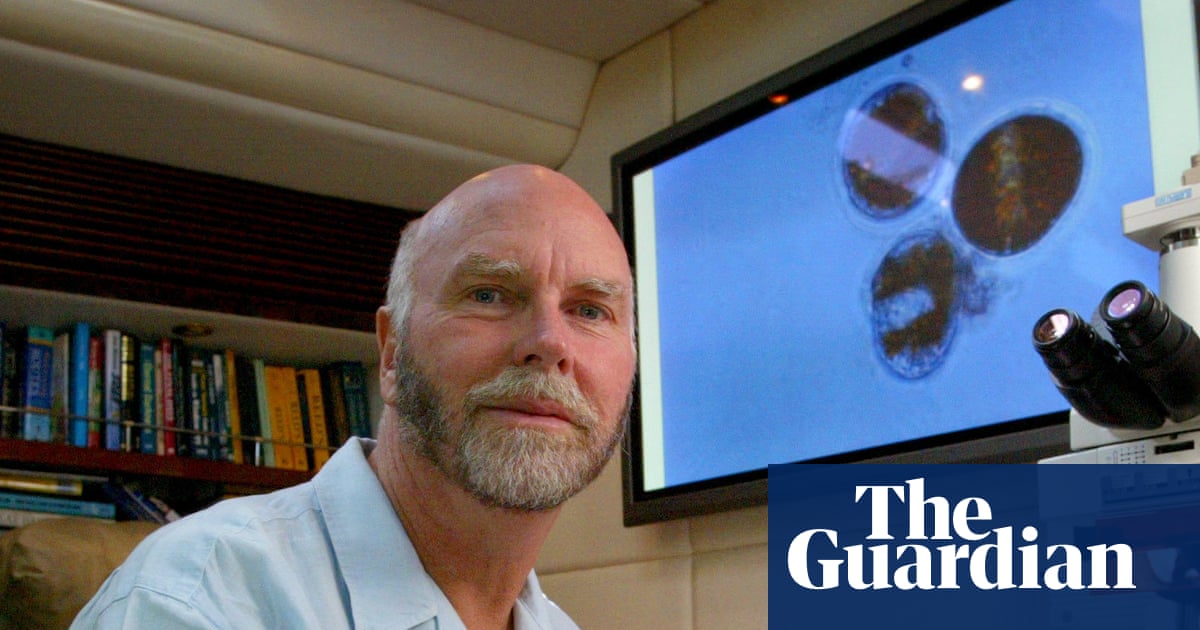
At the international BioVision conference in Lyon in February 2001, the geneticist Craig Venter performed a remarkable piece of scientific barnstorming. Human beings possess far fewer genes than science had ever realised, he announced. We have about 30,000, far lower than previous estimates of 100,000.
Such lack of heritable material showed people are not prisoners of their genes but are shaped primarily by environmental influences, he added. “We simply do not have enough genes for this idea of biological determinism to be right,” said Venter, who has died aged 79. “The wonderful diversity of the human species is not hard-wired in our genetic code. Our environments are critical.”
The timing of Venter’s announcement was dramatic. A few days later, the journals Nature and Science were scheduled to publish details of the first draft of the human genome, and outline our species’ detailed genetic makeup – which would indeed reveal the paucity of our genes. This work had been spearheaded by the US government and the UK Wellcome Trust’s Sanger Centre, in an uneasy partnership with Venter’s own privately funded sequencing company, Celera Genomics.
BioVision 2001 had been set up to orchestrate the publication of the partnership’s results, but at the conference’s closing sessions several days later. Venter had now thrown a spanner into this carefully arranged process. Journalists in the audience, myself included, were startled. Apart from revealing our unexpected low gene count (the figure has since been reduced even further, to about 20,000), Venter had completely undermined the impact his rivals were due to make.
“Did you know these results are embargoed until next week?” I asked Venter. “It might be their embargo but it wasn’t mine,” he replied. His announcement made the front pages of newspapers across the globe including my own at the time, the Observer.
Venter was a brilliant, daring entrepreneur and an unapologetic self-promoter who took pleasure in showing off his achievements as well as his private plane, yacht and flash watches. It was a tendency that made enemies. James Watson, co-discoverer of the double-helix structure of DNA, from which our genes are made, compared him to Hitler for attempting to dominate science by trying to patent human genes. Others nicknamed him “Darth” Venter, after the Star Wars villain.
Other scientists have been more forgiving. The neuroscientist Sir John Hardy of University College London (UCL), who collaborated with Venter on dementia research, acknowledged that the competition between Celera researchers and US and UK government scientists had sometimes been testosterone-driven. “On the other hand, there is no doubt that this competition speeded things up enormously and ended really in a score draw,” Hardy said.
Venter was born in Salt Lake City, Utah, to Elisabeth (nee Wisdom) and John Venter, both parents having served in the US marines during the second world war; by then his father was studying accountancy and his mother sold real estate to help the family finances. Growing up in Millbrae, California, he had a poor academic record at Mills high school. He was offered a swimming scholarship at Arizona State University but turned it down and instead chose the beaches of southern California to follow “pursuits that involved drink, girls and bodysurfing,” he wrote in his autobiography, A Life Decoded, published in 2007. These pleasures were interrupted by the Vietnam war. Venter signed up for the Naval Hospital Corps school and became a senior corpsman in Da Nang in the naval hospital’s intensive care unit, a job he later described as M*A*S*H without the jokes and pretty women.
“I witnessed several hundred soldiers die, more often than not while I was massaging their hearts – at times with my bare hand – or attempting to breathe life into them,” he recalled. “Vietnam would teach me more than I ever wanted to know about the fragility of life.”
The war had one beneficial impact on Venter. It stimulated an interest in life sciences and he applied to study medicine at the University of California, San Diego, where he gained a PhD in physiology and pharmacology in 1975, seven years after his return from Vietnam.
He began research into genome sequencing and in 1992 co-founded the Institute for Genomics Research (later the J Craig Venter Institute) in Gaithersburg, Maryland, with the biologist Claire Fraser, later his second wife. In 1995, their team generated the first genome sequence of a living organism, the bacterium Haemophilus influenzae, using a revolutionary technique he called whole genome shotgun sequencing. Random pieces of DNA are sequenced and then assembled into contiguous genome sequences using powerful computers. In 1998, Venter founded Celera Genomics, to apply this method to the human genome.
Crucially, Venter’s technique contrasted with that used by publicly funded UK and US scientists who were sequencing the genome in smaller, more organised segments. This relatively cautious approach was denounced by Venter as slow, wasteful and costly. A truce was agreed and celebrated at a White House ceremony in June 2000 before the competing draft sequences were published in February at Lyon.
Venter later revealed that much of the DNA used in Celera’s decoding efforts had come from his own cells, to the annoyance of scientists who felt he had subverted standard processes for selecting DNA donors and had behaved egotistically. “I’ve been accused of that so many times, I’ve got over it,” he responded. In any case, use of his own DNA had revealed he possessed an abnormal fat metabolism and an elevated risk of Alzheimer’s disease, so that he was now taking fat-lowering drugs to reduce its impact, he added.
Later that year, Venter was sacked as head of Celera by Tony White, the president of Applera – which owned the company – and who wanted it to move away from the business of gene sequencing and into the far more lucrative field of drug discovery. Venter was judged to be unsuitable for leading such a goal.
“I sought solace in the one thing I knew could cheer me: I headed for my boat and set sail for the turquoise seas of St Barts … in the Caribbean,” he recalled in Life Decoded. He returned to use his vast payoff to endow the J Craig Venter Institute with $100m. There he could pursue projects that included designing energy-producing microbes and synthesising bacterial genomes. He later set up two other companies, Human Longevity and Diploid Genomics, which aim to combine artificial intelligence with advances in ageing research and gene sequencing to boost human lifespans and diagnose disease.
As to Venter’s claims in Lyon about the overriding power of the environment in determining human behaviour revealed in our low gene count, these have since been questioned rigorously by scientists. Just because humans have a lot of different traits, does not mean we have to possess a lot of genes, they point out.
Nature has simply found a way to make our genes do increasingly sophisticated management work, said Sir John Sulston, one of the leaders of the UK’s public genome effort, in response to Venter’s claims. As we move up the ladder of complexity, we are simply increasing the variety and subtlety of genes, Sulston told the Guardian at the end of the Lyon conference.
Venter was married three times and had a son, Christopher, from his first marriage, to Barbara Rae, in 1968; they divorced in 1980. His marriage to Fraser in 1981 ended in divorce in 2005. Three years later he married Heather Kowalski, who had been his press officer at Celera. She survives him, along with Christopher and three siblings, Keith, Gary and Suzanne.
