

A proposed merger of the largest utility in the country by market value, NextEra Energy, with the sixth-largest, Dominion, would create a megacompany at a time when data centers and rapid increases in electricity demand are reshaping the industry.
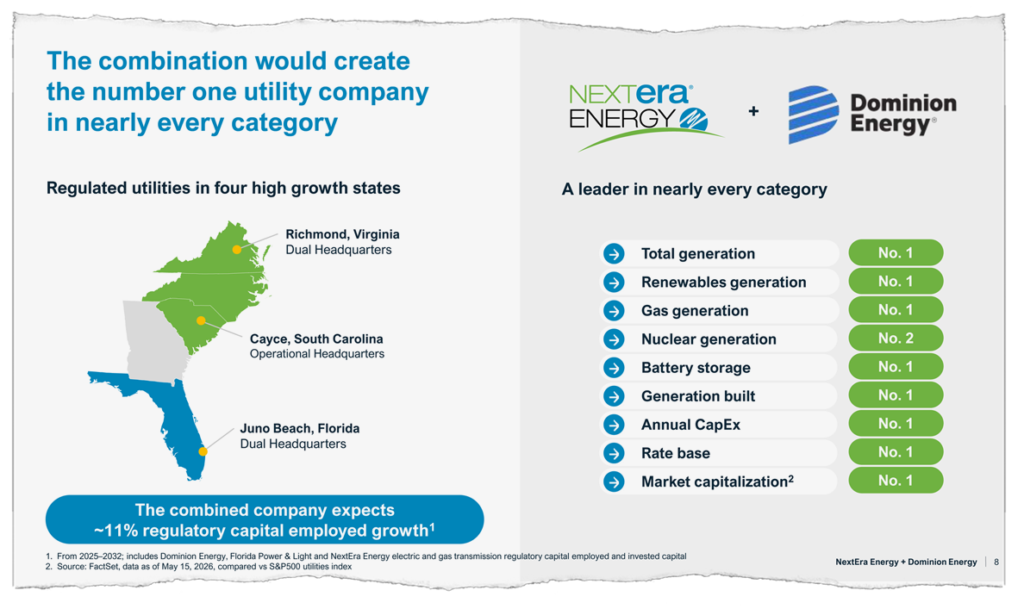
The proposal, announced Monday morning and contingent on state and federal regulatory approval, would result in a company that leads in nearly every aspect of the U.S. power and utility industry, including overall electricity generation, natural gas generation and renewables.
The $67 billion deal combines NextEra’s size and reach with Dominion’s positioning as the local utility for the world’s largest concentration of data centers in northern Virginia. But the results are likely bad for consumers and the environment, creating a company with enormous financial and political strength that will be difficult to effectively regulate, according to consumer advocates and analysts.
For perspective, only Exxon Mobil and Chevron would be larger based on market value among U.S.-based energy companies.
“Mergers are not about consumers; they’re about shareholders,” said Ari Peskoe, director of the Electricity Law Initiative at Harvard Law School. “For the Dominion shareholders, they are selling their shares at a premium. The executives are getting massive payouts for facilitating this, assuming it all goes through, and obviously NextEra believes the transaction is going to add value to the company. Ratepayers are all an afterthought.”
The deal makes financial sense for both companies, said Andrew Bischof, an equity analyst for Morningstar.
“We view the transaction as allowing NextEra to accelerate its data center ambitions, which had trailed those of its regulated peers, by using Dominion’s expertise and relationships to expedite NextEra’s data center hub plans,” he said in a note to clients.
NextEra, based in Juno Beach, Florida, includes Florida Power & Light, the largest regulated electricity utility in the state, and NextEra Energy Resources, a wholesale electricity supplier that owns power plants across the nation. Dominion, based in Richmond, Virginia, includes regulated utilities serving much of Virginia, parts of North Carolina and South Carolina and other assets across the country.
The company would be called NextEra Energy and NextEra CEO John W. Ketchum would serve in the same role after the deal closes. Robert M. Blue, Dominion’s CEO, would be the CEO for regulated utilities for the merged company. The parties said they expect regulatory approvals to take 12 to 18 months.
NextEra shareholders would own 74.5 percent and Dominion shareholders would own 25.5 percent, respectively, of the combined company in the all-stock transaction.
“We are bringing NextEra Energy and Dominion Energy together because scale matters more than ever— not for the sake of size, but because scale translates into capital and operating efficiencies,” Ketchum said in a statement.
“Adding to the Pollution Problem”
The post-merger NextEra would be the leader in so many categories in the U.S. utility sector that it’s easier to list the ones where it wouldn’t be on top. It would rank second in nuclear power generating capacity and in the number of regulated utility customers, trailing Exelon Corp. of Chicago in both.
NextEra and Dominion both have substantial carbon emissions, but neither was among the top five utility companies in the country in 2024, according to the most recent edition of Benchmarking Air Emissions report from the Natural Resources Defense Council. NextEra ranked sixth and Dominion ranked 11th, and their sum was less than that of each of the leaders, Vistra Energy and Duke Energy.
But those are still massive emissions from a company that stands to gain more clout because of its size.
“If we continue to add dangerous climate pollution into the mix, then people who are already suffering and are typically hurt first and worst will suffer even more,” said Susan Glickman, vice president of policy and partnerships at the CLEO Institute, a Florida-based nonprofit dedicated to climate education and advocacy. She noted that those with the fewest resources often are the most affected by disasters like hurricanes, which are intensifying as fossil fuel emissions warm the global climate.
“They’re going to continue to be at the short end of the stick, while these companies build more methane gas plants to provide additional power for data centers, and adding to the problem of pollution that is warming our climate.”

Consumers Stand to Lose
In a conference call Monday morning, company officials said the agreement will lead to economies of scale, providing savings that will benefit ratepayers. The deal includes $2.25 billion in bill credits for Dominion customers, spread over two years.
But utility mergers do not have a track record of delivering long-term benefits to consumers, said Marissa Paslick Gillett, who served as chair of the Connecticut Public Utilities Commission from 2019 to 2025. She resigned following clashes with utilities in the state and now is a senior fellow at the American Economic Liberties Project, a think tank that works to limit the concentration of corporate power.
“I continue to be sort of flabbergasted by the tone deafness,” she said. “I’m not sure that any of us could point to a major utility merger acquisition that’s happened in the past decade … where that merger acquisition has definitively provided the synergies that they told their commissions were going to come out.”
This story is funded by readers like you.
Our nonprofit newsroom provides award-winning climate coverage free of charge and advertising. We rely on donations from readers like you to keep going. Please donate now to support our work.
Gillett’s experience includes work as a staff member at the Maryland Public Service Commission during the 2012 merger of Exelon with Maryland-based Constellation Energy, which was one of the largest U.S. utility mergers ever.
One of the main problems that arises from a utility merger is that it creates a company that is difficult to regulate because of its complexity, she said.
“We know how this goes, and the real, tangible problems of having to regulate a behemoth like this,” she said.
Stephen Smith, executive director of the Southern Alliance for Clean Energy, said the merger could be a good thing if NextEra is responsible to customers and continues to expand its renewable energy portfolio. He noted NextEra’s status as the largest renewable energy developer in the country, but he also had concerns about the growing weight of the utility’s political influence, especially in Florida.
”You’re making a very large utility that has a tremendous amount of financial resources, a tremendous amount of political power, and that does not always bode well for ratepayers,” he said. “The more political power that a utility has, the more probable it is that they will use that power to the disadvantage of ratepayers.”
Smith cautioned that the merger should not be viewed as a done deal. NextEra has attempted to acquire other utilities in the past and failed, including aborted talks with Duke Energy in 2020.
“Their track record in acquisitions is not really that great,” he said. “Going after Dominion is the biggest fish that they have tried to reel in.”
Virginia’s Laws Would Still Apply
Despite those worries, Dominion and its out-of-state parent company would still need to follow Virginia’s laws and regulations, said William Shobe, a research professor emeritus of public policy at the University of Virginia.
“The regulations don’t mention Dominion, they mention the utility that covers Dominion’s footprint, whatever its name is,” he said.
Those laws include the Virginia Clean Economy Act, the state’s 2020 law seeking to decarbonize its grid by 2050, and the recently passed legislation increasing Dominion’s battery storage development targets.
If anything, NextEra’s track record as a leader in solar and wind power could “bleed” into the Dominion culture that “has not been super aggressive about adding non-emitting technology,” Shobe said.

Acquiring Dominion is appealing to NextEra Energy, he said, because Virginia has a friendly policy environment to build grid infrastructure, a strong profit margin and a booming data center market. NextEra said the merger creates a pipeline of 130 gigawatts worth of demand from data centers, which critics say are speculative, and a chance to more than double generation capacity to 225 gigawatts by 2032.
In November, state regulators approved a $7 billion rate hike for Florida Power & Light. Consumer groups characterized the rate hike, which faces a legal challenge in state court, as the largest in U.S. history.
Bradley Marshall, a senior attorney at Earthjustice, said the rate hike positioned NextEra financially to pursue the merger.
“In the past, when we see utilities become even more powerful, we’ve seen bills go up even further,” he said. “Consumers need to be informed about what’s happening and ensure that keeping bills from going up is a priority.”
About This Story
Perhaps you noticed: This story, like all the news we publish, is free to read. That’s because Inside Climate News is a 501c3 nonprofit organization. We do not charge a subscription fee, lock our news behind a paywall, or clutter our website with ads. We make our news on climate and the environment freely available to you and anyone who wants it.
That’s not all. We also share our news for free with scores of other media organizations around the country. Many of them can’t afford to do environmental journalism of their own. We’ve built bureaus from coast to coast to report local stories, collaborate with local newsrooms and co-publish articles so that this vital work is shared as widely as possible.
Two of us launched ICN in 2007. Six years later we earned a Pulitzer Prize for National Reporting, and now we run the oldest and largest dedicated climate newsroom in the nation. We tell the story in all its complexity. We hold polluters accountable. We expose environmental injustice. We debunk misinformation. We scrutinize solutions and inspire action.
Donations from readers like you fund every aspect of what we do. If you don’t already, will you support our ongoing work, our reporting on the biggest crisis facing our planet, and help us reach even more readers in more places?
Please take a moment to make a tax-deductible donation. Every one of them makes a difference.
Thank you,
