

We
are all full aware of what the hyperscalers, cloud builders, and AI model
builders are all doing to build out their datacenter infrastructure to support
their AI aspirations. But it is hard to get a sense of what regular enterprises,
service providers, governments, academic institutions, neoclouds, and sovereigns
– who will eventually represent maybe half of total AI spending – are doing. So
we have to use the sales of the traditional original equipment manufacturers as
a kind of proxy.
Depending
on the OEM, there are a fair amount of sales of chips or systems to
hyperscalers and cloud builders in the mix. IBM has basically none, Hewlett
Packard Enterprise, Dell, and Lenovo quite a bit more, and Supermico has most
of its sales to handful of very large companies and is more like an ODM. Cisco
Systems is somewhere in the middle, selling plenty of AI stuff to hyperscalers
and cloud builders but also selling AI wares into its vast UCS system customer
base, which numbers 90,000 unique customers worldwide after 17 years of being a
system OEM.
Teasing
out hyperscaler and cloud builder sales is tricky, and not the least of which
because Cisco sells both chips and optics to customers that build their own
systems as well as complete systems for those who don’t want to do that because
they are not at a sufficient scale for that to make sense.
Let’s
pick apart the Cisco numbers for the third quarter of fiscal 2026 just the same.
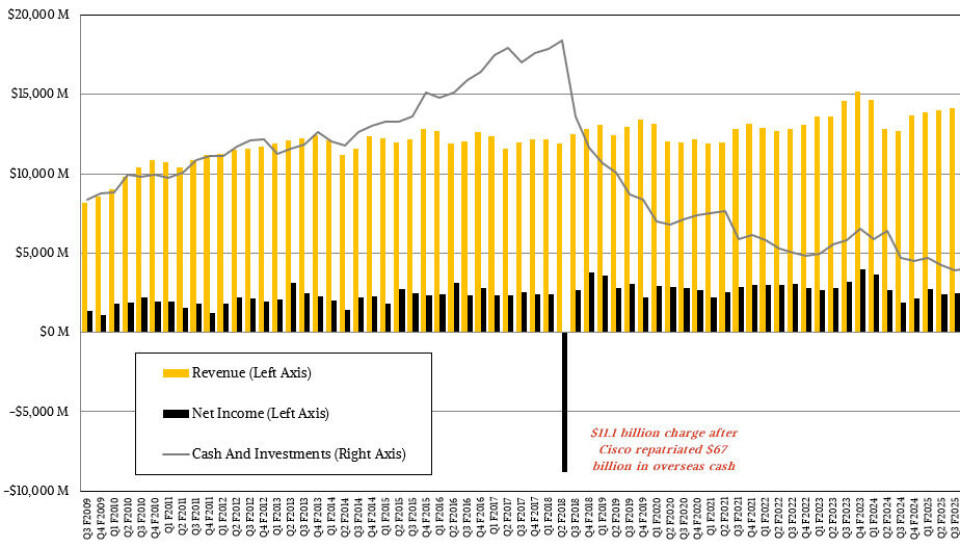
In
the quarter ended in April, Cisco’s overall revenues were $15.84 billion, up 12
percent year on year. Operating income rose by 23.7 percent to $3.96 billion,
and net income was up 35.4 percent to $3.37 billion. Like everyone else in the
world, Cisco wants to cut its overhead costs, and it is using AI as an excuse
to do layoffs. We have our doubts how much this reduction of around 4,000
people from Cisco’s workforce has to do with AI. It seems like every company is
looking to trim their coronavirus pandemic fat in human resources, and AI
provides air cover to do so as well as an impetus for retained employees to
figure out ways to make AI useful real quick now. . . .
In
early 2024, Cisco had about 85,000 employees and has reduced its headcount by
13,750 people in four rounds of layoffs over the past year and a half. (One
round was very small, at about 150 people.)
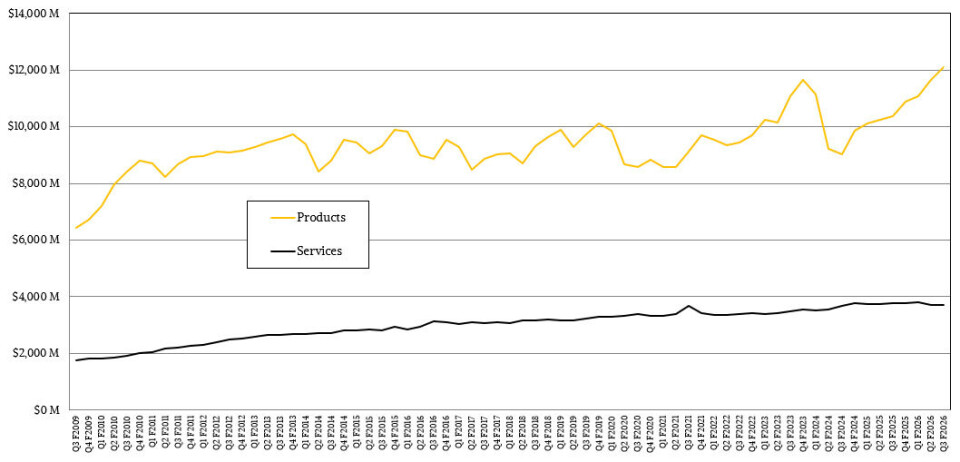
Cisco
is still largely a product peddler, but services is creeping up ever so slowly
to have a slightly larger share of the revenue pie at the company. But don’t get
too excited – the change to services revenue streams is relatively glacial,
from around 20 percent way back in 2009 (when we first started tracking the
company’s finances) to just under 25 percent in the trailing twelve months.
Some of that is due to Cisco being successful selling merchant switch and
router ASICs to hyperscalers and cloud builders as well as its Acacia optical transceivers.
It isn’t so much that services is not growing, but rather product sales have
just hooked an exponential curve.
As
the third quarter came to a close, Cisco had a revenue backlog of $43.5
billion, essentially unchanged from Q2 F2026, and it had $16.64 billion of cash
and equivalents in the bank.
Like
other OEMs, Cisco likes to talk about AI orders but not AI revenues. (Well, IBM
actually just stopped talking about even AI orders, and probably because it is
mostly a services play for Big Blue unless it starts counting Power Systems and
Z mainframe revenues as AI just because its processors have native matrix math
accelerators.)
Here
is a handy chart that Cisco made showing its to hyperscalers, by which Cisco
means hyperscalers and cloud builders as we use these terms here at The Next
Platform. Take a gander:
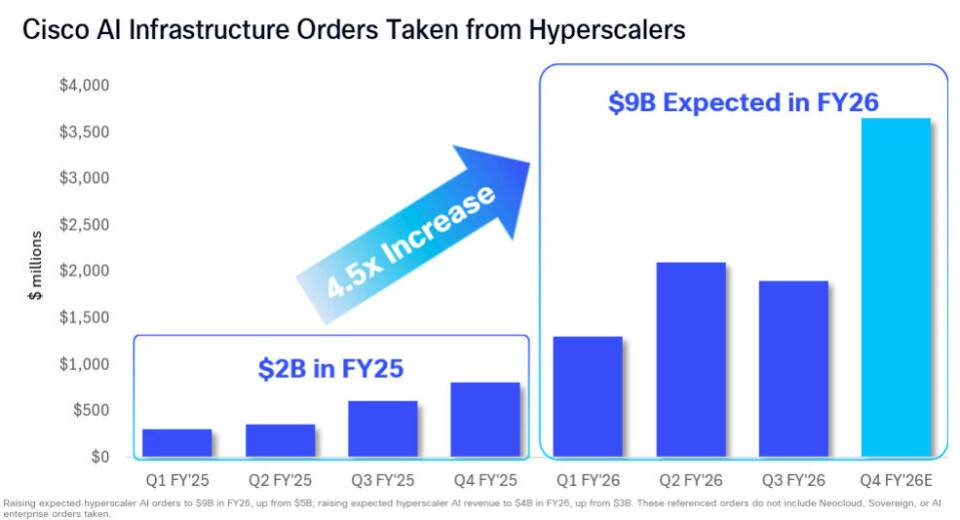
As
fiscal 2026 was getting going, Cisco was projecting that it would have north of
$5 billion in AI orders from hyperscalers and cloud builders this fiscal year,
and this is now being updated to $9 billion. If you do the math on that, this implies
that Cisco will book $3.7 billion in AI orders to hyperscalers and cloud
builders in its fourth quarter of fiscal 2026 ending in July.
In
the third quarter, AI product orders to hyperscalers and cloud builders were up
by 2.1X to $1.9 billion. Product orders by other customers were up a more
subdued 19 percent, but that is nothing to cry about. All told, product orders
rose by 35 percent year on year. Enterprise orders were up 18 percent, public
sector orders rose by 27 percent, with service providers more than doubling while
telcos were up 9 percent. Telcos are only just beginning to catch the AI wave,
apparently.
Of
these $9 billion in AI orders, Chuck Robbins, Cisco’s chief executive officer,
said about $4 billion of that will be recognized in the current fiscal year,
and added later in the call with Wall Street that it should recognize at least
$6 billion in AI revenues from hyperscalers. The Acacia pluggable optical
transceiver business had over $1 billion in orders and is on track to triple
its order book this year, and added that Cisco has shipped over 750,000 400
Gb/sec units and over 40,000 800 Gb/sec units, which he said exceeds the shipment
levels of the next biggest supplier. (Wouldn’t it be funny if some hyperscalers
and cloud builders want to use Cisco transceivers with Arista Networks or
Nvidia switches?)
On
the Silicon One P200 front for scale across networks linking together AI
datacenters, Robbins said that Cisco has five design wins with hyperscalers
and cloud builders.
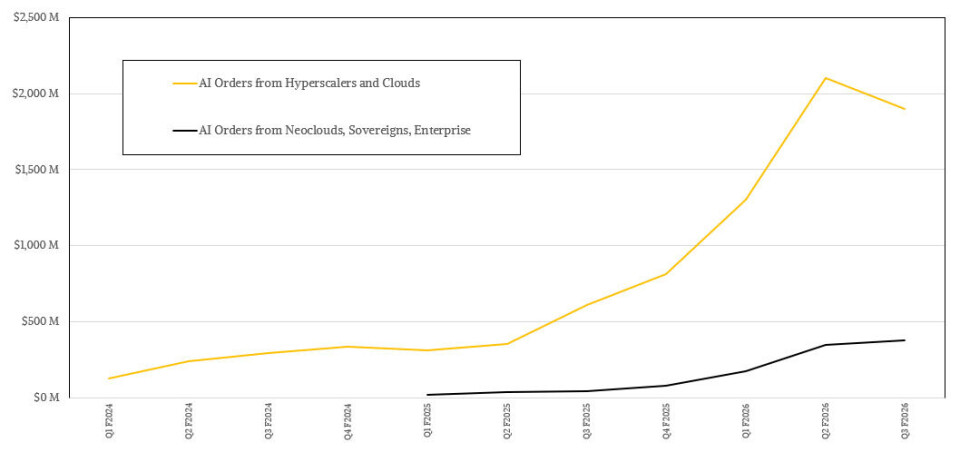
Robbins
said that Cisco had $300 million in AI infrastructure orders – servers,
switches, and such – from neocloud, sovereign, and enterprise customers in the
third quarter, with triple digit growth in all three quarters so far this
fiscal year, with a pipeline of $3 billion. In my model, AI system orders were
up 112 percent to $880 million, and Acacia optics orders rose by 5.4X to just a
tad over $1 billion. Add it all up, and Cisco had $2.2 billion in orders for AI
stuff in Q3 2026.
Enterprise
datacenter switching orders – Nexus switchery – was up by more than 40 percent,
and have grown by double digits in the past seven of nine quarters. Two years
ago, the GenAI boom started to hit enterprise customers, forcing them to
carefully consider the front end networks and systems that will feed into AI
systems. Campus and branch networks are also going to feel the heat from AI
workloads, and Cisco just did a survey of 3,500 IT people responsible for the
networks at their companies and 93 percent say they don’t just have to upgrade
the front end networks linking their enterprise platforms, they are going to
have to upgrade campus and branch networks, too.
It
is important to remember that some of this growth is for price changes as the
costs of GPU accelerators, CPUs, DRAM memory, and flash storage have gone
bonkers in recent months. To give a hint about how this helps Cisco’s numbers,
Mark Patterson, Cisco’s chief financial officer, said on the call with Wall Street
that outside of the hyperscalers and cloud builders, order growth was 10
percent in Q2 and 19 percent in Q3. Of that incremental sequential 9 percent
growth in business, about half came from increased shipments and the other half
came from price increases.
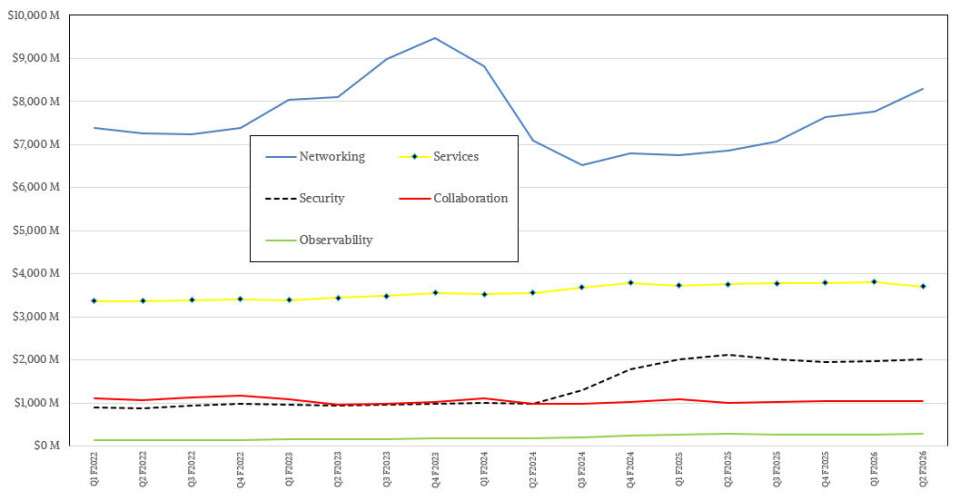
The
Networking group, which has servers, switches, and routers as well as merchant
silicon and optics all mashed up, had $8.82 billion in sales up 24.7 percent
year on year. I know this other stuff is important to Cisco customers, but it either
lives outside of the datacenter or far above in the stack.
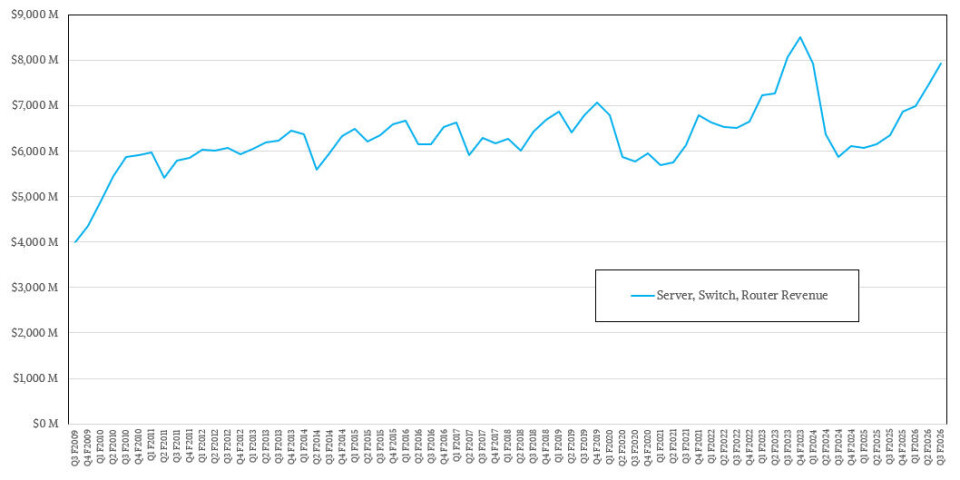
As always, we try to figure out what the “real” Cisco
datacenter business is, extracting out campus and branch networking and other
things in the Networking group that are outside the glass house. (More of a
steel warehouse these days, really.) My model suggests that this real
datacenter business at Cisco weighs in at $7.93 billion in Q3 2026 and had
$1.96 billion in operating income, about 24.7 percent of sales. This is a very
respectable datacenter platform business, and there is no reason to believe it
will not get bigger.
