

It is common understanding that as quantum computing gets
its feet under itself, it will work hand-in-hand with classical supercomputers
and leverage what rapidly evolving AI tools can offer to begin solving some
thorny calculations that the largest HPC systems may be unable to address.
We’ve written about this direction quantum is heading in and steps major
players already are taking to address what IBM calls “quantum-centric
supercomputing.”
Big Blue earlier this month demonstrated
the largest simulation of molecules performed with quantum hardware,
pairing its 156-qubit Heron r2 processors running in IBM quantum systems at the
Cleveland Clinic and at RIKEN in Japan in tandem with two classical
supercomputers, the Fugaku and Myaybi-G systems. In March, IBM rolled out
a reference
architecture for integrating quantum and HPC systems.
Nvidia is developing technologies to more
tightly link supercomputers with quantum systems, and the need for such a
pairing is being
pushed at a national level.
The challenge now is finding ways to make these systems work
together as seamlessly as possible, which means not only linking the hardware
but also addressing everything from algorithms to software to the role AI plays
in the mix. What jobs – or what portion of jobs – will run on classical
supercomputers rather than quantum systems, and what mechanisms will determine
how they move back and forth.
That is among the priorities of the quantum computer work
being done at the US Department of Energy’s Oak Ridge National Laboratory,
according to Tom Beck, section head for Science Engagement for the National
Center for Computational Sciences (NCCS) at the national research facility in
Tennessee.
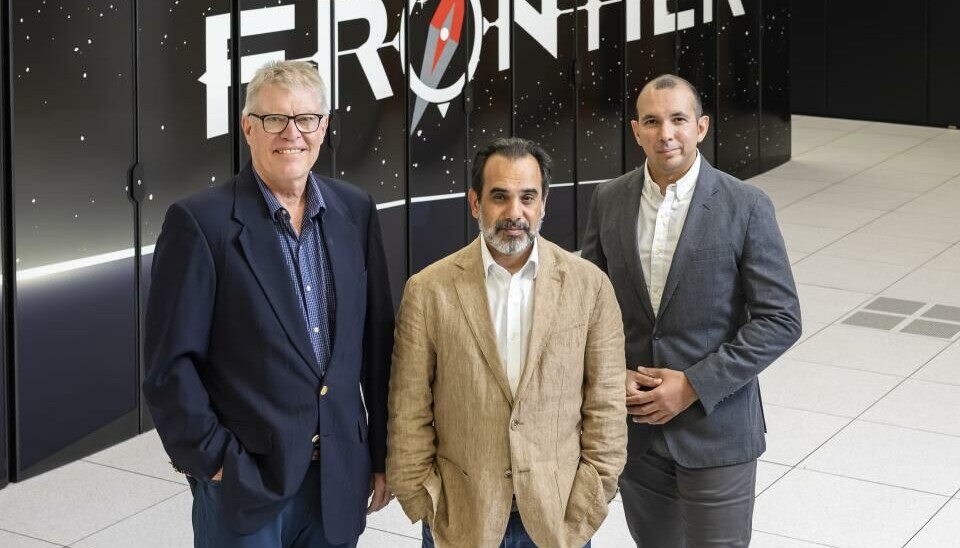
Beck, who also is the section head or Oak Ridge’s quantum-HPC
unit, tells The Next Platform that a key area Oak Ridge scientists are
looking into is the ongoing convergence of supercomputers, AI, and quantum,
what he calls the dominant areas the next era of HPC. Oak Ridge is home to Frontier, first exascale-class system in the United States. Comprised of HPE’s Cray
EX235A systems powered by AMD’s custom 64-core Epyc 2GHz processors and Instinct
MI250X GPUs and linked through the hardware maker’s Slingshot-11
interconnect, it still ranks four years after rollout as the second-fastest
system on the Top500 list.
As for AI, it’s “exploding in importance across business and
science,” Beck says, noting the DOE’s Genesis
Mission initiative to build an AI-driven, integrated compute platform to
accelerate scientific discovery in energy, national security, and technology. The
program, which in March received
$293 million that interdisciplinary teams can vie for to tackle some of the
core
26 challenges outlined by the DOE, connects all 17 national labs with private
sector companies in AI and supercomputing, like Microsoft, Nvidia, and OpenAI.
“Quantum computing is at an earlier stage, but it’s
developing rapidly and we are trying to figure out how to link quantum
computing to HPC, and quantum computing at this stage can be viewed as an
accelerator similar to GPUs 25 years ago,” Beck says. “Quantum computing allows
you in principle to solve some exponentially scaling problems in a polynomial
amount of time. In other words, you can solve problems that you could never
access even on a machine like Frontier. Those problems are not that many at
this time. There could be encryption and national security-type problems.
That’s definitely a big application.”
Oak Ridge scientists have been working on the details of a
hybrid HPC-quantum environment for several years. It not only houses Frontier
but also the Quantum Computing User Program, which opens time on privately owned
quantum processors to support quantum studies, and it leads the DOE’s Quantum
Science Center.
In a study in 2024, Beck and other ORNL scientists proposed
such ideas
as creating quantum test beds to work with a range of technologies and pair
those test beds with classical machines. They also recommended a high-speed
network be developed to connect classical HPC systems to their quantum
counterparts.
Getting Quantum And Classical to Work Together
Such technologies would be useful as Oak Ridge scientists
continue to explore how the two types of systems can work together. As an
example, Beck points to a software stack on a supercomputer may be linked to a
smaller set of GPUs that control the quantum device and provide access to it so
that some parts of the problem are offloaded onto the HPC system.
“We do the quantum sampling, say, for a bunch of electrons
in a large molecule on the quantum device, but then we ship the eigen – it’s
called the eigenvalue problem [a concept in linear algebra] – solving for the
energy states that you get from that sampling of what’s called the Hamiltonian,
or the energy, function,” he says. “It’s very hard to diagonalize this big
matrix on a quantum computer, so you offload that onto the HPC machine. But the
HPC machine, like Frontier, couldn’t do the quantum sampling in the same way
that it’s being done on the quantum device.”
Quantum systems also can model the highly complex entangled
quantum states and how electrons interact in molecules or between two molecules
as they move about. However, the information is carried in the Hilbert space,
which Beck says “is that two to the nth – ‘n’ is the number of qubits, that’s
the dimension of the Hilbert space that all this entanglement is being modeled
in.”
“You can transfer those quantum states – basically the ups
and downs of the electron states – in your model back to the classical machine,
but how do analyze all that incredibly complicated information?” Beck says. “How
do we extract a physical understanding? You can’t just visualize in two to the
nth dimensions. Humans can’t do that. So how do you process that information to
get a deeper understanding of what’s driving a topological material, for
example? If we can model one of those qubits, then how do we understand what
it’s really doing so that we can change something in the material to make it
more efficient? That’s really a job for an exascale supercomputer.”
Putting AI into Play
Now the scientists also are also exploring where AI can come
into play. One area is in error correction. Quantum now uses many physical
qubits to represent a single logical qubit, which is used to reduce errors in
quantum systems, but right now the problem is that – depending on the modality
– it can take tens to thousands of physical qubits to make up a single logical
qubit, an impediment to scaling quantum computers.
AI is being used to assemble large amounts of error data, running
rapid estimations of what the errors might be, and then trying to correct those
errors, Beck says. That work is being done on classical HPC machines, an
example of AI being used to accelerate quantum computing. Another area is accelerating
quantum by optimizing the circuits that run on the system.
“There are an infinite number of ways you could enact a
certain process, but using AI to optimize those circuits can reduce the time
needed on the quantum machine, and it might even accelerate to the point where
you can beat the coherence time problem” of qubits quickly losing their quantum
state, he says. “There’s definitely going to be a use for AI in optimizing the
quantum machine and in error correction.”
At the same time, there may be uses of quantum computers in
machine learning and AI, according to Beck.
“There are advantages to sampling high-dimensional spaces on
a quantum computer, and they may turn out to be very useful to optimize what’s
called the loss function in AI [measuring model performance by calculating the
deviation of its predictions from the correct predictions] by rapid sampling
over a high dimensional space,” he says. “People are working on that side, too.
That would be quantum for AI.”
