

REMIND model
In this study, we extend the integrated assessment model REMIND with a technology-explicit steel production model (below). This allows us to explore cost-efficient transformation pathways for the steel sector, assessing how different technological options could contribute to the transformation of the sector.
We use a version of the REMIND model64 based on the release version 3.5 (https://github.com/clarabachorz/remind/tree/steel-LockIn). REMIND is a global model which divides the world into 12 regions and uses a Ramsey-type macroeconomic growth model combined with a detailed and technology-rich energy system. The model maximizes intertemporal welfare for each region based on a nested CES (constant elasticity of substitution) production function in a tree structure (‘CES tree’), with a detailed representation of the three energy demand sectors: buildings, transport and industry. Each demand sector translates final energy inputs to energy services outputs, which in turn, together with generic capital and labour, contribute to economic production (gross domestic product).
Emissions from both energy and non-energy processes are tracked and penalized with an endogenous carbon price implemented as a tax. In climate policy scenarios, the carbon price is iteratively adjusted so that cumulative emissions meet prescribed carbon budgets compatible with certain levels of global warming.
Scenarios
The service demand trajectories for the buildings, transport and industry sectors rely on scenario assumptions on global political and economic development. Those are synthesized in narratives called the shared socio-economic pathways (SSPs)65 and commonly used in the integrated assessment model community. All scenarios in this study are based on the SSP2 scenario. The policy scenarios we develop to explore the steel lock-in use the Current Policies baseline scenario, where only currently implemented climate policies are preserved, and no further efforts are made to mitigate climate change: there are no additional climate policies and no prescribed carbon budget.
Country groups
REMIND models 12 regions in this study, but we group some of them for simplicity in these results. Global North refers to the United Nations Framework Convention on Climate Change (UNFCCC) Annex 1 countries grouped with the other countries of the former Soviet Union. Other Asia refers to the grouping of Southeast Asian countries, South Korea and North Korea but excludes China and India, which are modelled as individual regions.
Cost basis
All costs reported in this paper, if not indicated otherwise, are in 2017 US dollars.
REMIND steel implementation
The novel REMIND steel production model is a technology explicit, linear model. It connects to the energy-system module of REMIND, which provides final energy used by steel production processes, and to the CES (constant elasticity of substitution production function) tree (Supplementary Fig. 10), which determines material demand, that is, the amount of material produced by the model. This means that the steel sector presents an exception with respect to the CES tree: its primary production factors are not final energy demands, but material demands and the translation of final energy demands to material demands is calculated outside of the nested CES function.
Steel demands
Steel demand from the CES tree
The ‘steel’ node is one of four CES production factors contributing to the ‘industry’ node of REMIND, next to the ‘cement’, ‘chemicals’ and ‘other industry’ nodes, with an elasticity of substitution. To represent the substitution dynamics between primary and secondary steel, the ‘steel’ node is itself the output of a CES function, with the inputs ‘primary steel’ and ‘secondary steel’. These nodes are linked to the outflows of the processes in the steel model. Steel demands are therefore price sensitive and react to changes in production prices.
Baseline steel demands
The CES tree is calibrated to meet prescribed steel demands over time in the Current Policies scenario. The methodology for deriving these prescribed demand trajectories is described in detail in Pehl et al.66. Historical demands are based on historical production data from the World Steel Association. Projections into the future are based on a simple stock-and-flow model, which regresses future per capita in-use steel stocks as a logit function of time in each region, following the methodology in Pauliuk et al.22. A lifetime model derives inflows and outflows into/from the in-use stock. Steel trade is included as an exogenous assumption in this model, with historical relative trade shares assumed to remain constant into the future, with corrections ensuring global market clearing.
Secondary steel constraints
Two upper bounds constrain the amount of secondary steel production in each region.
First, the amount of secondary steel production must not exceed the amount of available scrap in each region. For this, 90% of the outflow of the in-use stock is assumed to be collected and available for recycling67,68.
Second, the share of secondary steel in the total steel production must not exceed 70%, due to quality constraints of recycled steel. This limit aligns with the share of secondary steel observed in the USA today69. This upper limit additionally reflects current quality constraints associated with the accumulation of tramp elements in steel scrap, in particular copper21,70. Sectors requiring high-quality steel sheets, such as the automobile industry, are therefore limited in their ability to rely on scrap steel21. Improved scrap segregation and recycling practices may relax this constraint in the longer term71, but it remains binding today, supporting the use of a 70% upper bound in this study.
Process-based production model
Technology graph
The main current and future technologies in steel production are represented in a multi-stage production model. The layout is depicted in Supplementary Fig. 10, including each technology’s material inputs and outputs. The model includes an integrated steel plant technology representing the blast furnace-basic oxygen furnace (BF-BOF) route and an electric arc furnace, and the precursory direct reduction furnace, resolved as individual technologies. Some technologies can switch between operation modes, which differ in terms of material and energy inputs, without changing the capacity stock: electric arc furnaces can be fed with scrap or with direct reduced iron, while direct reduction furnaces can be fed with natural gas or hydrogen. A full list of processes with their techno-economic parameters is given in Supplementary Table 1.
Capacity stock
Each technology’s production capacity is represented with a capacity stock model. It is parameterized with specific CAPEX for capacity additions, fixed operational expenditures and a mean lifetime for the stock depreciation model. Specifically, the share of surviving plants at an age x given a mean lifetime L is \(1-{\left(\frac{x}{1.25{L}}\right)}^{4}\).
The capacity factor, that is, the ratio of production to production capacity, is fixed and not just an upper bound, such that further unused capacities are not allowed by the model. However, optionally, a given share of the standing capacity can be allowed to retire early.
Energy and material inputs
REMIND differentiates five types of final energy: solid, liquid, gaseous, electricity and green hydrogen. The former three can stem from either fossil, biogenic or synthetic secondary energy sources (except for synthetic solids, which are not represented), but the steel model does not differentiate between secondary energy sources in its use. The prices for the material inputs of iron ore, DRI pellets and scrap are exogenous and constant for all regions and time steps. They are given in Supplementary Table 2.
Energy prices, such as electricity or hydrogen, are endogenous outputs of the REMIND optimization. These values correspond to the shadow prices of the respective energy balance equations and therefore represent the marginal cost of supplying one additional unit of the energy carrier in the optimal solution.
Historical energy demands and energy efficiency improvements
The specific energy demands in Supplementary Table 1 are literature values, usually referring to the best available technology (BAT). Real operating plants have different values and are typically less efficient.
The historical energy demand of steel production is obtained from the International Energy Agency’s world energy balances72. Historical energy efficiencies are derived by dividing this demand by historical production.
Future energy efficiencies are then assumed to converge towards the literature values given in Supplementary Table 1 at a rate following an exponential decay of base 0.9804 from 2020, such that the excess over BAT is halved by 2055.
All historical capacity for primary steelmaking is assumed to be from the BF-BOF or DRI-EAF-NG route. This is a simplification, especially in India, where primary steel is also produced via coal-based DRI. Coal-based DRI kilns cannot be retrofitted to operate with natural gas or hydrogen and fully rely on coal, making their dynamics similar to the BF-BOF route. In our calibration, we account for the higher energy demand and emissions of coal-based DRI in the historical data, such that the model’s ‘BF-BOF route’ in India should be interpreted as an aggregate of BF-BOF and coal-DRI. This aggregation allows us to capture the lock-in and energy demand associated with coal-based primary steel, even though we do not model coal-DRI as a separate technology. Coal-DRI also plays a minor role in India’s planned future capacity additions, such that this simplification only affects the already standing capacity.
The historical efficiency penalty (defined as the ratio of observed energy use to BAT levels) is applied to DRI furnaces at a reduced rate of 60%. This prevents the model from unrealistically achieving large energy efficiency gains by switching from BF-BOF to DRI in regions with low historical efficiency.
Emissions
Emissions accounting is based on final energy use: fossil-based final energy carriers have implied emissions factors given in Supplementary Table 3. For biogenic and synthetic gases/solids/liquids and for electricity and green hydrogen, these emissions factors are zero. Upstream emissions, such as electricity grid emissions and mining emissions, are not accounted for in the steel sector but in other sectors.
Local emissions are needed to derive the carbon capture potential. To this end, the fossil emissions factors are also applied to solids, liquids and gases of biogenic and synthetic origin.
Carbon capture in the steel sector
Carbon capture technology based on amine scrubbing can be retrofitted to blast furnaces and natural-gas-based direct reduction furnaces. This means that the techno-economic parameters in Supplementary Table 1 are given only for the capture technology, excluding the furnaces themselves. No cost distinction is made between greenfield and brownfield technology. All costs and inputs are given per ton of captured CO2 (the specific CO2 material input is thus the inverse of the capture rate). The heat input of the reboiler is assumed to be from gas burners, with 90% of the resulting reboiler heating emissions being directly captured in the plant.
Captured carbon is passed to REMIND’s carbon management module, which decides endogenously whether to sequester it (carbon capture and storage—CCS) or use it as a feedstock for e-fuels (carbon capture and use—CCU).
Unrepresented technologies
Casting and rolling, and their energy demand, are not explicitly represented in the model, as their energy requirements are independent of the chosen production route.
Technologies with a low technology readiness level are not included, as their techno-economics are too uncertain for a comparative analysis. This applies in particular to molten oxide electrolysis.
Locked-in and committed emissions
In this study, we define ‘locked-in’ or ‘committed’ emissions by building on the initial definitions used by Davis et al.73 and Tong et al.26. Specifically:
-
(1)
We define emissions as ‘committed’/‘locked-in’ when they arise from existing or already planned CO2-emitting assets and can only be avoided through (1) early retirement or (2) substantial additional investments outside normal investment cycles or conventional operation (including CCS retrofits or feedstock substitution). These typically entail significant additional costs.
-
(2)
We further distinguish this from an additional ‘lock-in risk’, which refers to emissions that are not yet committed but may become committed through continued investments in fossil technologies in a given policy scenario.
The definitions are summarized in Supplementary Table 4.
Steel plant data analysis
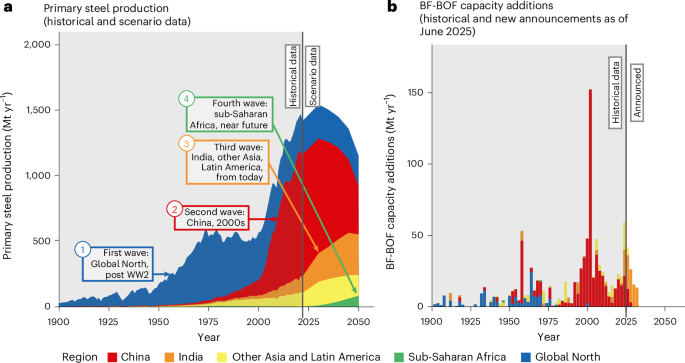
We use plant-level data from the Global Iron and Steel Plant Tracker from the Global Energy Monitor (June 2025 version)35. The dataset reports unit-level data for both steel plants and iron plants (DRI furnaces and BFs) and includes information on production route, operating status, steel and iron capacity, start dates, retirement dates and, if available for blast furnaces, relining dates.
For the analysis in Fig. 1, we use the steelmaking dataset to derive historical and announced BF-BOF capacity additions by region. The announced capacity additions data are also used to constrain near-term capacity additions in REMIND by setting lower bounds on BF-BOF capacity additions: depending on the scenario design, this lower bound is either set to all new plants (announced and under construction) or only under construction plants (Supplementary Table 1). According to GEM, plants are classified as ‘announced’ rather than ‘under construction’ if they are ‘Capacity that has been announced in corporate or governmental planning documents but has not begun construction’.
Figure 2 combines the steelmaking and ironmaking datasets to estimate the magnitude of the potential carbon lock-in from existing and planned capacity. Using a custom analysis code (Code availability), we match each BOF steel plant to its respective blast furnace(s). If a plant has multiple blast furnaces, the total steel capacity is distributed among blast furnaces in proportion to their respective iron production capacity.
Using the reported last relining date (or if not available, the start date of the steel plant or of the blast furnace), we estimate blast furnace-specific end dates under different relining assumptions (no further relining or relining for young BFs). From this, we can calculate what fraction of steel capacity is retired at what time. We follow Vogl et al.29 for blast furnace campaign life assumptions: 20 years before the first relining and an additional 15 years before the second.
From this projected retirement estimation, we can calculate the standing BF-BOF capacity over 2020–2070 for each relining case. This is then translated to CO2 emissions by assuming a capacity factor of 0.8 and an emissions factor of 2.3 tCO2 per t steel for existing plants, and 2 tCO2 per t steel for new plants. The resulting annual and cumulative emissions from BF-BOF plants are shown in Fig. 2.
Average abatement cost calculation
We calculate the average abatement cost from the ratio of the net-present value (NPV) difference in cumulative steel system costs to the NPV of avoided emissions. This metric also adjusts for steel demand changes between scenarios.
The average abatement cost for moving from a higher-emissions scenario (1) to a lower-emission scenario (2), over a total period of T years, is defined in equation (1):
$$\mathrm{AAC}\,=\,\frac{\mathrm{NPV}\left({\mathrm{Cost}}_{2}^{\,\,\mathrm{adj}}\left(t\right)-{\mathrm{Cost}}_{1}\left(t\right)\right)}{\mathrm{NPV}\left({\mathrm{Emissions}}_{1}\left(t\right)-{\mathrm{Emissions}}_{2}\left(t\right)\right)},$$
(1)
with
$$\mathrm{NPV}\left(x\left(t\right)\right)=\mathop{\sum }\limits_{t=0}^{T}\frac{x\left(t\right)}{{\left(1+r\right)}^{t}},$$
where t is time in years and r, the discount rate, is assumed to be 5% in this study, in line with market interest rates74. Emissionsn(t) are the steel sector CO2 emissions of scenario n in year t, while Costn(t) is the total steel system cost of scenario n in year t. \({\mathrm{Cost}}_{n}^{\,\mathrm{adj}}(t)\) is the total steel system cost of scenario n, combined with an additional term accounting for steel production differences between the two scenarios considered, at all (t), as seen in equation (2).
$$\begin{array}{rcl}{\mathrm{Cost}}_{n}^{\mathrm{adj}}\left(t\right) & = & {\mathrm{System}}\,{\mathrm{costs}}\left(t\right)+\left(\left({\mathrm{Steel}\,{\mathrm{production}}}_{1}\left(t\right)\right.\right.\\ & & \left.-{\mathrm{Steel}\,{\mathrm{production}}}_{2}\left(t\right)\right)\times \left.\frac{{P}_{1}^{\mathrm{steel}}\left(t\right)+{P}_{2}^{\mathrm{steel}}\left(t\right)}{2}\right),\end{array}$$
(2)
where \({P}_{n}^{\,\mathrm{steel}}(t)\) is the price of steel in scenario n and in year t, and Steel productionn (t) the steel produced in scenario n in year t.
Value of avoided emissions in Fast Transition
To assess the economic value of avoiding the steel lock-in, we compare the additional costs required in the Fast Transition (FT) scenario, compared to Transition with Lock-in (TwLI), for two different mitigation strategies:
-
(1)
reducing emissions directly in the steel sector by reducing the lock-in and
-
(2)
achieving equivalent emissions reductions in other energy sectors, at the lowest possible cost.
For strategy (1), this cost TC1 corresponds to the additional cumulative steel system costs in FT compared to TwLi (equation (3)):
$${\mathrm{TC}}_{1}=\mathrm{NPV}\left({\mathrm{Cost}}_{\mathrm{FT}}^{\,\,\,\mathrm{adj}}\left(t\right)-{\mathrm{Cost}}_{\mathrm{TwLI}}\left(t\right)\right),$$
(3)
with the NPV and all other symbols defined as in the section above.
For strategy 2, the cost TC2 represents the system-wide cost of compensating the additional emissions in TwLI by abating an equivalent amount of CO2 elsewhere in the energy system. In REMIND, the carbon price gives the marginal cost of abating an additional ton of CO2 across all economic sectors covered in a given time step. We therefore estimate TC2 by multiplying the emissions difference between FT and TwLI by the average carbon price of the two scenarios in the same time step t, as seen in equation (4):
$${\mathrm{TC}}_{2}\,=\mathrm{NPV}\left({\mathrm{Cp}}_{\mathrm{avg}}\left(t\right)\times \left({\mathrm{Emissions}}_{\mathrm{FT}}\left(t\right)-\,{\mathrm{Emissions}}_{\mathrm{TwLI}}\left(t\right)\right)\right),$$
(4)
where Cpavg(t) is the average carbon price in FT and TwLI. Using the average carbon price corresponds to approximating the marginal abatement cost curve between the two scenarios as linear, reflecting increasing marginal abatement costs as additional emissions reductions are required.
Emissions reductions occurring ‘elsewhere in the energy system’ are endogenously determined by the model and occur primarily in the energy supply sector and by increasing BECCS deployment (Extended Data Fig. 4).
Limitations
Several modelling assumptions and other uncertainties should be considered when interpreting our results.
The REMIND steel sector implementation does not include endogenous technological learning, so capital costs of steel technologies remain constant over time. However, endogenous learning is represented for other key technologies, including electrolysis, solar photovoltaics and wind turbines. As a result, the cost of, for example, hydrogen-based steel can decline endogenously over time through reductions in low-emission hydrogen cost. In addition, energy efficiency improvements are included for all modelled steel production technologies on a regional basis, based on historically observed trends.
Additionally, relining events are represented as additional investment costs that extend the mean BF-BOF plant lifetime to 35 years, without explicitly capturing potential efficiency upgrades associated with these refurbishments.
We do not model international trade for iron and steel and instead assume broadly stable trade patterns—alternative scenarios with, for example, increased steel exports from China or a reshaping of trade flows with the expansion of hydrogen DRI are not explored.
Finally, our analysis focuses on supply-side mitigation and does not explore demand-side interventions such as material efficiency, substitution or lifetime extension of steel products, which could further reduce investment needs and emissions.
