

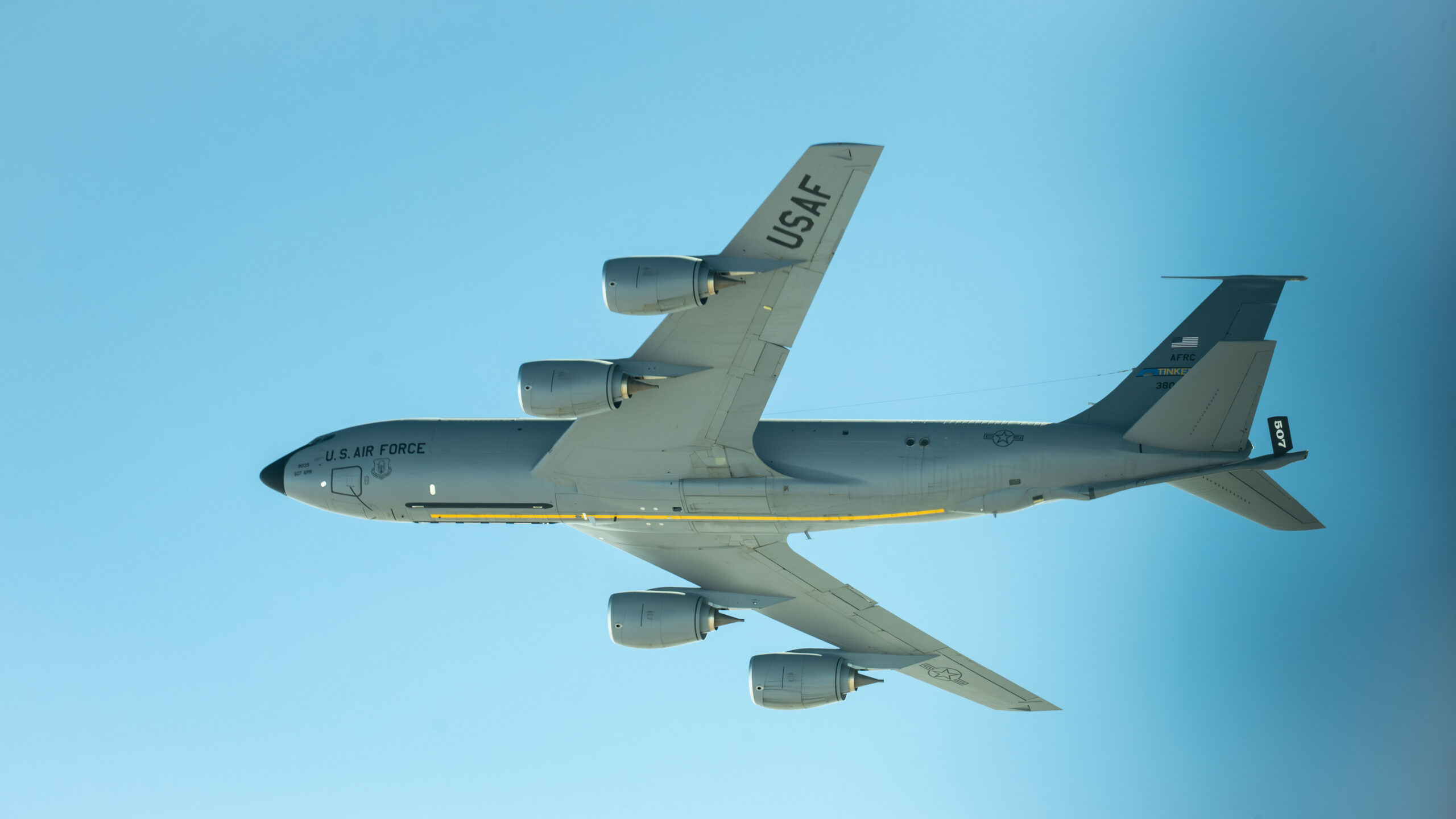
Air Force leaders expect all six KC-135 Stratotankers that were damaged but not destroyed as part of Operation Epic Fury will eventually be repaired and returned to service.
Some of those damaged KC-135s are already flying again, Air Force Chief of Staff Gen. Kenneth S. Wilsbach told the Senate Appropriations subcommittee on defense June 9. But the most heavily damaged refuelers could take a year or two to be fully repaired, he added.
Wilsbach did not say provide specific numbers on how many have returned to service or not. But he said “most” had been able to muster at least one flight, even if only to fly to another site to be repaired.
“Some of them are already flying,” Wilsbach said. “In fact, most of them are already flying. Some of them had a one-time flight to have further repair, but some of them are already back in service. The ones that have the more significant damage will take a year or two to get fixed.”
Five of the KC-135s were damaged in an Iranian missile strike on Prince Sultan Air Base in early March, which was first reported by the Wall Street Journal. President Donald Trump, in a March 14 post on Truth Social, confirmed the strike but downplayed the extent of the damage, saying four of the five tankers had “virtually no damage” and were already back in service.
In the weeks that followed, photographs emerged of two battle-damaged KC-135s transiting through RAF Mildenhall in the U.K., each showing signs that they had been hit with shrapnel or other projectiles and temporarily patched up to fly for repairs.
A sixth KC-135 sustained significant damage to its vertical stabilizer in a midair collision with another Stratotanker. That damaged KC-135 was able to land safely in the March 12 incident, but the other was completely destroyed when it crashed in Iraq, killing all six Airmen aboard.
Three weeks after that crash, the Air Force pulled a KC-135 out of its aircraft storage facility known as the Boneyard to be put back into flying status, though the Air Force has not confirmed it was done specifically in response to the crash.
The U.S. military has lost at least 40 aircraft as part of operations against Iran. The bulk of those are roughly 30 MQ-9 Reapers, but other losses include four F-15E Strike Eagles, two MC-130 special operations refueling and mobility aircraft, the crashed KC-135, an E-3 AWACS, an A-10, about three MH-6 Little Bird helicopters, and most recently an Army Apache helicopter. Additional aircraft have also been damaged.
In another hearing April 30, Wilsbach told lawmakers the Air Force wants to replace at least some of the aircraft lost as part of Epic Fury as part of the supplemental budget process.
In the June 9 hearing, Wilsbach told subcommittee members that the damaged and lost KC-135s “had a very short-term” effect on the Air Force’s ability to generate tanker sorties. However, he said, the service surged other tankers into the region to make up for the Stratotanker losses, and there is now “very little impact” operationally to the loss of the KC-135s.
When asked if the 15 KC-46 Pegasus refueling tankers requested in the Air Force’s 2027 budget are enough to make up for both the lost KC-135 and the service’s recapitalization needs, Air Force Secretary Troy Meink said the Air Force is buying them as fast as Boeing can make them.
Meink said the damage that took some KC-135s out of the Iran fight “could potentially” be a factor in deciding which bases would receive new KC-46s, and said it will “be considered as part of the strategic basing process.”
