

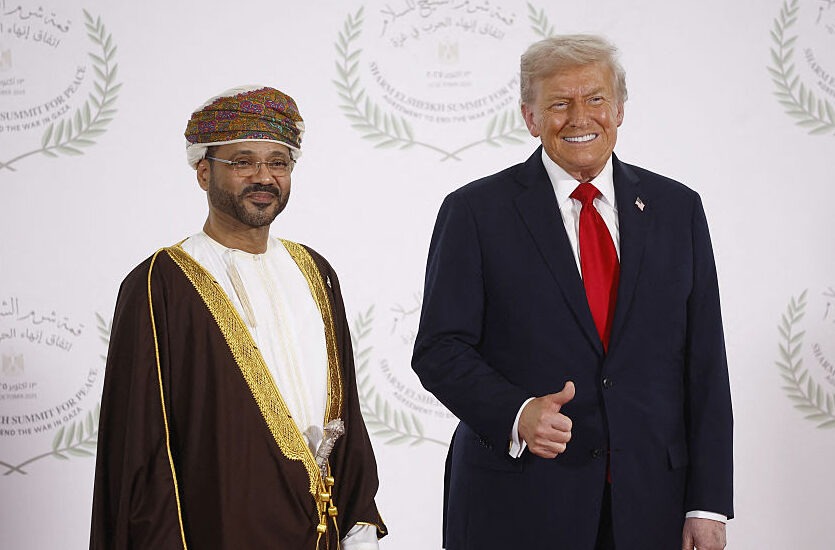
President Donald Trump’s 27 May threat to ‘blow up’ Oman if it didn’t fall into line was strategically self-defeating. With one off-the-cuff remark, the United States risked damaging the one quiet, trusted channel through which Washington and Tehran have repeatedly stepped back from the brink.
Trump’s comment, made during a Cabinet meeting amid rising tensions over the Strait of Hormuz, was not an isolated outburst. A 1 June Wall Street Journal report indicated the administration was actively pressing Oman to abandon its longstanding neutrality, cut diplomatic ties with Tehran and face potential sanctions or further pressure if it refused. Treasury Secretary Scott Bessent reinforced the point on 28 May, warning that Washington would aggressively target any actor facilitating Iranian tolls in the strait, Oman included.
The Strait of Hormuz crisis will eventually be resolved, but the attack on Oman’s credibility as a neutral mediator threatens to remove an asset which the US cannot quickly rebuild and which no other Gulf state can replace. This pressure reveals a fundamental misunderstanding of Oman’s foreign policy and its unique value to the US. Oman’s neutrality cannot be attributed simply to hedging or opportunism. Rather, it is a deliberate and long-standing doctrine rooted in Omani geography and history.
Positioned at the mouth of the Strait of Hormuz, through which roughly 20 percent of global oil and much liquefied natural gas passes, Oman has long recognised that its own survival depends on preventing major escalation between larger powers. For decades, Muscat has carefully maintained working relations with all sides: the US, Iran, Saudi Arabia, the United Arab Emirates, and even non-state actors when necessary. This positive neutrality has allowed it to act as a trusted mediator when others could not.
The US has directly benefited from this approach through a relationship that spans nearly two centuries. The bilateral relationship dates back to the 1833 Treaty of Amity and Commerce, the US’s first formal agreement with any Arab Gulf state. In 1980, Oman became the first Gulf country to grant the US military access to its facilities, a partnership that has supported virtually every major US operation in the region since. The relationship extends well beyond security cooperation. In 2006, Oman and the US signed a free trade agreement, making Oman one of the few countries in the region to enjoy such a comprehensive economic partnership with Washington.
Oman’s role has also extended far beyond diplomacy. Over the years, it has helped secure the release of US and other foreign detainees, facilitated sensitive negotiations between adversaries and provided trusted backchannels that have helped avert escalation and open pathways to dialogue when official channels were blocked. Ports such as Duqm, capable of accommodating aircraft carriers, remain strategically important today.
The consequences of undermining this partnership are significant. Public threats and pressure can erode Oman’s credibility and once lost, will be difficult to restore. The backchannel that has helped de-escalate several crises – including facilitating Yemen talks, hostage releases and the lead-up to the 2015 Joint Comprehensive Plan of Action – could quietly disappear. Facing a tenuous ceasefire and recurring incidents in the Strait of Hormuz, losing that channel increases the risk of dangerous miscalculation.
Rebuilding such a unique relationship would be extraordinarily difficult. No other Gulf state can fill Oman’s role. Saudi Arabia and the UAE carry deeply engrained rivalries with Iran that make them unacceptable intermediaries in Tehran’s eyes. Qatar has its own limitations in its approach to Iran. Oman’s position is singular and built on decades of consistent, low-profile diplomacy that has earned trust across the divide.
Allies across the Indo-Pacific and Europe are also watching. When even a quiet, reliable partner of nearly 200 years can be publicly threatened, the message is clear that today’s ally can quickly become tomorrow’s target. The US doesn’t need Oman to abandon its neutrality or pick a side, but rather to remain what it has always been: a stable, discreet facilitator that keeps options open when everyone else has closed them. In the volatile geopolitics of 2026, with global energy security and Indo-Pacific supply chains at stake, Washington cannot afford to alienate such a partner.
