

A durable, fire‑conditioned Nature-based Climate Solutions architecture integrates climate physics, landscape ecology and law. Policy priorities to secure Nature-based Climate Solutions durability may include:
Prevention‑first ignition control. Institute predictable, graduated zero‑ignition rules during high‑risk windows triggered by sub‑seasonal forecasts, combined with pre‑announced enforcement surges and rapid on‑site adjudication. Participatory fire‑use governance can avoid criminalizing subsistence burning while tightening controls on high‑risk corridors16.
Degradation‑explicit Monitoring Reporting and Verification (MRV) and reporting. Near‑real‑time detection of understory fires, selective logging, and edge effects should feed jurisdictional performance dashboards. Payments and market access should reward verified reductions in anomaly‑normalized fire metrics, not just reduced clearing.
Market and supply‑chain rules. Move from “deforestation‑free” to “degradation‑free” sourcing for beef, soy, timber and high‑risk commodities—geolocated, audited, and jurisdictionally conditioned—so markets penalize fire‑enabled degradation.
Remove frontier‑opening incentives. Withdraw or condition projects and policies (road upgrades, permissive land‑regularization, new extractive licenses) that increase access rents and ignition pressure along supply chains.
Scale prevention finance. Prioritize ex‑ante funding for brigades, territorial monitoring, ignition buffers, fuel breaks, community training and fire‑free land‑preparation alternatives. Prevention is cost‑effective when unpriced reversal costs (carbon, health, infrastructure, biodiversity) are considered.
Strengthen tenure and indigenous stewardship. Secure and accelerate titling, fund Indigenous brigades and monitoring, and pair territorial rights with supported prevention capacity – investments that function both as protection and as restoration policy.
Treating fire as a central risk preserves carbon, biodiversity and the Amazon’s hydro‑ecological functions. Fire‑driven degradation shifts communities toward pioneer and fire‑tolerant species and reduces richness, often approaching the biodiversity loss seen with conversion in human‑modified landscapes17. Recurrent fires and edge creation also delay wet‑season onset and lengthen dry seasons; because the Amazon recycles roughly half its rainfall, these changes can reduce downwind precipitation and threaten urban water security.
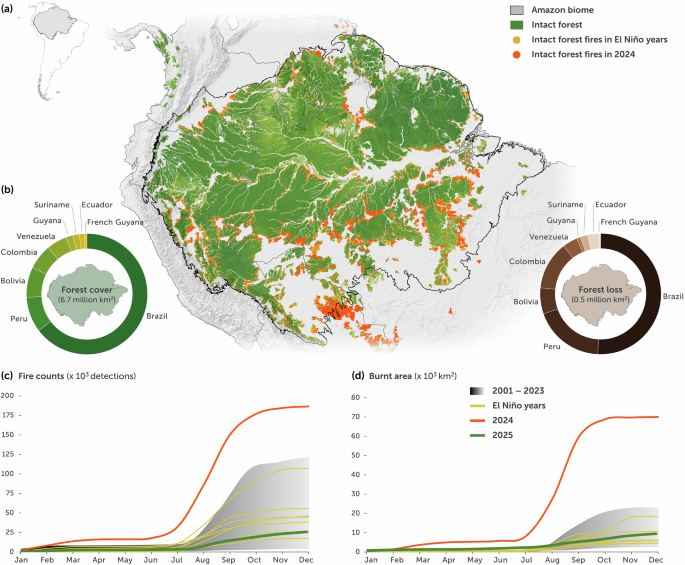
A sceptical test of the 2024–2025 wildfire contrast (Fig. 1) suggests 2025’s unusually low season is not explained by weather alone. Basin‑mean June-to-September moisture anomalies were near‑climatology in 2025 but substantially drier and hotter in 2024 (consistent with a late‑phase El Niño and sustained in part by anomalously warm Tropical North Atlantic sea-surface temperatures that can suppress regional moisture availability). Although the weather helped keep fires at bay in 2025, the larger signal is policy preparedness: the severe 2024 season triggered state plans, expanded brigades, targeted burn bans and tighter supply‑chain scrutiny.
The 2025 outcome – with fire activity well below the 2001–2023 interquartile range – indicates that decisive governance, combined with modestly supportive weather, can suppress ignition at scale. This example supports our conclusion that fire risk is tractable and that prevention‑first policies can make nature‑based solutions durable.
Amazonian Nature-based Climate Solutions will remain fragile unless fire and degradation are treated as first-order risks. The contrast between catastrophic and suppressed seasons in the past few years shows both the threat and the remedy: fires can rapidly erase mitigation gains, yet targeted governance can stabilize the basin’s carbon, water and biodiversity.
A science aligned Nature-based Climate Solutions architecture must prioritize drought window ignition control; embed degradation-explicit Monitoring Reporting and Verification; finance and fund Indigenous stewardship; and remove frontier-opening incentives. Only by integrating prevention, monitoring, market rules and tenure security can Nature-based Climate Solutions shift from fragile accounting to durable resilience.
