
LIVE NEWS
  • Prime Day is almost over, but these are still the best Apple deals I’ve seen
  • How messages between two dads helped expose the largest NHS maternity scandal
  • Building Supervised Fine-Tuning Data from NVIDIA Open-SWE-Traces: Trajectory Parsing, Patch Analysis, Token Budgets, and Tool-Use Metrics
  • From pet to pest, goldfish can wreck entire ecosystems
  • DNC plans weekend of events to focus on affordability concerns
  • Butter and margarine look similar but their chemistry changes everything
  • How big a cybersecurity threat are the latest AI models, really?
  • U.S. pledges generous earthquake relief to Venezuela
Prime Reports
  • Home
  • Popular Now
  • Crypto
  • Cybersecurity
  • Economy
  • Geopolitics
  • Global Markets
  • Politics
  • See More
    • Artificial Intelligence
    • Climate Risks
    • Defense
    • Healthcare Innovation
    • Science
    • Technology
    • World
Prime Reports
  • Home
  • Popular Now
  • Crypto
  • Cybersecurity
  • Economy
  • Geopolitics
  • Global Markets
  • Politics
  • Artificial Intelligence
  • Climate Risks
  • Defense
  • Healthcare Innovation
  • Science
  • Technology
  • World
Home»Geopolitics»AI Will Destabilize Jobs, the Middle Class and the Welfare State Unless We Act in Time — Global Issues
Geopolitics

AI Will Destabilize Jobs, the Middle Class and the Welfare State Unless We Act in Time — Global Issues

primereportsBy primereportsJune 26, 2026No Comments6 Mins Read
Share Facebook Twitter Pinterest LinkedIn Tumblr Reddit Telegram Email
AI Will Destabilize Jobs, the Middle Class and the Welfare State Unless We Act in Time — Global Issues
Share
Facebook Twitter LinkedIn Pinterest Email


AI Will Destabilize Jobs, the Middle Class and the Welfare State Unless We Act in Time — Global Issues
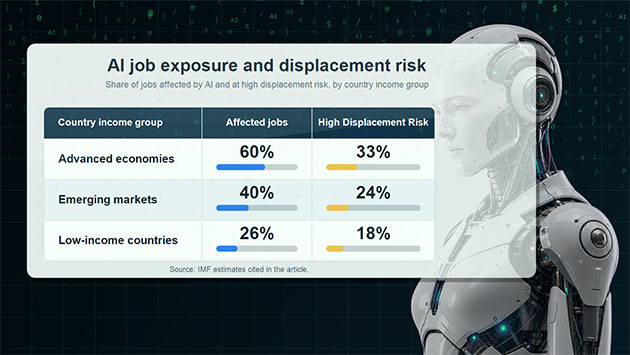
AI job exposure and risk of human jobs lost to AI. Image generated by IA
  • Opinion by Isabel Ortiz, Bill Shoulder (new york)
  • Friday, June 26, 2026
  • Inter Press Service
  • Isabel Ortiz, Director, Global Social Justice, was Director at the International Labor Organization (ILO) and UNICEF, and a senior official at the UN and the Asian Development Bank.

    Bill Shoulder is an AI software engineer and a researcher, with a background in artificial intelligence and international project management.

NEW YORK, June 26 (IPS) – Artificial intelligence (AI) promises remarkable gains in productivity, science, medicine and education. But it is also poised to wipe out millions of jobs, hollow out the middle class, and drain the tax revenues that pay for hospitals, schools and pensions. The process has already begun, and the time to act is running out.

The International Monetary Fund (IMF) estimates that AI will affect almost 40% of jobs worldwide. In advanced economies, around 60% of jobs are exposed and as many as one in three (33%) human jobs are at high risk of being replaced by AI. In emerging markets, about 40% are exposed, with roughly one in four (24%) at high displacement risk; and in low-income countries, an estimated 26%, with close to one in five (18%) human jobs lost to AI.

Job losses shrink the middle class

The most exposed jobs include many occupations long seen as the backbone of middle-class stability: clerical work, customer service, translation, journalism, legal support, financial analysis, marketing content, and even parts of software and data work. These jobs support middle-class incomes, consumer demand and, ultimately, tax-paying households, yet many are among those the IMF finds most exposed to AI.

New jobs will appear but, according to the IMF, far more are likely to vanish. The effects spread beyond the workers who lose their jobs. Wages fall, insecure work multiplies, and bargaining power collapses once employers can credibly threaten to swap workers for AI. More income flows to those who own the technology and to a handful of dominant firms, while the share reaching ordinary employees and workers shrinks.

Middle-class households are the economy’s main consumers. If their incomes fall, shops and small businesses sell less, investment slows, and closures rise. The economy can then slip into a low-growth trap of weak demand, low wages and chronic underemployment.

Falling tax revenues weaken the welfare state

The pressure then moves to public finances. Much of governments’ funding depends on the middle class: income taxes, consumption taxes and social security contributions. If wage income falls and stable employment shrinks, public revenues shrink with it. At the same time, more people need unemployment support, retraining, healthcare and income assistance. Governments then face the fiscal vise of lower revenue and higher need, a risk highlighted in the IMF’s 2026 analysis of AI, labor markets and public policy.

Public pension systems rely on pay-as-you-go financing, where current workers fund retirees. In health, healthy people finance those who are sick. If the pool of contributors shrinks, sustainability collapses; then governments tend to cut benefits, raise charges or shift more costs onto households, as explained in the UNRISD article AI and the Future of the Social Contract.

Public services and democracy come under strain

History suggests what often comes next: austerity policies. Governments under pressure raise consumption taxes, increase user fees, tighten eligibility rules and cut public spending. When revenues weaken, education, health, care services and social protection are often treated as budget lines to be “rationalized,” even though they are human rights and indispensable public services that hold societies together. The result is a two-tier world: quality private services for the wealthy few and failing public provision for everyone else.

Economic insecurity erodes democratic trust. If people feel that work no longer provides stability, that public institutions no longer protect them, and that the gains from technology flow upward to a small elite, resentment grows. Polarization intensifies. Scapegoating becomes easier, as does the appeal of surveillance, manipulation and more authoritarian forms of control, especially when AI itself can be used to shape information and public debate.

The future is ours to shape

None of this is inevitable. As Nobel laureates Acemoglu and Johnson argue, the impact of AI depends far less on the technology than on the political and economic choices we make about how to use it. Governments can tax the windfall profits and concentrated power AI creates. With these funds, they can protect demand and guarantee income security through the transition. Governments can and should expand public services and social security as fundamental human rights. States should also give workers and citizens a real say in how AI is deployed, and regulate AI to strengthen democracy, prevent disinformation and surveillance from eroding civic trust before it is damaged beyond repair.

AI is already transforming society. The decisive question is whether democracies can ensure that its enormous gains are shared widely enough to foster prosperity for all, preserving the social contract on which stable, dignified societies depend. That choice is still ours, but not for much longer.

Isabel Ortiz, Director, Global Social Justice, was Director at the International Labor Organization (ILO) and UNICEF, and a senior official at the UN and the Asian Development Bank.

Bill Shoulder is an AI software engineer and a researcher, with a background in artificial intelligence and international project management.

IPS UN Bureau

© Inter Press Service (20260626164156) — All Rights Reserved. Original source: Inter Press Service

Where next?

Related news

Browse related news topics:

Latest news

Read the latest news stories:

  • AI Will Destabilize Jobs, the Middle Class and the Welfare State Unless We Act in Time Friday, June 26, 2026
  • War, Heatwaves and Energy Shocks Fuel Push for Clean Energy Friday, June 26, 2026
  • Colombia’s next President: A Reckoning for Peace, Climate and Human Rights Friday, June 26, 2026
  • Aid Is Falling Fast. What Can African Countries Do? Friday, June 26, 2026
  • From Nets to Numbers: How Kenya’s Small-Scale Fishers Use Data to Save Their Ocean Friday, June 26, 2026
  • In a Post-Aid World, Investing in Sustainable Livestock Farming Is an Investment in Global Stability Friday, June 26, 2026
  • Venezuela earthquakes LIVE: Death toll rises amid recovery and rescue efforts Friday, June 26, 2026
  • Venezuela quake: ‘People still terrified to re-enter what were their homes’ Friday, June 26, 2026
  • Should BRICS+ Lead the Global South? Friday, June 26, 2026
  • UNCTAD: A Shift of Risk, Geopolitical Tension Weighs on Global Markets Heavier than Trade Policy Thursday, June 25, 2026

In-depth

Learn more about the related issues:

Share this

Bookmark or share this with others using some popular social bookmarking web sites:

Link to this page from your site/blog

Add the following HTML code to your page:

AI Will Destabilize Jobs, the Middle Class and the Welfare State Unless We Act in Time, Inter Press Service, Friday, June 26, 2026 (posted by Global Issues)

… to produce this:

AI Will Destabilize Jobs, the Middle Class and the Welfare State Unless We Act in Time, Inter Press Service, Friday, June 26, 2026 (posted by Global Issues)

Share. Facebook Twitter Pinterest LinkedIn Tumblr Email
Previous ArticleNow we know how much tax King Charles pays, and it is very little | King Charles III
Next Article NOWPayments Expands Its Ecosystem with Crypto Tax Readiness Toolkits for Global Businesses By Chainwire
primereports
  • Website

Related Posts

Geopolitics

Venezuela Earthquakes Live Updates: Death Toll Rises to 589 as Rescuers Search for Survivors

June 26, 2026
Geopolitics

Lipsky quoted in WSJ article on CIPS transactions

June 26, 2026
Geopolitics

Defense Business Brief: SECARMY’s dream marketplace; USARPAC + USVs; and Quantum EOs

June 25, 2026
Add A Comment
Leave A Reply Cancel Reply

Top Posts

Paxton’s win over Cornyn sets up high-stakes Texas clash with Talarico

May 28, 202616 Views

Global Resources Outlook 2024 | UNEP

December 6, 202510 Views

Texas Democrat Talarico claims voting laws are rigged ahead of Paxton race

May 28, 20269 Views
Stay In Touch
  • Facebook
  • YouTube
  • TikTok
  • WhatsApp
  • Twitter
  • Instagram
Latest Reviews

Subscribe to Updates

Get the latest tech news from FooBar about tech, design and biz.

PrimeReports.org
Independent global news, analysis & insights.

PrimeReports.org brings you in-depth coverage of geopolitics, markets, technology and risk – with context that helps you understand what really matters.

Editorially independent · Opinions are those of the authors and not investment advice.
Facebook X (Twitter) LinkedIn YouTube
Key Sections
  • World
  • Geopolitics
  • Popular Now
  • Artificial Intelligence
  • Cybersecurity
  • Crypto
All Categories
  • Artificial Intelligence
  • Climate Risks
  • Crypto
  • Cybersecurity
  • Defense
  • Economy
  • Geopolitics
  • Global Markets
  • Healthcare Innovation
  • Politics
  • Popular Now
  • Science
  • Technology
  • World
  • About Us
  • Contact Us
  • Privacy Policy
  • Terms & Conditions
  • Disclaimer
  • Cookie Policy
  • DMCA / Copyright Notice
  • Editorial Policy

Sign up for Prime Reports Briefing – essential stories and analysis in your inbox.

By subscribing you agree to our Privacy Policy. You can opt out anytime.
Latest Stories
  • Prime Day is almost over, but these are still the best Apple deals I’ve seen
  • How messages between two dads helped expose the largest NHS maternity scandal
  • Building Supervised Fine-Tuning Data from NVIDIA Open-SWE-Traces: Trajectory Parsing, Patch Analysis, Token Budgets, and Tool-Use Metrics
© 2026 PrimeReports.org. All rights reserved.
Privacy Terms Contact

Type above and press Enter to search. Press Esc to cancel.