

If
you have a few pallets of datacenter CPUs sitting in a barn somewhere, and they
have a reasonable number of cores and a healthy number of I/O lanes and memory
channels, then let me tell you, you can find a buyer for them lickety-split. Thanks
to the GenAI boom, Intel and AMD are focusing on putting out high core count
parts because that is what high-end AI training and inference machines need.
More
importantly for Intel, as we move from a market focused on AI training to one
concerned overwhelmingly with AI inference in production, the ratio of GPUs or
XPUs to CPUs is actually decreasing, according to Intel, not increasing.
And that means CPU content per AI system is on the rise at the same time that
the number of AI systems (and the aggregate amount of investment in them) is
also on the rise. It’s a “double thank you mammy” instead of the double whammy bammy
that Intel has lived through in the past few years when its foundry slipped
some process cogs and therefore its server CPU designs fell behind rival X86
CPU supplier AMD.
Instead
of the 8 to 1 ratio that was common a few years back, we see more and more 4 to
1 designs and even some 2 to 1 designs. We do not think it will go all the way
down to 1 to 1, but stranger things have happened. The funny bit is that Intel
CPUs are still being used in a lot of 8 to 1 and 4 to 1 designs as far as we
can tell, but when Intel finally gets NVLink ports put on future Xeons, they
should be a drop-in replacement in whatever rack designs Nvidia and its partners
put together, which are based on 2 to 1 designs. This is a socket statement,
not a chip or chiplet statement. Many times, if you drill down into the
architecture, you see multichiplet CPUs and multichiplet GPUs paired into
something like a 1 to 1 ratio, as we have discussed in the past.
Couple
that with the fact that all of the X86 processors from Intel and AMD that can
be made in 2026 seem to be allocated to their respective hyperscalers, cloud
builders, OEMs, and other channel partners. How much under capacity there is
remains a bit of a mystery, but Dave Zinsner, Intel’s chief technology officer,
gave a hint late last week on a call with Wall Street analysts going over the
chip maker’s Q1 2026 results. When one analyst asked that if Intel’s
manufacturing capacity for chips (by which we presume he meant both PC and
server chips) was 10 percent lower than demand, Zinsner said: “I probably not
want to put a specific number. Let’s just say it starts with a B. So it’s
meaningful.”
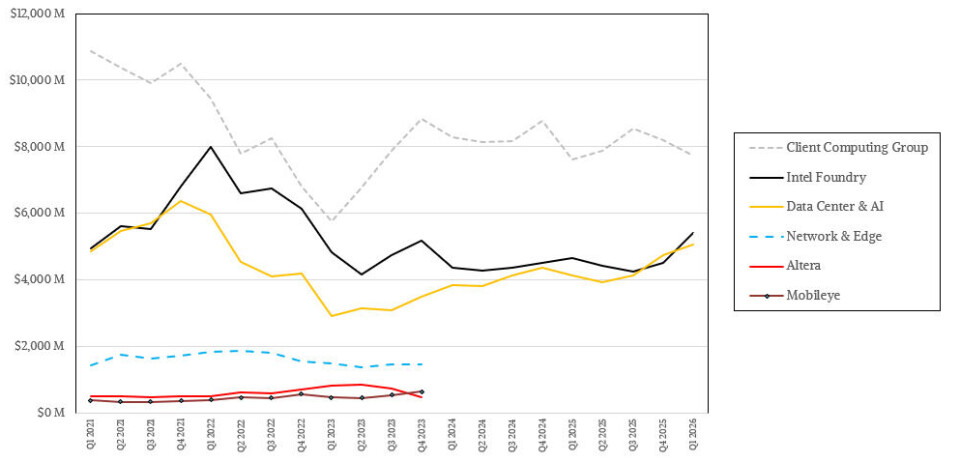
OK,
at least $1 billion. If all of that undercapacity came from the datacenter side
of the Intel Products group, then that would represent an incremental 20 percent
of revenue. If it is across all Intel Products, then it is around 8 percent. If
it was more than that – billions – then take it from there. It looks to us that
the guess of Timothy Arcuri, semiconductor analyst at UBS Investment Bank, was
pretty close at around 10 percent. We have no way of knowing if the datacenter CPUs
have a bigger supply-demand imbalance than the PC CPUs. Our hunch is that the
tech titans are a little more hungry for datacenter CPUs than PC and laptop
makers.
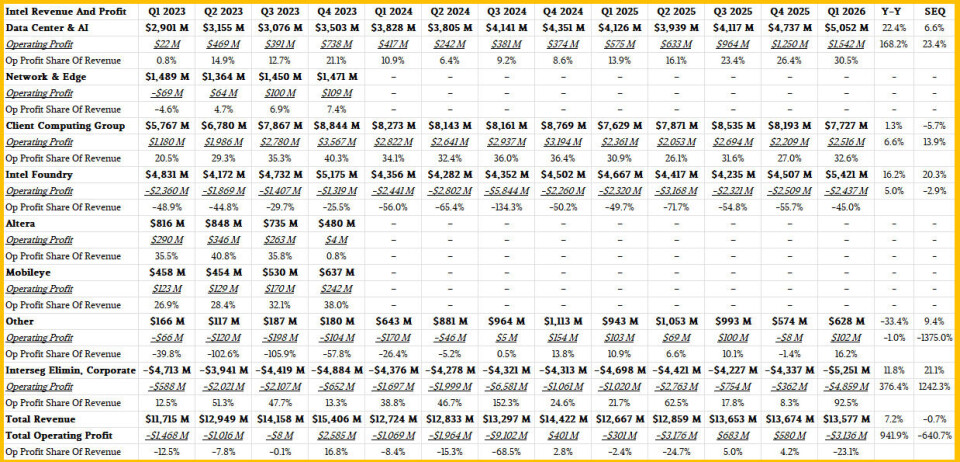
Zinsner
tossed out another interesting tidbit on the call with Wall Street, saying that
Intel’s “collective AI-driven businesses now represent 60 percent of revenue
and grew 40 percent year-over-year.” Zinsner then added that Intel’s “AI PC
revenue grew 8% sequentially and now represents greater than 60 percent of our
client CPU mix.” If you play around with those numbers, it means Xeon sales
into AI systems probably represented somewhere around 57 percent of the total
$5.05 billion in sales for the Data Center and AI group, which works out to
$2.88 billion, while AI related CPUs accounted for $4.79 billion, or 62 percent
of the $7.73 billion in sales for the Client Computing group.
Aside
from the yields on the mature Intel 7, Intel 4, and Intel 3 processes running
ahead of schedule, and ditto for the much more important Intel 18A and Intel
14A processes that are the foundation of Intel’s own CPU business as well as
its merchant foundry aspirations, most of the talk on the call with Wall Street
was one of relief.
People
keep saying that Intel is back. No it isn’t, no more than the IBM that had a
near-death experience in the early 1990s and nearly went bankrupt and laid off
half of its 400,000-strong workforce “was back.” Intel is not back. Intel is
transformed, trimmed down, and focused on doing what it can to delight customers.
And it will be lucky to have a 25 percent share of the overall CPU business and
some low double digit share of the merchant foundry business in the coming
years. Yes, Intel has plenty of advantages when it come to advanced packaging.
I know. So did IBM Microelectronics, which also had several generations of
Power cores that could do twice as much work as an X86 core as well as advanced
packaging. And then IBM’s chip business disappeared into the gaping maw of
GlobalFoundries when the foundry game became too rich for Big Blue’s blood. IBM
basically paid GlobalFoundries to take it.
What
is emerging here in 2026 is a less cocky, more focused, and absolutely realistic
Intel. It is not the company run by marketeers that read the pricing and
technical riot act to hyperscalers and cloud builders in the 2010s, and essentially
pushed these key customers into the awaiting arms of Arm. It is not the
paranoid one that nearly crashed and burned as it exited the memory business so
many decades ago to foster an X86 CPU business and make it grow from the
desktop to the laptop to the datacenter. This is a different Intel, and Lip-Bu
Tan is setting the tone and calling the conservative shots. Like IBM under Lou
Gerstner, Intel will only invest in technologies that is reasonably sure will
make money. Which is why the 14A process node is not a sure thing yet. Intel
cannot – and will not – carry the financial burden of ramping 14A all by
itself. Tan has been very clear on this, and he shows no indication of changing
his mind.
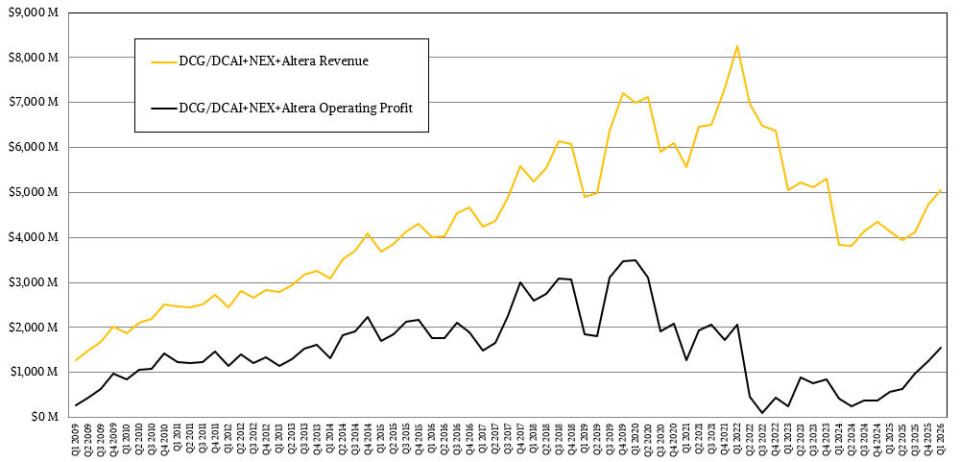
As
we said, thanks to product mix and what we presume are aggressive pricing
tactics when demand exceeds supply, Intel’s DCAI group had revenues of $5.05
billion, up 22.4 percent year on year and up 6.6 percent sequentially. More
important, due to yield improvements as well, operating income rose by a very
nice 2.7X to $1.54 billion. Some of that improved profit comes from cutting
jobs, too, which Intel has certainly done, and all of these things could have
been done by former Intel chief executive officer Pat Gelsinger. But, just as
was the case with John Akers, an insider who ran IBM up on the rocks, he couldn’t
or wouldn’t make the tough choices and someone else, in this case former
American Express CEO Lou Gerstner, had to come in and swing the double-headed axe,
cutting people and projects until revenues and costs came back into something
akin to balance.
That
operating income for DCAI as a share of profits hit 30.5 percent, and we think
it can grow from there. Only three years ago, DCAI essentially had no profits,
and a decade and a half ago it had operating profits in the 50 percent of revenue
range.
As
another sign of strength, Intel bought the 49 percent minority stake it had
sold in its Fab 34 foundry in Ireland to private equity firm Apollo Management.
Intel sold that stake for $11.2 billion, and in early April paid Apollo $14.2
billion to get it back. So it was a temporary loan with a $3 billion fee for
ten months. The US government has invested $11.1 billion in total into Intel, and
Nvidia has invested another $5 billion, so that is the roundabout way that Intel
could afford to do this. Intel exited the quarter with $17.3 billion in cash
and equivalents, another $15.5 billion in short-term investments, and another $8.5
billion in equity investments. So it has maneuvering room.
But not enough to make a big mistake. Or maybe even a
few little ones.
