

As far as I can tell, no one thought there was going to be a resurgence in the server CPU market thanks to the GenAI boom. Yes, we all thought that the CPUs used in AI host servers would have lots of strong cores for AI hosts and need lots of I/O and memory bandwidth and reasonable capacities. But the emergence of agentic AI and the sandboxes that actually do things (usually in Python) rather than “thinking” about them as the GPUs in an AI cluster do as they interpret tokens and spit out responses means we need another kind of general purpose compute.
I had always thought that a lot of AI inference was going to be done on CPUs, but this is a bit different even if those server CPUs are doing some inference work. And I may be right in the longest of runs as CPUs become infused with vector and matrix math units. Some HPC experts recently called into question the very idea that we will need GPUs in the long run as CPUs get to be more like GPUs.
In any event, the enormous demand for AI host CPUs and the need to setup AI sandboxes to execute work on CPU clusters are making Intel grow again, despite the fact that many server CPUs are less expensive (like the homegrown Arm server chips at the hyperscalers and cloud builders almost certainly are) or more powerful (as AMD’s Epyc lineup assuredly is compared to the variations of Intel’s Xeon 6). In talking about its financial results for the second quarter of 2026 last week, Intel’s top brass pointed out that in the quarter Intel saw the highest growth in server CPUs it has seen in fifteen years.
While technically true – and good news for the venerable chip maker, which missed the GPU boat after several attempts at HPC and AI accelerators and sold off its flash business just in time to miss the biggest price hikes in flash storage ever – these statements miss the point that Intel’s datacenter business cratered in the past couple of years. This GenAI boom in general and the advent of agentic AI are lucky breaks for Intel, not really the result of the design of the former top brass at Intel under Brian Krzanich, Bob Swan, or Pat Gelsinger or the current top brass under Lip-Bu Tan. We do not say this to be mean, but because it is true: If you can design an X86 or Arm server CPU and get it out of the foundry and packaging in high volume, you can sell it. The market can’t care too much because all CPUs are scarce just as is DRAM and flash memory.
We are glad that Intel’s foundry efforts are starting to bear fruit with its 18A process and that it is moving ahead with an 18A-P high performance variant and that 14A is not dancing on the window ledge as it was when Tan first took over running Intel last year.
“We continue to build out and validate the IP portfolio for 14A as we position the 14A family for broad-based adoptions across a wide range of customers,” Tan told Wall Street on the call to go over the Q2 numbers. “I am pleased to see the increasing momentum on customer engagements for Intel 14A, and I am increasingly confident that the 14A will be highly competitive process offering across key vectors of performance, power, density, cost, and schedule. With encouraging external customer progress and increased demand for our internal products, we remain on track for 14A risk production for our internal products in second half of 2027, and we made the decision in Q2 to fully committed to high-volume ramp in 2028.”
So that is good news. And so is the interest in Intel EMIB-T packaging technology, which even rival Taiwan Semiconductor Manufacturing Co is welcoming because it cannot make enough CoWoS-L packaging to satisfy customers. TSMC has plenty of wafer capacity, so it can fab the chips for customers and have them use EMIB-T if they can’t get CoWoS-L. Intel got chiplets from TSMC and used an earlier version of EMIB to create the ill-fated “Ponte Vecchio” GPUs, which were a bit ambitious for 2020 in that 47 chiplets using five different process nodes from both Intel and TSMC were put into a single package. As far as we know, first gen EMIB worked even if it was a bit fussy, and now Intel has an opportunity to make some money here.
Intel is also interested in helping companies do custom processors (both CPUs and IPUs), a business that Intel chief financial officer David Zinsner said has an annualized run rate of $2 billion as Q2 2026 came to a close and would be at a $4 billion run rate “in the not too distant future” against a $100 billion total addressable market for custom chips.
These are all hopeful things, and maybe the CPU renaissance for agentic AI will be enough to get Intel back to where it was a decade ago. But it still does not have an AI inference accelerator that can compete with the likes of Nvidia’s GPUs and its Grok LPUs for low latency inference. The partnership with SambaNova is important, but Intel does not control that technology and it likes control. Tan is chairman of SambaNova as well as chief executive officer at Intel, and the wonder is why they didn’t come to some kind of terms to merge. But once Nvidia paid $20 billion to “aquihire” Grok for its LPUs, SambaNova became too expensive for Intel to spend money on, particularly when it was not able to afford its foundry ambitions and was getting funds from the US government and Nvidia. SambaNova keeps getting more and more expensive as it keeps raising funds – $1 billion three weeks ago in a Series F round, giving it an $11 billion valuation. That is half of a foundry.
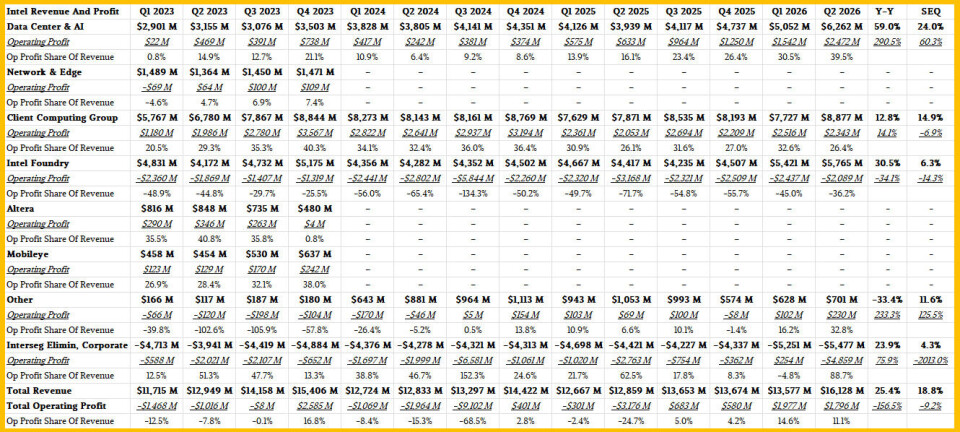
With that as a backdrop, let’s take a look at the numbers. Here is a monster table with the last few years of data:
And here is a chart for those of you who like to see trends in color:
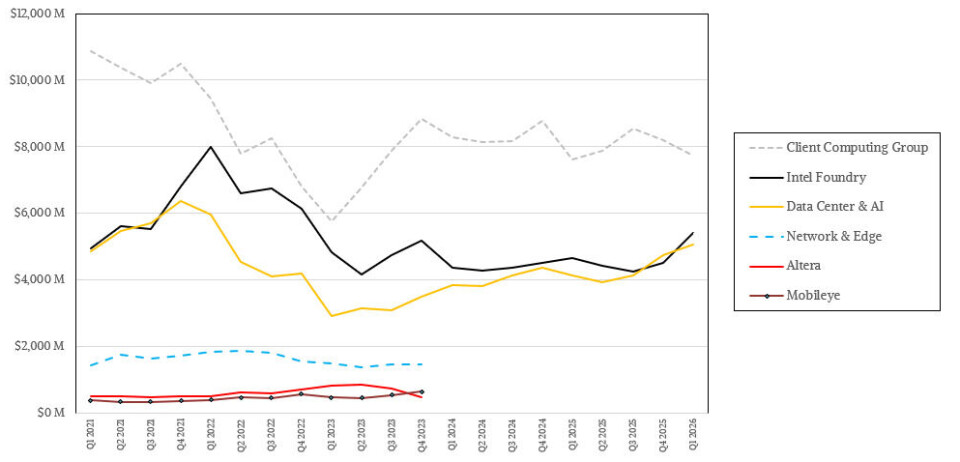
In the quarter, Intel’s Data Center & AI group had $6.26 billion in sales, up 59 percent year on year and up 24 percent sequentially. This is obviously a big spike. Operating profit for the DCAI group was up by a factor of 3.9X in the quarter, to $2.47 billion. This is 39.5 percent of revenues, a level of profitability that Intel has not seen for five years. It is still pretty far away from the 50 percent operating income that Intel used to have in its Data Center Group when X86 servers comprised almost all of server shipments and very nearly all of server revenues worldwide a decade and more ago.
The Intel Foundry group brought in $5.77 billion, up 30.5 percent as Intel’s desktop and server parts are ramping in volume. The foundry business did, however, post an operating loss of $2.09 billion, which is a 34 percent smaller operating loss from a year ago. Most of those revenues from inside of Intel, and external foundry customers only accounted for $293 million in Q2 2026. Intel’s 18A process ramp was 25 percent higher than Intel’s target in Q2 and was up more than 50 percent compared to Q1 2026. Intel saw yield improvements for its Intel 4, 3, and 18A processes during the quarter.
I like to track datacenter-related businesses for all of the public companies we track, which is easy now but which was more difficult when Intel was more complex with FPGA ad flash products as well as server chips, chipsets, motherboards, and once in a while whole systems. But this shows just how far Intel has fallen, and how it looks like it is climbing back out again.
In the past decade, Intel’s datacenter business peaked at $9.06 billion in Q2 2020, with $3.43 billion in operating income. Operating profits between 2009, when AMD was essentially driven out of the datacenter market, and 2015 floating between 45 percent and 50 percent of revenues.
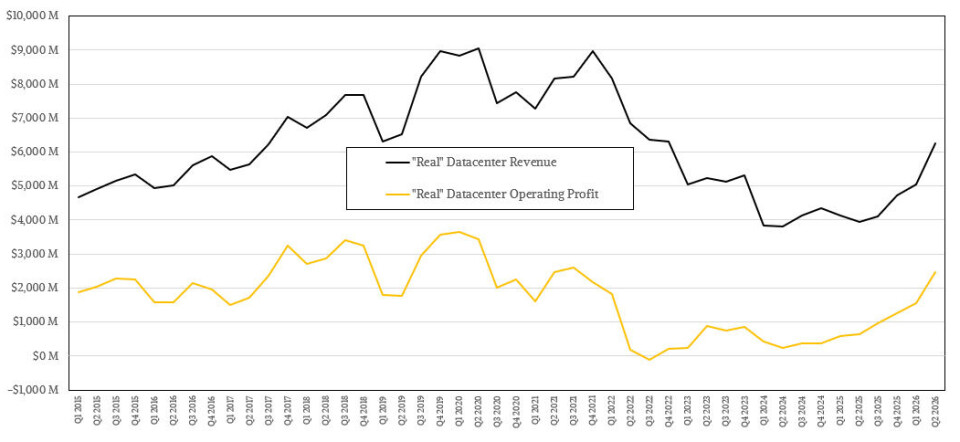
It will take Intel a bit of time to get back to those levels. But it is still possible.
