

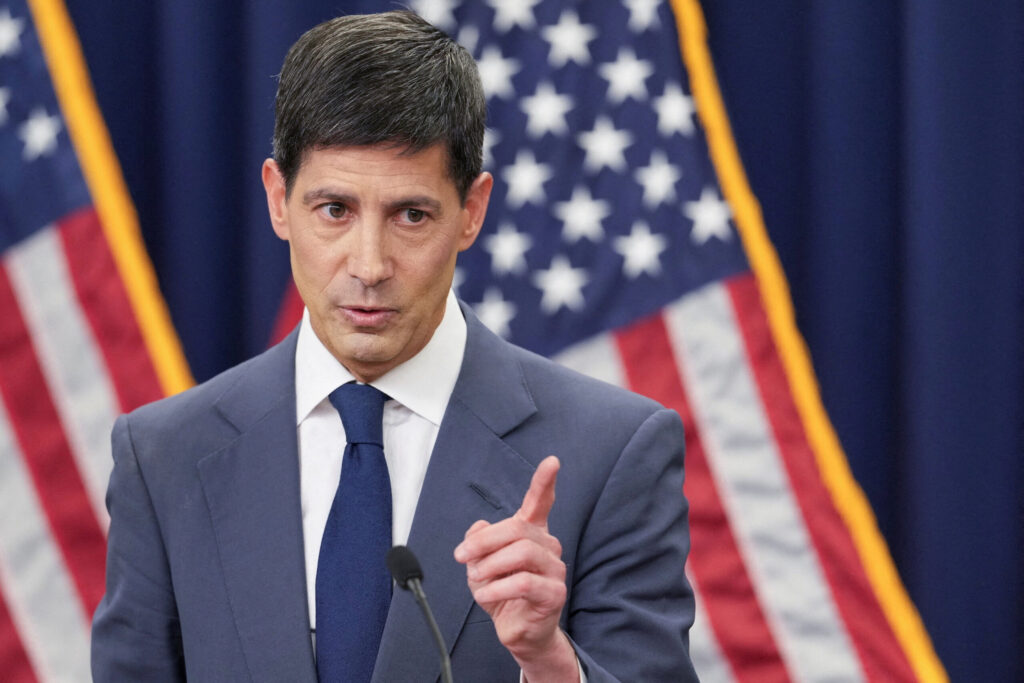

On Wednesday, Kevin Warsh—at his first press conference as Federal Reserve chair—pointed out that inflation in the United States has been “running well ahead” of the central bank’s 2-percent inflation goal.
Warsh has already moved fast to implement his desired policy “regime change” at the US central bank. For example, he shortened the Fed’s rate policy statement and opted to stop giving “forward guidance,” both of which signal to the public the future course of monetary policy. He also launched five task forces to study potential overhauls—yet he reasserted the Federal Open Market Committee’s unambiguous and unanimous commitment to price stability.
Warsh isn’t the only central bank leader contending with the challenge of meeting inflation-rate targets. More of the world’s largest central banks are missing their targets today than at any point since the height of the COVID-19 shock. The latest US consumer price index inflation rate sits at 4.2 percent—the highest in over three years—with Australia, Brazil, and the Eurozone not far behind. The United Kingdom had just gotten headline inflation within its target range in April before it spiked again in May. The European Central Bank is now raising interest rates for the first time since 2023 to pull eurozone inflation back toward 2 percent.
The Iran war has driven up inflation nearly everywhere. Brazil’s inflation rate had sat inside the central bank’s 1.5 to 4.5 percent band through April but is now surging through the top of that range; South Korean inflation is at its highest in two years, and according to the finance ministry would have been even higher if not for nationwide fuel price caps. While the Iran war explains the sudden rise in inflation, relying on this excuse obscures that there is potentially a long-term problem central banks will need to confront as they manage the long tail of this crisis.

Born of one crisis, strained by another
Inflation targeting is a relatively recent invention. The practice only became common in the 1990s, as central banks attempted to anchor inflation expectations and prevent another episode akin to the nearly-twenty-year Great Inflation, which had ended in the early 1980s. New Zealand led the way by setting low inflation, which it defined as 2 percent, as monetary policy’s sole medium-term objective. Other central banks soon followed, with Canada adopting a range with 2 percent as the midpoint in 1991 and the Bank of England in 1992. The Federal Reserve had been researching long-term inflation targets for two decades by the time it adopted the two percent goal in 2012.
But central banks are missing these goals at a concerning rate. The current moment marks the first time since October 2023 that at least nine of these fourteen banks have missed at once. Barring the shocks caused by COVID-19 and Russia’s full-scale invasion of Ukraine, the last time the world saw a comparable cluster of banks missing their targets was July 2016. But at that time, the problem was that inflation was too low, and this was before some of these banks even had symmetric targets, meaning that at the time, they saw undershooting the target as preferable to overshooting. And the last time this many central banks ran this far above their mandates was back in 2011, before the Fed or Bank of Japan had even adopted targets.
Credibility under pressure
The longer central banks miss these goals, the less grounded expectations will become. This raises an uncomfortable question: How long can central banks keep inflation expectations stable when they have spent years off the mark?
Well-anchored expectations of future price levels are critical in ensuring that the effects of short-term shocks do not become entrenched. If people believe that inflation will be high long term, they will act accordingly, raising prices and demanding higher wages; in the end, the expectation that inflation will be high could become the causal mechanism for its rise. Persistently deviating from stated mandates, especially while hinting at rate cuts, could signal to households and markets that inflation will not be returning to two percent soon.
But despite the closure of the Strait of Hormuz, headline inflation climbing, and COVID-era inflation still on people’s minds, long-run inflation expectations in the US have fallen. The University of Michigan’s five-to-ten-year measure of those expectations dropped to 3.4 percent this month from 3.9 percent in May. Yet the expectations are still far above the 2.8 to 3.2 percent range indicated in 2024. It seems the American public still half-believes that this most recent bout will pass.
This puts Warsh in a delicate situation. Of all the major changes he announced in his first press conference, he maintained a strong commitment to the Fed’s 2-percent target. But this hawkishness and the potential for rate hikes later this year will draw the ire of the president who nominated him to do just the opposite. A peace agreement with Iran will provide cover to hold rates steady, but price relief will not immediately flow through a reopened strait. Gasoline prices have a tendency to rocket up but only slowly float back down, fertilizer shortages will spill over into food prices, and lingering uncertainty means elevated prices will not dissipate immediately.
The long-term inflation outlook is unclear, but Warsh’s recent history of appeasing US President Donald Trump’s demands for rate cuts at any cost need not be prologue.
Jack Muldoon is a program assistant at the Atlantic Council’s GeoEconomics Center.
This post is adapted from the GeoEconomics Center’s weekly Guide to the Global Economy newsletter. If you are interested in receiving the newsletter, email JYin@atlanticcouncil.org.
Further reading

Wed, May 27, 2026
Don’t call it a G7 comeback
Econographics
By
Bart Piasecki
The G7’s equity rebound may look broad-based. In reality, it’s largely a tale of US tech dominance, driven by the “Magnificent Seven” and an extraordinary concentration of global market power.
Image: New US Federal Reserve Chairman Kevin Warsh holds a press conference following a two-day meeting of the Federal Open Market Committee at the US Federal Reserve in Washington, DC on June 17, 2026. Photo via REUTERS/Eric Lee.
