
LIVE NEWS
  • DeBriefed 17 April 2026: Fossil-fuel power slumps | ‘Super’ El Niño warning | Afghanistan’s climate struggle
  • Senior official ousted over Peter Mandelson security row to face MPs
  • Scientists say this type of olive oil could boost brain power
  • The Best Smart Home Accessories to Boost Your Curb Appeal (2026)
  • Trinidad and Tobago police uncover 56 bodies, mostly children, at cemetery | Crime News
  • The best TV antennas to buy in 2024
  • Look beyond Trump for the real story on US climate action
  • Obama meets Mamdani in New York City before reading to preschoolers
Prime Reports
  • Home
  • Popular Now
  • Crypto
  • Cybersecurity
  • Economy
  • Geopolitics
  • Global Markets
  • Politics
  • See More
    • Artificial Intelligence
    • Climate Risks
    • Defense
    • Healthcare Innovation
    • Science
    • Technology
    • World
Prime Reports
  • Home
  • Popular Now
  • Crypto
  • Cybersecurity
  • Economy
  • Geopolitics
  • Global Markets
  • Politics
  • Artificial Intelligence
  • Climate Risks
  • Defense
  • Healthcare Innovation
  • Science
  • Technology
  • World
Home»Science»Chinese lander reveals giant ‘cavity’ of radiation between Earth and the moon — and it could change how lunar exploration is done
Science

Chinese lander reveals giant ‘cavity’ of radiation between Earth and the moon — and it could change how lunar exploration is done

primereportsBy primereportsMarch 25, 2026No Comments5 Mins Read
Share Facebook Twitter Pinterest LinkedIn Tumblr Reddit Telegram Email
Chinese lander reveals giant ‘cavity’ of radiation between Earth and the moon — and it could change how lunar exploration is done
Share
Facebook Twitter LinkedIn Pinterest Email


Could being a “morning person” improve your health … on the moon? Scientists have identified what appears to be a “cavity” of reduced cosmic radiation near Earth’s moon. The finding could help lower astronauts’ exposure to harmful radiation on future lunar missions by timing some surface operations for local morning hours.

The discovery, based on data from China‘s Chang’e-4 lunar lander, suggests Earth’s magnetic field may affect distances in space farther than scientists previously expected. According to the researchers, the finding challenges the long-held assumption that galactic cosmic rays are roughly uniform throughout the space between Earth and the moon outside our planet’s protective magnetic field.

The study, published Wednesday (March 25) in the journal Science Advances, analyzed measurements from the Lunar Lander Neutron and Dosimetry experiment aboard Chang’e-4. Researchers reported a region of reduced galactic cosmic rays during the moon’s local morning, roughly a few hours after lunar sunrise.

Article continues below


You may like

Cosmic rays are among the biggest radiation hazards for astronauts traveling beyond low Earth orbit. These high-energy particles can penetrate spacecraft and human tissue, in turn damaging DNA and increasing the risk of cancer. With more crewed trips planned to the moon, starting with NASA‘s Artemis II mission launching as soon as April 1, researchers said a better map of radiation intensity could help mission planners reduce astronauts’ radiation exposure during surface explorations.

“The next landings will probably be in the polar regions,” which can be permanently sunlit, Robert Wimmer-Schweingruber, a professor at the Institute of Experimental and Applied Physics at Kiel University in Germany and a corresponding author of the study, told Live Science in an email. He said lunar morning appears to be the best time for excursions because it reduces the amount of radiation on astronauts’ skin by about 20% compared to average radiation levels on the moon.

Calculating cosmic rays

I had not expected to see this ‘shadow’ or cavity,

Robert Wimmer-Schweingruber, professor at the Institute of Experimental and Applied Physics at Kiel University

To find this cosmic-ray cavity, the researchers analyzed data collected over 31 lunar cycles from January 2019 to January 2022, focusing on quiet times in the solar cycle, when the measured space radiation was predominantly from galactic cosmic rays. They looked for repeated changes in Chang’e-4’s measured proton counts from the rays as the moon moved through different parts of its orbit around Earth.

The Lunar Lander Neutron and Dosimetry instrument recorded galactic cosmic ray protons in two energy ranges, which the researchers then grouped by lunar local time. They found that the lower-energy protons, in the 9.18 to 34.14 mega-electron-volt range, dropped by about 20% during the moon’s local morning, during the moon’s waxing gibbous phase (in the period between a new moon and a full moon) compared with later hours.

Get the world’s most fascinating discoveries delivered straight to your inbox.

Because the decrease showed up in a specific, recurring part of the moon’s waxing phase rather than across all times, the team inferred that the moon was passing through a real region of reduced cosmic ray radiation, which they believed was being created as Earth’s magnetic field blocked some high-energy protons. To investigate this idea, they ran simulations of the protons’ movement through the moon’s orbit and found the same cavity.

“I had not expected to see this ‘shadow’ or cavity,” Wimmer-Schweingruber said. “It makes absolute sense in retrospect, but I was very skeptical when I first saw this result,” and that’s why the team performed so many tests, he added.

Stretching Earth’s magnetic influence

The findings point to a new picture of how cosmic radiation behaves between Earth and the moon. Scientists had generally believed that, once galactic cosmic rays crossed Earth’s magnetosphere, they were spread fairly evenly throughout the Earth-moon space and were only minimally affected by Earth’s magnetic field.

“Basically this result means that the Earth’s magnetosphere influences space even beyond its extension,” Wimmer-Schweingruber said. The team expected Earth to affect the moon in the magnetotail, the long stream of magnetic field extending away from the sun on Earth’s nightside, he noted, but they did not predict the similar effect ahead of the magnetosphere on the sunward side

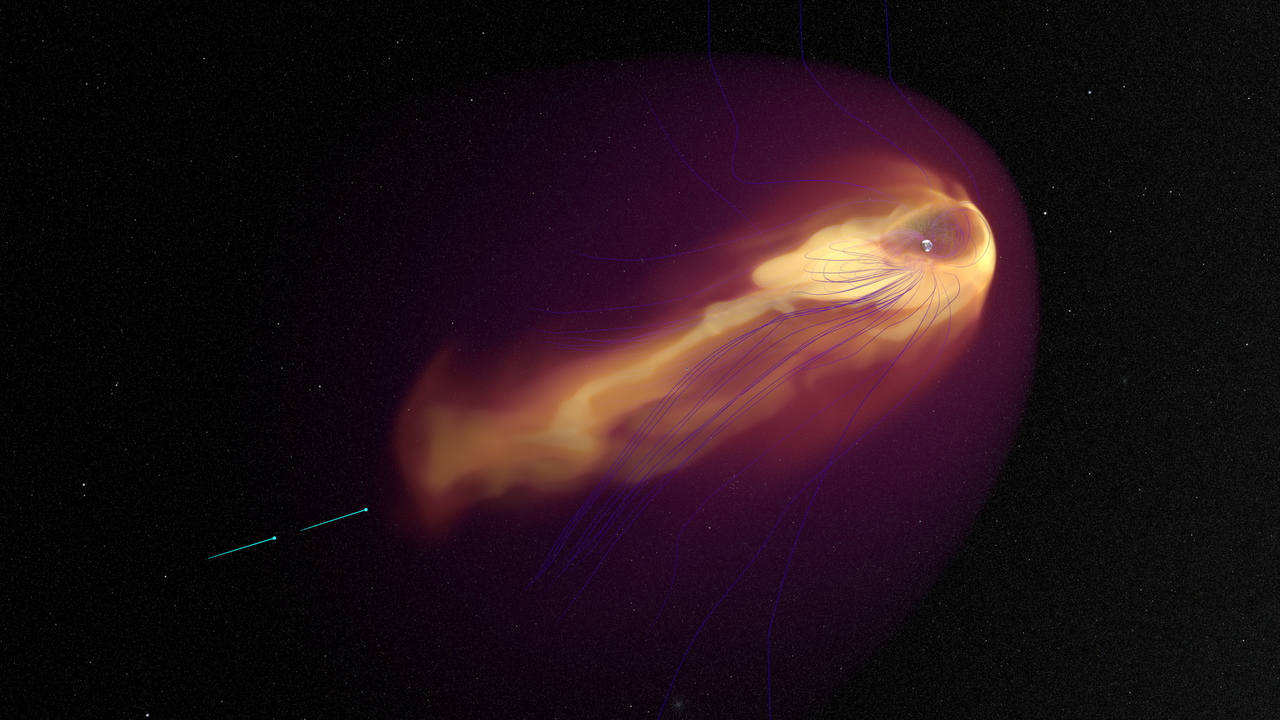
A visualization of Earth's magnetotail, as a ball of flowing light bubbles over the Earth and stretches to the bottom left of the image

A rendering of Earth’s magnetotail extending behind it, away from the sun. (Image credit: NASA’s Scientific Visualization Studio – ADNET Systems, Inc./AJ Christensen, Kyoto University/Yusuke Ebihara, University of California, Berkeley/Robert Lillis, eMITS/Vanessa Thomas, eMITS/Joy Ng, Public domain, via Wikimedia Commons)

Wimmer-Schweingruber said future studies with bigger datasets could better define the size and behavior of this cavity, which could help pave the way for a more practical era of lunar exploration. He suggested a familiar rule of thumb may apply for safer moon missions: It’s “best for astronauts to venture out onto the lunar surface in the local morning hours,” Wimmer-Schweingruber said — “just like for humans on Earth!”

Shang, W., Liu, J., Xu, Z., Yue, C., Guo, R., Xiao, C., Shi, Q., Wimmer-Schweingruber, R., Guo, J., William, D. A., Rankin, R., Tian, A., Zong, Q., Han, C., Park, J., Wang, H., Liu, W., Fu, S., Zhai, L. M., . . . Chen, T. (2026). A galactic cosmic ray cavity in Earth-Moon space. Science Advances. 12(1), eadv1908. www.science.org/doi/10.1126/sciadv.adv1908


Moon quiz: What do you know about our nearest celestial neighbor?

Share. Facebook Twitter Pinterest LinkedIn Tumblr Email
Previous ArticleTrump vows accountability for those who pursued him in court cases
Next Article AI adoption should protect human communication and judgement
primereports
  • Website

Related Posts

Science

Electric vehicle owners could earn thousands by supporting power grid

April 18, 2026
Science

700-year-old mummy from Bolivia contains earliest confirmed evidence of strep throat bacteria in the Americas

April 18, 2026
Science

Science behind the scenes

April 18, 2026
Add A Comment
Leave A Reply Cancel Reply

Top Posts

Global Resources Outlook 2024 | UNEP

December 6, 20258 Views

The D Brief: DHS shutdown likely; US troops leave al-Tanf; CNO’s plea to industry; Crowded robot-boat market; And a bit more.

February 14, 20264 Views

German Chancellor Merz faces difficult mission to Israel – DW – 12/06/2025

December 6, 20254 Views
Stay In Touch
  • Facebook
  • YouTube
  • TikTok
  • WhatsApp
  • Twitter
  • Instagram
Latest Reviews

Subscribe to Updates

Get the latest tech news from FooBar about tech, design and biz.

PrimeReports.org
Independent global news, analysis & insights.

PrimeReports.org brings you in-depth coverage of geopolitics, markets, technology and risk – with context that helps you understand what really matters.

Editorially independent · Opinions are those of the authors and not investment advice.
Facebook X (Twitter) LinkedIn YouTube
Key Sections
  • World
  • Geopolitics
  • Popular Now
  • Artificial Intelligence
  • Cybersecurity
  • Crypto
All Categories
  • Artificial Intelligence
  • Climate Risks
  • Crypto
  • Cybersecurity
  • Defense
  • Economy
  • Geopolitics
  • Global Markets
  • Healthcare Innovation
  • Politics
  • Popular Now
  • Science
  • Technology
  • World
  • About Us
  • Contact Us
  • Privacy Policy
  • Terms & Conditions
  • Disclaimer
  • Cookie Policy
  • DMCA / Copyright Notice
  • Editorial Policy

Sign up for Prime Reports Briefing – essential stories and analysis in your inbox.

By subscribing you agree to our Privacy Policy. You can opt out anytime.
Latest Stories
  • DeBriefed 17 April 2026: Fossil-fuel power slumps | ‘Super’ El Niño warning | Afghanistan’s climate struggle
  • Senior official ousted over Peter Mandelson security row to face MPs
  • Scientists say this type of olive oil could boost brain power
© 2026 PrimeReports.org. All rights reserved.
Privacy Terms Contact

Type above and press Enter to search. Press Esc to cancel.