

WASHINGTON—The 2026 Atlantic Council Global Energy Forum arrived at a pivotal moment. Entering the year, many of us expected affordability and competitiveness to dominate the energy conversation, particularly as policymakers in the United States turn their attention toward consequential midterm elections. Those issues have certainly featured prominently. But events in the Middle East have reordered global priorities, leading to the defining takeaway from this year’s forum: Energy security is once again at the top of the global agenda—to an extent that hasn’t been the case since at least the energy crises of the 1970s.
The conflict with Iran has underscored energy’s centrality to modern life; the interconnected nature of global energy markets; and the inseparability of peace, prosperity, and energy. As has been abundantly evident with disruptions to shipping through the Strait of Hormuz, what happens in one region can immediately affect energy access, prices, and supply chains around the world.
Over the forum’s two days, more than 1,500 participants from ninety countries gathered in Washington, DC for fifty-two public sessions, twenty-four private sideline events, and countless bilateral meetings and informal conversations. That included more than fifty C-suite executives and thirty-four government leaders from around the world, while more than 6,100 viewers participated virtually. It was the largest single convening in the Atlantic Council’s sixty-five-year history. But the forum’s impact has never been measured by size alone. Its value lies in its ability to bring together leaders from government, industry, finance, and civil society to build a common understanding of the challenges ahead and identify pathways toward actionable solutions moving forward.
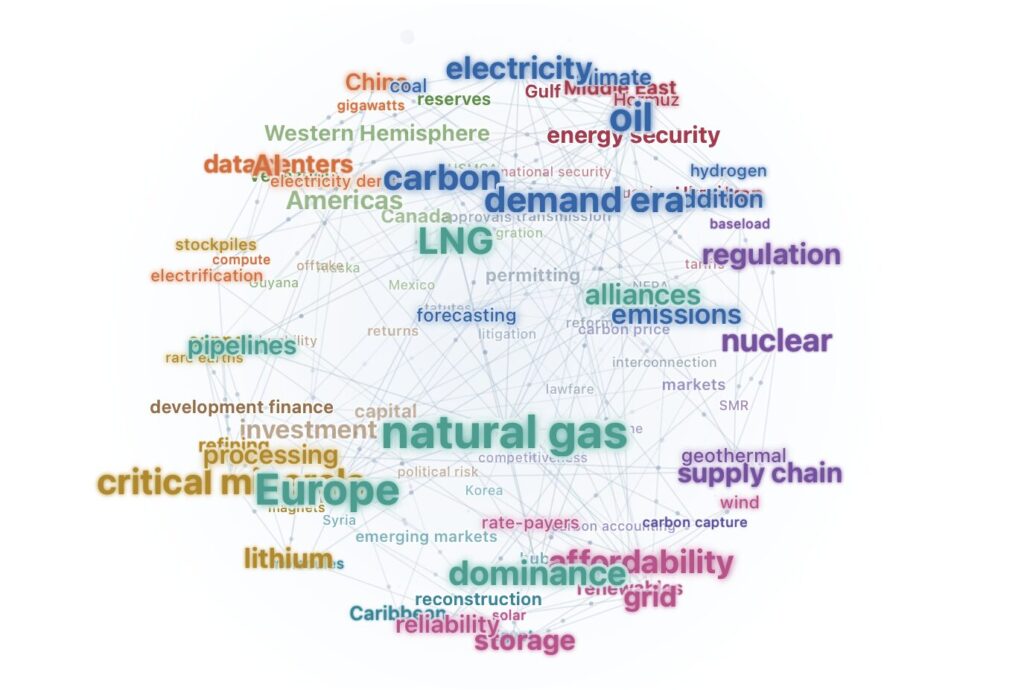
To capture the insights generated at the forum and share them widely, we partnered with the artificial-intelligence platform BanterBox to create an AI-assisted distillation of the toplines from more than thirty hours of forum programming, shaped and vetted by Atlantic Council experts.
Click to launch the AI-powered summary

The synthesis surfaced twelve overarching themes that defined this year’s discussions with the world’s leading energy experts, policymakers, and industry leaders—from the return of energy security and the rise of a new era of energy demand to the growing geopolitical importance of artificial intelligence, critical minerals, and resilient supply chains. Together, they reinforced the takeaway that economic competitiveness, technological leadership, and geopolitical stability now depend on the secure, abundant, and affordable flow of energy.
On the ground at the forum, one of the most memorable moments came when Shaikh Nawaf Al-Sabah, the deputy chairman and chief executive officer of the Kuwait Petroleum Corporation, discussed the uncertainty facing the Middle East and the security concerns confronting countries such as Kuwait. His message was clear: Countries across the region seek strong partnerships with the United States to safeguard regional stability because protecting the free flow of energy through strategic chokepoints such as the Strait of Hormuz is necessary not only for regional security, but for the health of the global economy as well.
And as the Forum demonstrated, now is not the time to be short energy. The world is entering an entirely new era of energy demand. Artificial intelligence, electrification, advanced manufacturing, and digital infrastructure are dramatically increasing the need for reliable and affordable energy systems. Critically, nations capable of building and deploying that infrastructure quickly and at scale will enjoy significant economic and strategic advantages in the years ahead.
Given that emerging reality, we cannot allow today’s crisis to distract from the actions required to secure tomorrow’s prosperity. Permitting reform, resilient critical-mineral supply chains, and the workforce needed to build diverse energy systems remain essential if the United States and its partners are to compete effectively in an increasingly AI-driven world and maintain a strategic advantage over their adversaries. These priorities did not become any less important as tensions with Iran escalated; if anything, they became more urgent.
The world no longer has the luxury of treating energy security and competitiveness as separate conversations. They are one and the same. Energy security is not a competing priority alongside affordability, technological leadership, and economic growth; it is the foundation upon which all of them rest.
