

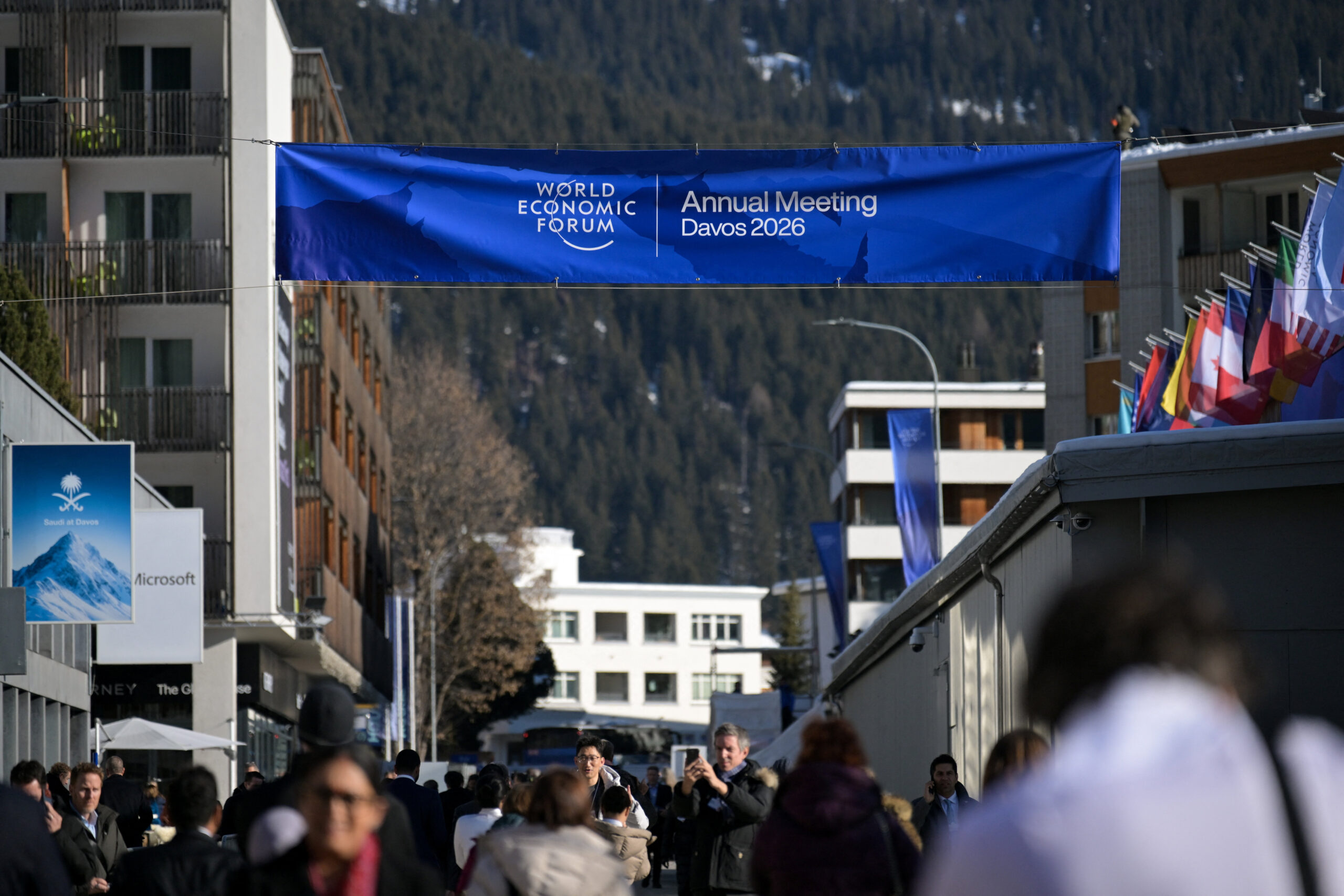
DAVOS—This week Davos, Switzerland, returns to being a charming ski town. The shops and restaurants—temporarily rented by every major tech company on the planet to host events and receptions—return to their owners and will soon be filled with tourists on holiday.
But what happened at the 2026 World Economic Forum won’t soon be forgotten. This was the year the forum changed policy. As one attendee told us on her way off the mountain, “Imagine what would have happened this week if Trump didn’t have to meet the Europeans face to face.” It’s an intriguing, if chilling, thought.
While Trump’s speech this past Wednesday and his subsequent decision to backtrack on Greenland threats drove the roller coaster news cycle of the week, there were several other notable moments that may have much longer term—and more important—policy repercussions. Here’s what we saw on the ground:
The two Davoses
Davos is always two different things at once. “Business Davos” is the place where executives huddle in Swiss office buildings negotiating deals far away from the TV cameras. This is, actually, what brings most people to the mountain year after year. That Davos traditionally operated independently from “geopolitical Davos.” That’s the Davos most people are familiar with—leaders from around the world speaking in the Congress Center, and academics, journalists, and think tankers debating on panels.
Most years, those two Davoses can operate in their own spheres. But not this year. Last Monday, as markets swung sharply negative on the Greenland news, business Davos had its eyes glued to the Congress Center. Leaders of some of the largest companies in the world lined up and waited just like everyone else to get a seat. Suddenly, everyone was an expert on Nuuk, the Arctic, and whether military leases were a viable compromise. It was a reminder of a big lesson of the past few years—from the COVID-19 pandemic to Russia’s invasion of Ukraine—that finance and national security are deeply interconnected. In fact, there’s a good word for that—geoeconomics.
The new reality of tariffs
One year ago Davos attendees watched Trump’s inaugural address and then listened to him virtually address the forum. He hardly said the word “tariffs” once between the two speeches, and the delegates decided that his threats during the campaign were just threats. What a difference a year makes. After twelve months of the biggest shock to the global trading system in decades, which left the world facing the long-term prospect of the US economy having a 10 percent or higher tariff rate, reality settled in on the mountain. Gone was the optimistic talk about how deregulation was going to lead to an investment boom. In its place was chatter about finding new trade arrangements with emerging markets, and forecasting what would happen if the Supreme Court rules against Trump in the tariff case.
The risk and rewards of artificial intelligence
Few topics were more in the air in Davos than artificial intelligence (AI). Almost every billboard and storefront had a reference to AI—whether for supply-chain efficiency or content creation. On the surface, businesses wanted to project confidence, with AI positioned as the engine of future growth. But step inside these company events and a different picture emerged. Many featured chief risk officers or chief ethics officers, titles that barely existed a few years ago, grappling with questions around the different types of “risks,” whether those were geopolitical risks, economic risks, or climate risks. There was a stark contrast between the glossy AI optimism outside and the sober risk assessment on the inside of these conversations, and a reminder that for all the promise of growth, the industry knows the hard questions are just beginning.
More than a transatlantic affair
On the main stage and in the global news cycle, this Davos felt like a US–Europe affair. Tariffs announced and abandoned on European allies. French President Emmanuel Macron responding directly. US Treasury Secretary Scott Bessent outlining the health of the US economy. California Governor Gavin Newsom sparring rhetorically with Washington. For audiences watching from afar, it was easy to conclude this was a narrow, transatlantic Davos.
On the ground, however, the picture was far more global. Brazil House, India House, Indonesia House, and a dozen country pavilions were packed with programming all day. A large Pakistani delegation arrived on its own official shuttle bus. Philippines House ran cultural programs, including concerts featuring traditional music, alongside policy panels.
India, in particular, projected quiet confidence. Officials framed the country as a durable pillar of global growth, especially on AI. China maintained a low profile, with Chinese Vice Premier He Lifeng offering brief remarks about Beijing’s willingness to buy more foreign goods and services—a notably muted presence compared to previous years.
Yet the US footprint on the promenade was impossible to miss. The US delegation was one of the largest in Davos, anchored by a sprawling USA House with a dense schedule of events and receptions. From the number of officials and security on the ground to the symbolic bald eagle overlooking the promenade, the message was clear: US influence loomed over nearly every discussion. For all the activity in country pavilions, this remained a global forum shaped by great-power rivalry.
From Canada, a clarion call
Canadian Prime Minister Mark Carney delivered one of the most consequential addresses during Davos, declaring that the post–Cold War rules-based international order is “in the midst of a rupture, not a transition.” Carney argued that great-power rivalry, economic coercion, and unilateral actions by dominant states (not mentioning Trump by name) have weakened longstanding global norms and institutions. He called on middle powers to work together to protect their interests and build new cooperative frameworks rooted in shared values. Simply going along to get along is no longer the answer, he argued. Whether other middle powers respond to that message may be the single most important question from this year’s forum.
Descending the mountain
As delegates packed their bags and headed down the mountain, few were under any illusions. The convergence between business Davos and geopolitical Davos is the new reality. The tightrope that companies are walking is not getting any less precarious. And the question of whether economic cooperation can survive an era of rising geopolitics remains very much unanswered.
