

The late ’90s were an exciting time for tech enthusiasts, with new and experimental gadgets appearing constantly. Looking back now, it’s easy to remember early portable storage media like floppy disks, CDs, and flash drives. But that’s because those are the devices that won the war, at least for a little while. A plethora of other storage technologies helped mold the industry into what it is today, but many of them were so short-lived that their impact is easy to overlook.
Iomega’s Clik! Drive fits right into that category. If you were following emerging storage mediums near the turn of the millennium, you may remember it. But if you don’t, it’s probably because Clik never managed to gain a proper footing, and its viability evaporated shortly after its debut. Around this time, Iomega had already made a name for itself with the popularity of its Zip drive that was released a few years prior. Although Zip drives had greater capacity, they were too bulky for laptops or cameras, and Iomega was looking for a way to break into the fledgling portable devices market.
Flash memory cards like CompactFlash and SmartMedia existed, but their price put them out of reach for a lot of consumers in 1999. A 40MB flash card could set you back $120 to $160, while a Clik! disk held the same 40MB for about $10. The drive could fit into a PCMCIA (PC Card) slot and sit flush with the side of a laptop, which was a big deal in 1999. It’s weird to think about using a spinning disk for camera storage, but Iomega’s pitch was that users could offload their camera’s stored photos onto a Clik! Disk while out shooting. A nice idea on paper, but a naming blunder and poor timing led to its swift demise.
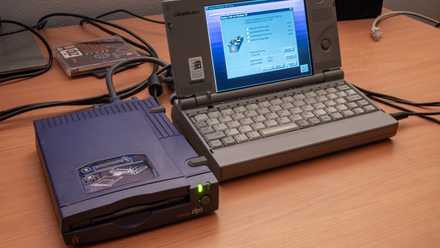
Why Zip drives dominated the 90s, then vanished almost overnight
A major flaw brought this promising format to its end
Iomega chose a disastrously bad name
A lawsuit made the word “click” infamous in the tech world

Iomega really could not have picked a worse name for their product. A year before Clik’s premiere, Iomega was hit with a class-action lawsuit for the widespread “click of death” failures in their Zip drives. That’s right, the phrase “click of death” originated here, before being ascribed to failing IDE hard disks. It’s a horrible sound ingrained in the memory of anyone who has ever had a traditional spinning-platter hard drive longer than 10 years (sometimes way less). There’s a soundbite of a clicking Zip drive on Wikipedia, which is liable to trigger latent PTSD for anyone that’s owned older storage media long enough to hear one fail.
As you can imagine, naming your novel storage medium “Clik!” amid the popularization of the phrase “click of death” isn’t a great way to sell drives. It quickly became synonymous with any defective drive, and the dreadful sound of its impending failure. Iomega rebranded the product to “PocketZip” the following year. Believe it or not, the naming mishap only played a comparatively small role in its lack of success, though it certainly gave prospective buyers an additional reason to avoid purchasing it.
The real reason Clik! failed spectacularly
No one wanted to adopt it with flash on the rise

It’s easy to understand Iomega’s previous success with their Zip drives. It filled a genuine gap in the storage market. The drives looked and operated like floppy disks, but instead of 1.44MB of storage, they offered 100MB. The industry was quick to adopt the technology because it was a no-brainer. Unfortunately for Iomega, they were unable to replicate the same success with Clik, especially as flash storage prices were already falling fast.
Clik! drives had moving parts, and couldn’t compete in a market that was shifting to solid state storage. The cheaper price point kept the product afloat for a couple of years, but the format never enjoyed widespread adoption, and Iomega ultimately killed it off completely by 2002. These days, it barely makes it into the footnotes of computer storage history.
Iomega attempted to get camera and MP3 player manufacturers to implement the technology, but they weren’t biting. Everyone could see where the storage market was heading, and it wasn’t toward another bulky format with moving parts. Iomega did get Agfa to release a camera model that utilized the format, the Agfa ePhoto CL30 Clik! This was one of the only commercial products to feature Clik, along with Iomega’s own MP3 player, the HipZip. They came and went as fast as the format itself. This marked the beginning of the end for Iomega, which was eventually acquired by EMC in 2008 and faded from relevance shortly after.
Clik! was a solution to a problem that didn’t exist
None of Iomega’s products ever mirrored the success of its Zip drive. Iomega needed the camera industry to cooperate with its Clik! drive the same way the PC industry had a few years before with Zip drive. The manufacturer mistakenly believed it could go toe-to-toe with flash cards, but flash won by a landslide, and persists as the dominant storage medium to this day, being used in SSDs, USB drives, SD cards, smartphones, and other devices.
I don’t think Clik! was a bad product. It came with a cost advantage at the time, and its implementation was clever. I attribute its downfall to Iomega’s attempt to solve a problem that was already in the process of solving itself. Flash memory was on an unstoppable trajectory when Clik! arrived, making it easy to predict Clik’s imminent obsolescence from the start.
