

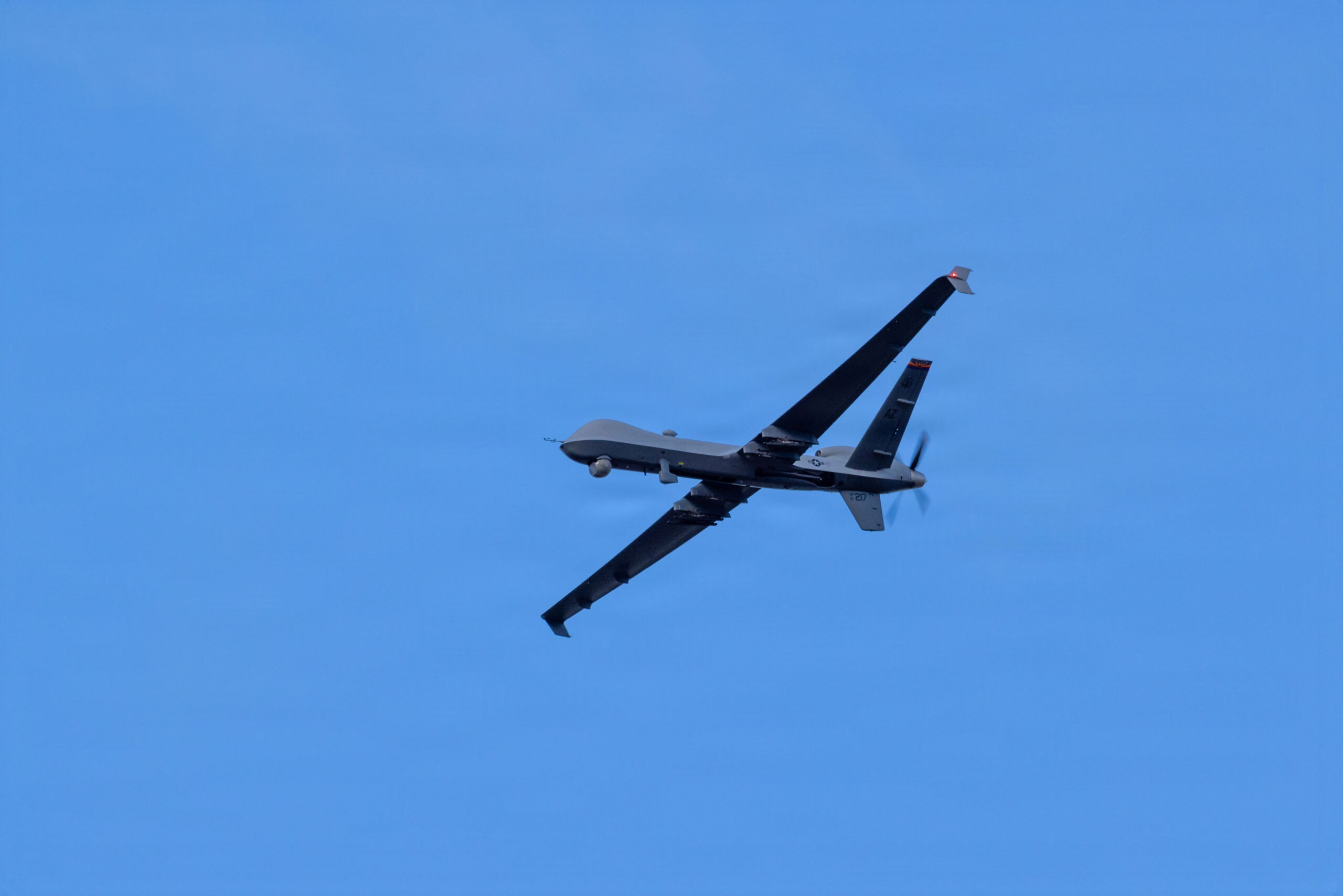
Combat video from MQ-9 Reaper remotely piloted aircraft (RPA) striking targets in Iran may have surprised those who thought the iconic unmanned aircraft were destined for retirement now that the wars in Iraq and Afghanistan are behind us.
The Reapers are neither stealthy nor fast and therefore seen as unsurvivable against adversaries with sophisticated air defense systems. Yet just as surprisingly, the loss of Reaper aircraft to Iranian air defenses in Operation Epic Fury tells a different story. Indeed, the MQ-9s offer insights as the Air Force develops the next generation of unmanned planes: collaborative combat aircraft (CCA).
Originally developed as intelligence, surveillance, and reconnaissance planes, the Reaper has evolved into a unique sensor-shooter. Without life support systems and a human pilot aboard, mission endurance extends to 24 hours and beyond. The pilots and sensor operators operating these aircraft remotely work in shifts, so they don’t face excessive fatigue. They can remain on station for hours on end waiting for a target to show itself. What’s more, RPAs can take risks that inhabited systems would not.
Similarly, CCAs are not replacements for piloted combat jets, which fly faster, are more maneuverable and survivable than RPAs, and can carry larger payloads deeper into enemy territory than something like the MQ-9. Fifth- and sixth-generation fighters feature unparallelled information processing, stealth, and advanced electronic warfare functions enabling them to deliver distinctive combat effects.
But what really sets inhabited fighters apart is the superior human cognition of highly trained pilots and aircrew specialists. Comparing the advantages of unmanned aircraft against these systems is simplistic. The fact is, we need both.
It’s no accident that B-2s, F-22s, and F-35s were employed during Operation Midnight Hammer last June. They were the best tools for the mission based on their unique capabilities.
Notably, when Operation Epic Fury kicked off in late February, MQ-9s were reportedly among the first aircraft over Iranian territory—the best option to watch for and target Iran’s mobile missile and drone launchers as they emerged from hidden locations. Over long and challenging sorties, the Reapers’ ability to loiter for hours enabled these shooters to destroy targets that crewed aircraft might never have found.
MQ-9s yielded perhaps the most successful hunt in history for mobile missiles and drones, dramatically degrading Iran’s capacity to strike back. The Reapers persistently denied the enemy sanctuary.
True, a number of Reapers were shot down during Epic Fury—but here, too, the story is not a bad one. The longer any aircraft remains on station, the greater the risk that it might be shot down. With an RPA, however, there is an advantage: no pilot to be rescued in the event of a shootdown. Rescue missions are complex, dangerous, and resource intensive. Consider the dramatic and successful recovery of the F-15E crew in Iran in early April. Using MQ-9s throughout the campaign helped ensure an aircrew at risk behind enemy lines was a one-off event during weeks of war.
Looking beyond Epic Fury, the use of MQ-9s over Iran also points to how tomorrow’s autonomous CCAs can be employed in the future. CCAs are intended to complement fifth- and sixth-generation fighters to make them more effective against countermeasures and enhance their capability as hunter-killers.
Having both an F-22 to dominate the sky and an MQ-9 that can persist to attack fleeting targets provides options at the tactical, operational, and strategic levels. Likewise, CCAs should be developed to leverage the strengths unique to the uninhabited paradigm, rather than to merely mimic those of crewed fighters. Think of it like a basketball team: While a star center and star point guard are both valuable, teams would fail if they tried to play with five centers or five point guards. It takes a diversity of attributes to build a strong team.
CCA strengths will likely center on affordable mass, risk-reduction, interoperability, and multi-mission payload flexibility. To achieve these, they will need to leverage open architectures, software-defined design, digital engineering, and rapid, iterative development. Crewed fighters, by contrast, will center on their strengths, beginning with human cognition, superior maneuverability, high performance subsystems, stealth, teaming, and more.
As we look to the future, the U.S. must not lose its edge in superior unmanned aircraft. MQ-9s and successor CCAs will be needed well into the future. Indeed, the Air Force should backfill combat losses today with more advanced and capable MQ-9Bs to ensure the has the aircraft inventory to meet national security requirements. The MQ-9B production line is hot, so the time to buy is now.
At the same time, the Air Force must continue to robustly invest in next-generation CCAs and manned aircraft, systems that promise high-end combat capacity against advanced threats. Working as a team, each will bring different strengths to the fight, providing
commanders with more options with which to defeat a growing range of threats against the interests of the United States and our allies.
