
LIVE NEWS
  • The lamentable state of British defence acquisition
  • One of the sky’s rarest phenomena is back — How to see rare night-shining clouds this summer
  • A maritime drone explodes at a Romanian Black Sea port, no one hurt
  • A stablecoin tied to Strategy stock depegs putting a new DeFi dollar risk in focus as Bitcoin sells off
  • Rust-Written IronWorm Hits NPM Supply Chain
  • Panini stickers, a World Cup tradition, sees biggest demand yet in the U.S. : NPR
  • As Global Demand for Gold Grows, UN Mercury Head Warns Toxic Fumes Put Women in a Motherhood Dilemma — Global Issues
  • XAU/USD languishes below $4,480 with US Nonfarn Payrolls on tap
Prime Reports
  • Home
  • Popular Now
  • Crypto
  • Cybersecurity
  • Economy
  • Geopolitics
  • Global Markets
  • Politics
  • See More
    • Artificial Intelligence
    • Climate Risks
    • Defense
    • Healthcare Innovation
    • Science
    • Technology
    • World
Prime Reports
  • Home
  • Popular Now
  • Crypto
  • Cybersecurity
  • Economy
  • Geopolitics
  • Global Markets
  • Politics
  • Artificial Intelligence
  • Climate Risks
  • Defense
  • Healthcare Innovation
  • Science
  • Technology
  • World
Home»Science»I’ve witnessed nearly 100 rocket launches. Artemis II was like nothing I’ve ever experienced.
Science

I’ve witnessed nearly 100 rocket launches. Artemis II was like nothing I’ve ever experienced.

primereportsBy primereportsApril 4, 2026No Comments4 Mins Read
Share Facebook Twitter Pinterest LinkedIn Tumblr Reddit Telegram Email
I’ve witnessed nearly 100 rocket launches. Artemis II was like nothing I’ve ever experienced.
Share
Facebook Twitter LinkedIn Pinterest Email


Freelance space writer Roger Guillemette has witnessed close to 100 rocket launches since 1975. On Wednesday (April 1), he was on the ground at NASA‘s Kennedy Space Center, reporting live on the Artemis II moon launch for Live Science. Here’s what he saw at the historic liftoff:

There was palpable excitement at the Kennedy Space Center (KSC) press site for the Artemis II launch, unlike anything I’ve experienced in my many years of reporting on human spaceflight from this iconic location.

Journalists from all over the world — both grizzled veterans and wide-eyed newcomers — were positively giddy about witnessing astronauts returning to the moon after so many decades.


You may like

Bright television lights glowed atop the news organization trailers along “media row” as the major networks assembled their A-teams to cover the landmark event. Morning and evening national newscasts originated from KSC, with the Vehicle Assembly Building’s huge American flag and NASA “meatball” logo (first unveiled in 1959) serving as a dramatic backdrop. What was old suddenly felt new again.

Those of us on the older end of the age spectrum have fuzzy, fading memories of the Apollo era. For me, the historic Apollo 11 lunar landing mission in July 1969 filled the week of my 10th birthday; a few years later, in December 1972, a buddy and I “camped out” in his finished basement, watching color (!) television until after midnight to see Apollo 17 light up the heavens over Florida’s Space Coast on what would be the final crewed voyage to the moon for 50 years and counting.

You don’t simply watch the mighty rocket rise — you feel it, shaking the ground beneath you, its powerful, staccato thumping reverberating through your chest.

After those heady years of the “moon race,” the closest experience to Artemis II for me was the first flight of the space shuttle Columbia, STS-1, in April 1981. As a college senior, I stood just a few hundred yards from the spot where I watched Artemis II, witnessing a brand-new, never-flown space plane soar skyward into the dawn. I remember watching Columbia leap off the launchpad while I softly whispered, “Go, go,” with tears welling in my eyes. I found myself unconsciously doing the same for Artemis II (now with a few added colorful epithets).

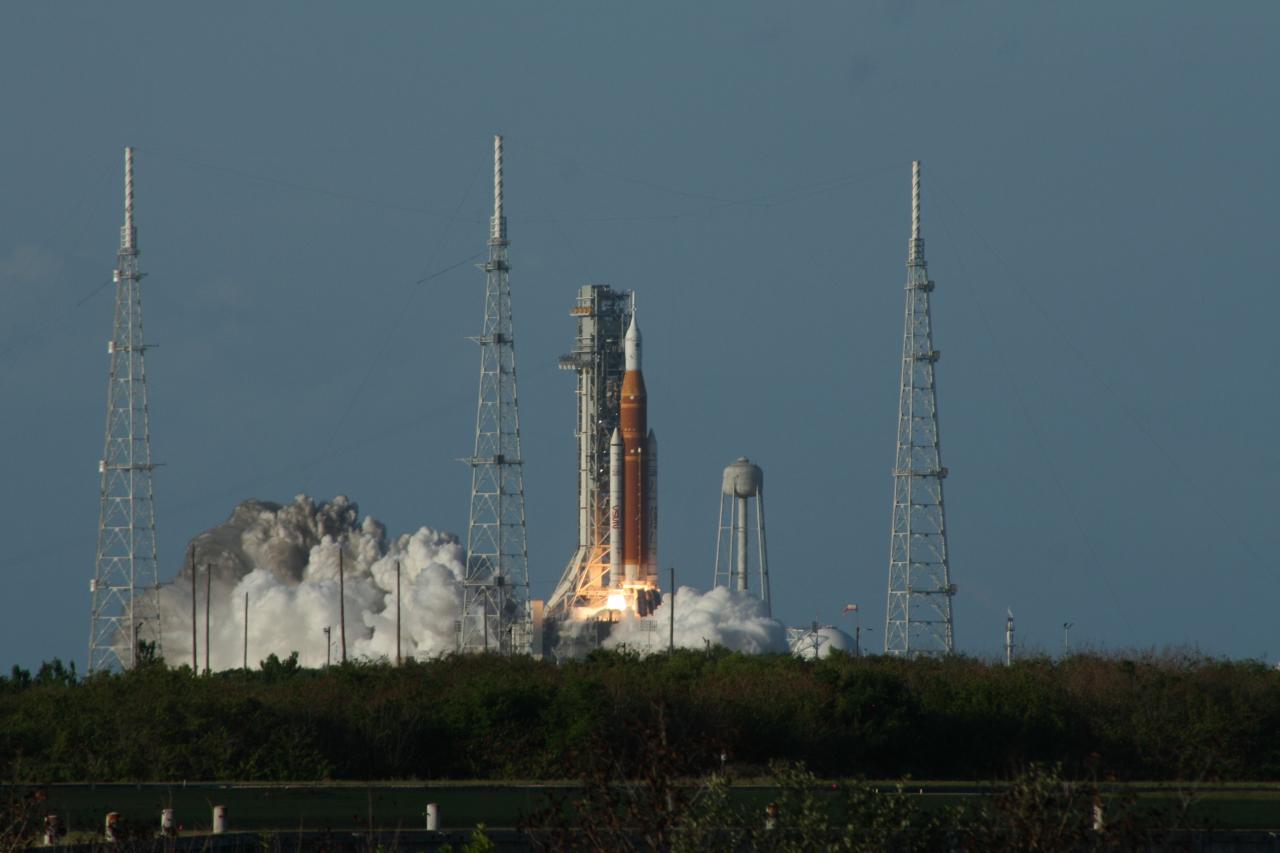
An orange and white rocket blasts off a launchpad, billowing gray smoke behind it.

A view of the Artemis II rocket as it leaves the launchpad. (Image credit: Roger Guillemette)

Artemis II’s launch was impossibly bright to witness in person. Still images or video simply do not capture the sheer brilliance and intensity of the Space Launch System‘s ignition and liftoff. Seeing the brilliant white-orange plume concentrate beneath the rocket was like looking at the sun itself, and it appeared much more dazzling than any space shuttle launch I ever witnessed. You don’t simply watch the mighty rocket rise — you feel it, shaking the ground beneath you, its powerful, staccato thumping reverberating through your chest.

Get the world’s most fascinating discoveries delivered straight to your inbox.

More than five decades after Apollo 17 astronauts Gene Cernan and Harrison “Jack” Schmitt reluctantly departed the spectacular rolling hills and massive boulders of the lunar valley known as Taurus-Littrow, the United States (with its international partners) is once again taking the bold steps to continue exploring the strange new world it abandoned generations ago.

The goal has always been in sight. On a clear winter night, it rides high in the heavens, bringing light to barren, snow-covered landscapes. On a cool autumn evening, it hangs impossibly large on the eastern horizon, casting a warm orange glow on farmers and stargazers alike — each witness sharing the feeling that they can almost reach up and touch it.

Almost.

The goal has never been out of sight. It beckons us all to stop and renew an old acquaintance: our neighbor, the moon.

Roger Guillemette at NASA Kennedy on April 1

Roger Guillemette at NASA’s Kennedy Space Center on April 1. (Image credit: Roger Guillemette)

Think you know about the moon? Test your smarts with our moon quiz!

Share. Facebook Twitter Pinterest LinkedIn Tumblr Email
Previous ArticleWhat we know so far
Next Article Trump seeks to double number of ship requests with 2027 defense budget
primereports
  • Website

Related Posts

Science

One of the sky’s rarest phenomena is back — How to see rare night-shining clouds this summer

June 5, 2026
Science

‘They surprise me every time’: bees can use tools to solve problems, study finds | Bees

June 4, 2026
Science

Musk's SpaceX share sale: Four things you need to know

June 4, 2026
Add A Comment
Leave A Reply Cancel Reply

Top Posts

Paxton’s win over Cornyn sets up high-stakes Texas clash with Talarico

May 28, 202616 Views

Global Resources Outlook 2024 | UNEP

December 6, 202510 Views

Texas Democrat Talarico claims voting laws are rigged ahead of Paxton race

May 28, 20269 Views
Stay In Touch
  • Facebook
  • YouTube
  • TikTok
  • WhatsApp
  • Twitter
  • Instagram
Latest Reviews

Subscribe to Updates

Get the latest tech news from FooBar about tech, design and biz.

PrimeReports.org
Independent global news, analysis & insights.

PrimeReports.org brings you in-depth coverage of geopolitics, markets, technology and risk – with context that helps you understand what really matters.

Editorially independent · Opinions are those of the authors and not investment advice.
Facebook X (Twitter) LinkedIn YouTube
Key Sections
  • World
  • Geopolitics
  • Popular Now
  • Artificial Intelligence
  • Cybersecurity
  • Crypto
All Categories
  • Artificial Intelligence
  • Climate Risks
  • Crypto
  • Cybersecurity
  • Defense
  • Economy
  • Geopolitics
  • Global Markets
  • Healthcare Innovation
  • Politics
  • Popular Now
  • Science
  • Technology
  • World
  • About Us
  • Contact Us
  • Privacy Policy
  • Terms & Conditions
  • Disclaimer
  • Cookie Policy
  • DMCA / Copyright Notice
  • Editorial Policy

Sign up for Prime Reports Briefing – essential stories and analysis in your inbox.

By subscribing you agree to our Privacy Policy. You can opt out anytime.
Latest Stories
  • The lamentable state of British defence acquisition
  • One of the sky’s rarest phenomena is back — How to see rare night-shining clouds this summer
  • A maritime drone explodes at a Romanian Black Sea port, no one hurt
© 2026 PrimeReports.org. All rights reserved.
Privacy Terms Contact

Type above and press Enter to search. Press Esc to cancel.