

If you have purchased a laptop in the last few years or even explored available options, you must have noticed how all companies like Apple, Dell, Lenovo, and Asus are pushing thinner laptops. Marketed as sleek, slim, ultra-thin, or lightweight, these models are suddenly getting all the attention, whether on the official website or with third-party retailers.
While they offer convenience and comfort, especially for frequent travelers, there are critical areas where such laptops fall short. These are aspects that really matter to the vast majority, but most people often fail to realize that. The reason, I believe, is that people have been conditioned to believe that thinner models are somehow superior to the slightly bulky laptops we had until a decade ago. That perception is fast setting in, and people are losing out on what’s important without even questioning the rationale behind these ultra-thin, sleek laptops.
Fewer ports, more problems
You are forced to spend on adapters and hubs
One of the biggest complaints I have with these thin laptops is the lack of ports. For instance, I have an Apple MacBook Air (15-inch, M3, 2024), which features just 2 USB-C ports alongside a 3.5mm jack and a MagSafe port. Another that comes to mind is the Dell XPS 16, which features 3 USB-C ports, a 3.5mm jack, and a MicroSD card reader. I understand that the USB-C standard is gaining prominence, but a wide range of devices still have USB-A ports. If you want to connect one of these, get ready to spend on USB-C to USB-A adapters.
Apart from that, we are losing out on the HDMI and Ethernet ports. There are a lot of us who still rely on wired connections for reliability, but manufacturers are taking that away. Again, you can get an adapter or a connector for these, but that’s a workaround to a problem that shouldn’t have existed in the first place. When laptops worth over $1,500 skip on USB-A, Ethernet, and HDMI ports just to deliver those ultra-sleek designs, it could be a good marketing decision, but from a user’s perspective, it’s a disaster.
If you think it ends there, the 3.5mm jack is the next victim of this aggressive push for thinner laptops. First dropped from smartphones to allow sleeker designs and free up space for other, more important components, it’s now vanishing from laptops. While most people don’t mind the change, since Bluetooth headphones and earbuds have become mainstream and are really affordable, there’s still a segment that values wired audio devices for their sound quality and reliability. Companies have acknowledged the impact on sound quality when using Bluetooth headphones for bi-directional audio, but they are still ditching the 3.5mm jack.
Upgradability and repairability suffer
You are at the mercy of manufacturers

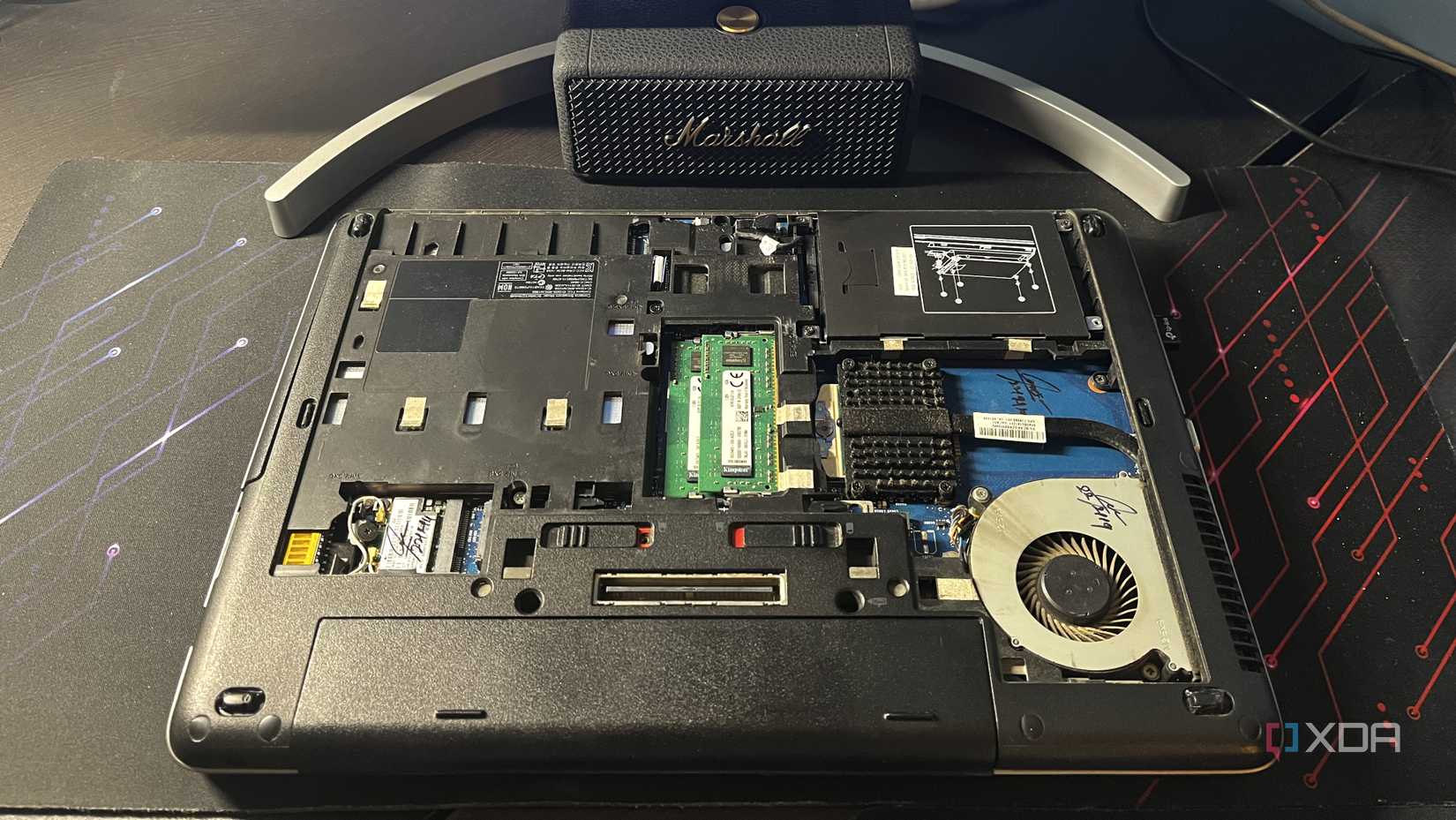
It isn’t just about fewer ports either. Back in the day, we had upgradable and repairable laptops. And many of these upgrades and repairs could be performed at home without professional supervision. I still have a 12-year-old laptop that has a detachable battery and a removable back panel. I have changed the battery once, and it didn’t take more than a minute. Similarly, I have added RAM sticks, cleaned the fan, and done a lot more without any help. Because the components are all easily accessible.
With modern laptops, that’s no longer the case. My other two, a Dell Inspiron 14 2-in-1 and MacBook Air, are a challenge when it comes to that. For even basic repairs, I am forced to visit a professional. I know, with the right set of tools, I could open them up, but with the components packed so closely together, there’s a lot of risk.
Then there are aspects like soldered RAM. While it’s faster and offers other space-saving benefits that help achieve these slim designs, soldered RAM hurts upgradability. You can’t just order a RAM stick and add it to your PC anymore. That means you will have to buy a laptop with more RAM if you plan to run it for 5–7 years. This added expense and the surrounding confusion could have been avoided had manufacturers not pushed these ultra-sleek designs.
Thinner laptops are portable and convenient
But that’s not the only thing that matters

As I said earlier, slimmer, ultra-thin laptops make sense to people who have to move them around. But there are others who don’t. Many have laptops placed on workstations and rarely move them. All three of mine remain in the same position for weeks at a stretch. I have my primary laptop connected to an external monitor, so it’s largely stationary. The other two sit on their dedicated stands unless I am traveling as well.
That begs the question, why are we sacrificing this much? Beyond aesthetics, portability, and convenience, they have little to offer that a slightly bulkier one doesn’t. Let’s not forget how running resource-intensive tasks can take a toll on these, leading to overheating and thermal throttling. When components are packed closely together, there’s usually little room for hot air to dissipate. Although manufacturers are introducing advanced cooling technologies, overheating remains a concern, at least for now.
They’re here to stay
Alternatives are fast shrinking
Given how things have transpired over the last couple of years, it feels like thinner laptops are here to stay. Not just expensive ones, even budget models are getting sleeker and dropping ports. Even though manufacturers and perhaps the majority of buyers have approved of this, a few remain defiant. People who still believe that laptops, though convenient, are only useful if they are an all-in-one package. As long as they don’t weigh more than 4 pounds and are less than 30mm thick, I see no problem with them. And neither should most of you, unless aesthetics and portability eclipse real-world use.
