

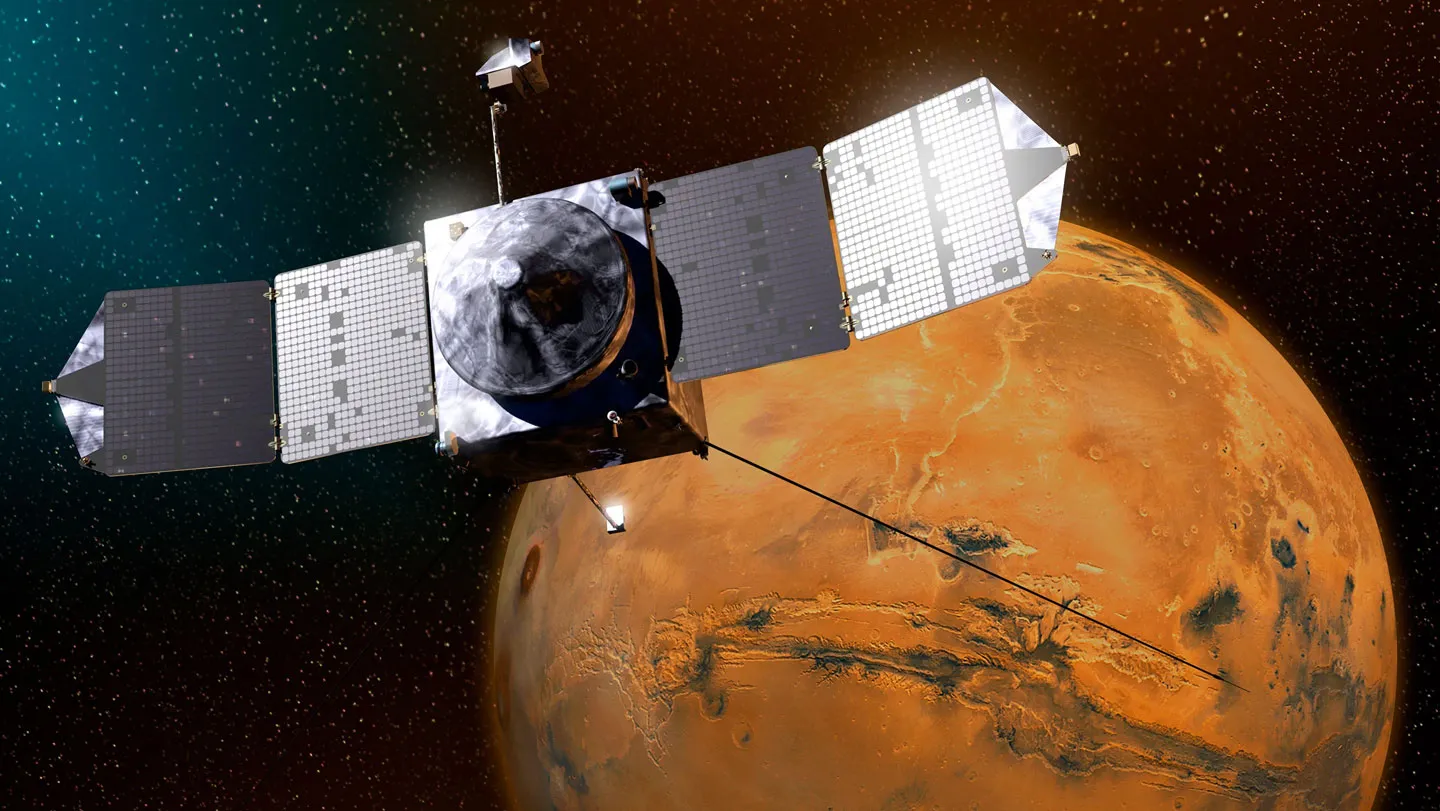
A veteran spacecraft has sniffed the Martian atmosphere for the last time. More than a decade after the MAVEN orbiter arrived at Mars and six months after it unexpectedly went quiet, NASA has officially declared the mission over.
With it, NASA loses a workhorse science resource and a crucial link in the communications network between rovers on Mars and scientists on Earth.
“The conclusion is that the spacecraft is not recoverable,” said project manager Mike Moreau of NASA’s Goddard Space Flight Center in Greenbelt, Md., at a June 3 news conference. “The team has really experienced the loss of a loved one with the end of the mission here.”
MAVEN (for Mars Atmosphere and Volatile Evolution) last contacted Earth in December 2025, shortly before it passed behind Mars. When it emerged, radio dishes couldn’t find its signal. Fragments of data received December 6 suggested the spacecraft was spinning at about 2.7 revolutions per minute, when it shouldn’t have been spinning at all.
“Any kind of rotation was anomalous,” Moreau said. A review board convened in February determined that the spinning drained the batteries, cutting power to the spacecraft’s communications. The root cause of the rotation is still under investigation.
MAVEN entered Mars orbit in September 2014 to learn how the Red Planet’s climate changed over time. Its orbit periodically brought it on “deep dips” inside the upper layers of Mars’ atmosphere.
One of its most important findings is that the solar wind, a continuous stream of charged particles from the sun, constantly strips gas molecules from Mars’ atmosphere. With no planetary-scale magnetic field to protect it, like Earth has, the Red Planet loses about 100 grams of atmosphere every second.
During a solar storm, when the sun emits flares and energetic bursts of plasma, that escape rate jumps by about a factor of 10. The sun emitted more flares when it was younger, so Mars probably lost its atmosphere even faster in the past.
MAVEN also measured atmospheric sputtering, in which heavy ions plunge into the atmosphere and splash lighter, neutral molecules out. It was the first time sputtering had been observed directly on any planet.
“We now have a better understanding of atmospheric escape at Mars than any other planet, including Earth,” said MAVEN principal investigator Shannon Curry, a planetary scientist at the University of Colorado Boulder, at the news conference.
That escape goes a long way toward explaining why Mars appears to have been much more hospitable to life in the past — though there is still no clear evidence that life ever took hold there.
“The mission provided the strongest evidence yet for why Mars went from a warm, wet world (capable of supporting liquid water) to the cold, dry environment it is today,” says geoscientist Vicky Hamilton of the Southwest Research Institute in Boulder, Colo.
MAVEN also discovered new types of auroras at Mars. It coordinated with the Perseverance rover to make the first observation of an aurora from Mars’s surface, giving an idea of what those light shows might look like to future human visitors. And it observed how a global dust storm in 2018 lofted water molecules high into the atmosphere, letting more of them escape.
MAVEN was a “key component” in NASA and the European Space Agency’s five-satellite Mars Relay Network, said NASA Mars Exploration Program director Tiffany Morgan. The rovers have adjusted to four satellites, though there are now occasional delays.
“MAVEN was critical in getting science data, as opposed to operational data,” Morgan said. “But the Mars Relay Network is resilient enough at this time to accommodate the loss of MAVEN.”
NASA is planning to build a new Mars Telecommunications Network to provide “continuous communications in support of a Mars sample return mission and future Mars surface, orbital, and human exploration missions,” the agency wrote in a request for proposals in May. But it may not be ready until 2030 or later.
Meanwhile, the existing network satellites range from 10 to 25 years old. These aging assets are vulnerable to cancellation by an agency looking to cut costs. “Our Mars infrastructure is growing increasingly more fragile every year,” says planetary scientist Briony Horgan of Purdue University in West Lafayette, Ind.
Hamilton notes that Mars surface missions must now rely on Mars Odyssey and Mars Reconnaissance Orbiter. “But their future is currently threatened by the proposed NASA budget.”
