
LIVE NEWS
  • Apple Will Reportedly Add Bill-Splitting Feature to iOS 27
  • Opinion | Putin Has No Good Way Out of His War
  • Flowise’s MCP implementation can run ghost commands
  • DOE Restarts Home Efficiency Rebates, and Electrification Is the Biggest Loser
  • Albania prosecutors probe Jared Kushner-linked resort amid violent protests
  • Clinical Workflow Automation: Where AI Is Making Real Inroads
  • AMD Radeon RX 9070 GRE review: A cheaper GPU for a wildly expensive era
  • US court upholds injunction against Trump policy banning transgender troops | Donald Trump News
Prime Reports
  • Home
  • Popular Now
  • Crypto
  • Cybersecurity
  • Economy
  • Geopolitics
  • Global Markets
  • Politics
  • See More
    • Artificial Intelligence
    • Climate Risks
    • Defense
    • Healthcare Innovation
    • Science
    • Technology
    • World
Prime Reports
  • Home
  • Popular Now
  • Crypto
  • Cybersecurity
  • Economy
  • Geopolitics
  • Global Markets
  • Politics
  • Artificial Intelligence
  • Climate Risks
  • Defense
  • Healthcare Innovation
  • Science
  • Technology
  • World
Home»Defense»Pentagon looks to reinvent the bunker-buster bomb
Defense

Pentagon looks to reinvent the bunker-buster bomb

primereportsBy primereportsMay 29, 2026No Comments3 Mins Read
Share Facebook Twitter Pinterest LinkedIn Tumblr Reddit Telegram Email
Pentagon looks to reinvent the bunker-buster bomb
Share
Facebook Twitter LinkedIn Pinterest Email


With nations such as Iran protecting their arsenals by burying them deep underground, the Pentagon’s Defense Advanced Research Projects Agency is searching for new types of bunker-buster bombs.

The goal is to go beyond the traditional brute-force approach of giant bombs that rely on the force of gravity to smash their way deep into the ground before exploding.

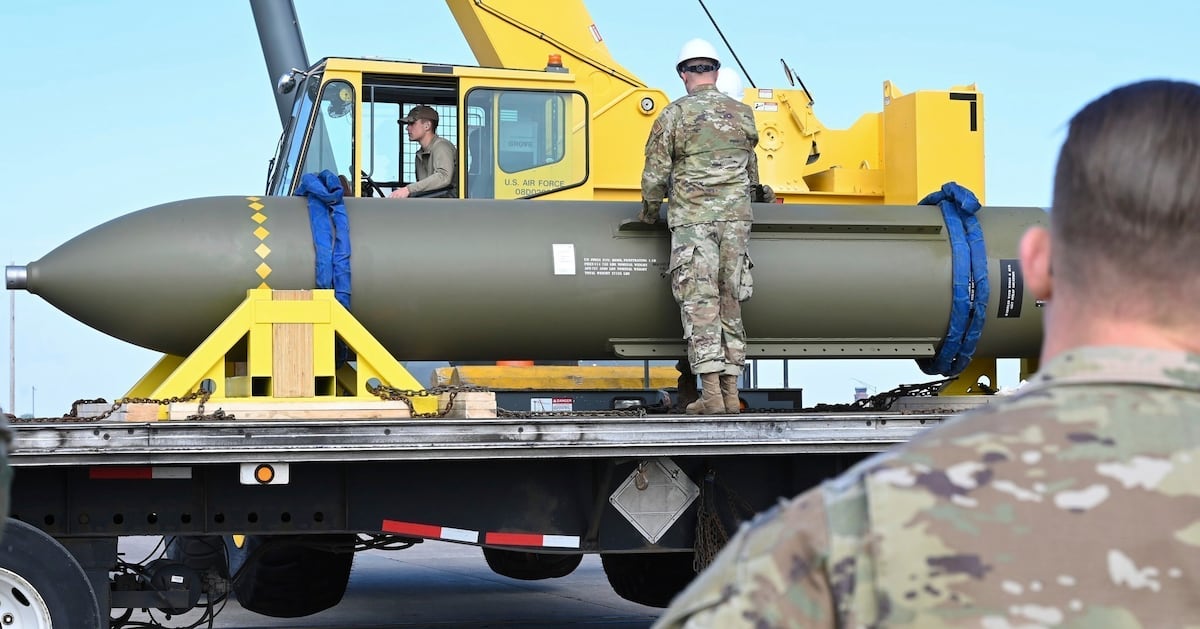
During World War II, the Royal Air Force dropped 22,000-pound “Grand Slam” bombs. Eight decades later, the U.S. Air Force has used the 30,000-pound GBU-57 Massive Ordnance Penetrator in the campaign against Iran.

Now, DARPA wants to pivot away from the traditional bunker busters and instead manipulate shock waves to destroy targets.

“The government is explicitly interested in concepts that move beyond traditional mass-velocity scaling and empirical design toward mechanisms that deliberately shape, steer, amplify, or suppress stress waves within homogeneous and heterogeneous materials,” according to DARPA’s Request for Information. The deadline is June 26.

“Areas of interest include, but are not limited to, transient material state manipulation under extreme loading, non-linear and anisotropic wave control, dynamic impedance matching, controlled failure initiation and progression, and the coupling of structural, material, and geometric effects to achieve step-change performance against complex targets,” DARPA continued.

DARPA also seeks “new regimes of performance or observability in shock-dominated environments.”

Potential advances include “architected or actively tunable materials, novel fabrication methods that embed function into structure,” and “advanced diagnostics capable of resolving high-strain-rate phenomena in situ.”

DARPA’s quest for better bunker-busters comes as the future of warfare heads beneath the surface. Iran has embedded nuclear facilities and missile stockpiles inside mountains. North Korea uses bunkers and tunnels to conceal nuclear sites, missile launchers and artillery.

Even non-state actors such as Hamas and Hezbollah — and before them, the Viet Cong — waged war from underground. In the Ukraine War, drones have become such a pervasive threat that human soldiers spend much of their time in bunkers.

Rooting out insurgents from tunnels is hard enough, as the U.S. Army’s “tunnel rats” can attest. Trying to destroy an Iranian nuclear site 300 feet underground is an order of magnitude harder.

That’s why weapons like Grand Slam and the Massive Ordnance Penetrator were invented. But the Grand Slam could be carried only by a specially modified Lancaster four-engine bomber, while the MOP is dropped by a B-2 bomber, of which the U.S. Air Force has only 19 operational.

DARPA’s RFI doesn’t mention reducing the size of bunker-buster bombs. But if scientists can devise ways to exploit shock waves to destroy targets, this opens the possibility of smaller bunker-busters that can be carried by a variety of aircraft.

About Michael Peck

Michael Peck is a correspondent for Defense News and a columnist for the Center for European Policy Analysis. He holds an M.A. in political science from Rutgers University. Find him on X at @Mipeck1. His email is mikedefense1@gmail.com.

Share. Facebook Twitter Pinterest LinkedIn Tumblr Email
Previous ArticleRed dwarf stars are cosmic killers that eat their own planets
Next Article Kevin Warsh’s troublesome inflation in-tray
primereports
  • Website

Related Posts

Defense

One in Five Eligible Airmen Promoted to Master Sergeant in 2026

June 1, 2026
Defense

US military seeks cultural advisors in Somalia amid regional strikes

June 1, 2026
Defense

Poland spends $16.5 billion in EU-backed loans on heavy army weapons

June 1, 2026
Add A Comment
Leave A Reply Cancel Reply

Top Posts

Paxton’s win over Cornyn sets up high-stakes Texas clash with Talarico

May 28, 202616 Views

Global Resources Outlook 2024 | UNEP

December 6, 202510 Views

Texas Democrat Talarico claims voting laws are rigged ahead of Paxton race

May 28, 20269 Views
Stay In Touch
  • Facebook
  • YouTube
  • TikTok
  • WhatsApp
  • Twitter
  • Instagram
Latest Reviews

Subscribe to Updates

Get the latest tech news from FooBar about tech, design and biz.

PrimeReports.org
Independent global news, analysis & insights.

PrimeReports.org brings you in-depth coverage of geopolitics, markets, technology and risk – with context that helps you understand what really matters.

Editorially independent · Opinions are those of the authors and not investment advice.
Facebook X (Twitter) LinkedIn YouTube
Key Sections
  • World
  • Geopolitics
  • Popular Now
  • Artificial Intelligence
  • Cybersecurity
  • Crypto
All Categories
  • Artificial Intelligence
  • Climate Risks
  • Crypto
  • Cybersecurity
  • Defense
  • Economy
  • Geopolitics
  • Global Markets
  • Healthcare Innovation
  • Politics
  • Popular Now
  • Science
  • Technology
  • World
  • About Us
  • Contact Us
  • Privacy Policy
  • Terms & Conditions
  • Disclaimer
  • Cookie Policy
  • DMCA / Copyright Notice
  • Editorial Policy

Sign up for Prime Reports Briefing – essential stories and analysis in your inbox.

By subscribing you agree to our Privacy Policy. You can opt out anytime.
Latest Stories
  • Apple Will Reportedly Add Bill-Splitting Feature to iOS 27
  • Opinion | Putin Has No Good Way Out of His War
  • Flowise’s MCP implementation can run ghost commands
© 2026 PrimeReports.org. All rights reserved.
Privacy Terms Contact

Type above and press Enter to search. Press Esc to cancel.