
LIVE NEWS
  • Top Golang Backend Frameworks for Developers in 2026
  • Decades of increased emissions from forest-fuelled BECCS
  • Virginia redistricting campaigns have left voters confused : NPR
  • It doesn’t matter how much you sit — walking more could lower your risk of death and disease
  • AI streaming is going mainstream in China, whether audiences want it or not
  • Starmer expected to lead Labour into next election, says minister, but warns there are ‘no certainties’ amid Mandelson scandal – UK politics live | Politics
  • Oracle delivers semantic search without LLMs
  • Fears for more than 1,000 Wrexham toads after reservoir is drained
Prime Reports
  • Home
  • Popular Now
  • Crypto
  • Cybersecurity
  • Economy
  • Geopolitics
  • Global Markets
  • Politics
  • See More
    • Artificial Intelligence
    • Climate Risks
    • Defense
    • Healthcare Innovation
    • Science
    • Technology
    • World
Prime Reports
  • Home
  • Popular Now
  • Crypto
  • Cybersecurity
  • Economy
  • Geopolitics
  • Global Markets
  • Politics
  • Artificial Intelligence
  • Climate Risks
  • Defense
  • Healthcare Innovation
  • Science
  • Technology
  • World
Home»Science»Science history: Female chemist initially barred from research helps helps develop drug for remarkable-but-short-lived recovery in children with leukemia — Dec. 6, 1954
Science

Science history: Female chemist initially barred from research helps helps develop drug for remarkable-but-short-lived recovery in children with leukemia — Dec. 6, 1954

primereportsBy primereportsDecember 6, 2025No Comments3 Mins Read
Share Facebook Twitter Pinterest LinkedIn Tumblr Reddit Telegram Email
Science history: Female chemist initially barred from research helps helps develop drug for remarkable-but-short-lived recovery in children with leukemia — Dec. 6, 1954
Share
Facebook Twitter LinkedIn Pinterest Email


Milestone: Chemotherapy agent sends leukemia into remission

Date: Dec. 6, 1954

Where: Sloan Kettering Institute and Weill Cornell Medical College in New York

Who: Gertrude Elion and colleagues

In 1954, researchers described a new drug that sent children with acute leukemia into remission. It would become one of the first chemotherapy drugs and would later form the basis for a new, “rational” approach to designing drugs.

Gertrude Elion had earned a master’s degree in chemistry in 1941, but she was turned down for many graduate research posts, which were not available to women. So she worked as a high school chemistry teacher and a food quality tester for a supermarket company, according to an autobiographical sketch she wrote in 1988.

But by 1944, she had found a job in the lab of George Hitchings at the Burroughs-Wellcome pharmaceutical company (now GSK). Hitchings was developing a novel way to make new drugs that eschewed the trial-and-error approach that had previously dominated drug design.


You may like

“One of the deciding factors may have been that my grandfather, whom I loved dearly, died of cancer when I was 15. I was highly motivated to do something that might eventually lead to a cure for this terrible disease,” Elion wrote in 1988.

Hitchings and Elion reasoned that, because all living cells need nucleic acids, which make up DNA, to reproduce, then fast-growing cells, like invasive bacteria and tumor cells, would need even more of these compounds to fuel their insatiable growth. So, they rationalized, finding compounds that inhibit the synthesis of nucleic acids could squelch cancer growth.

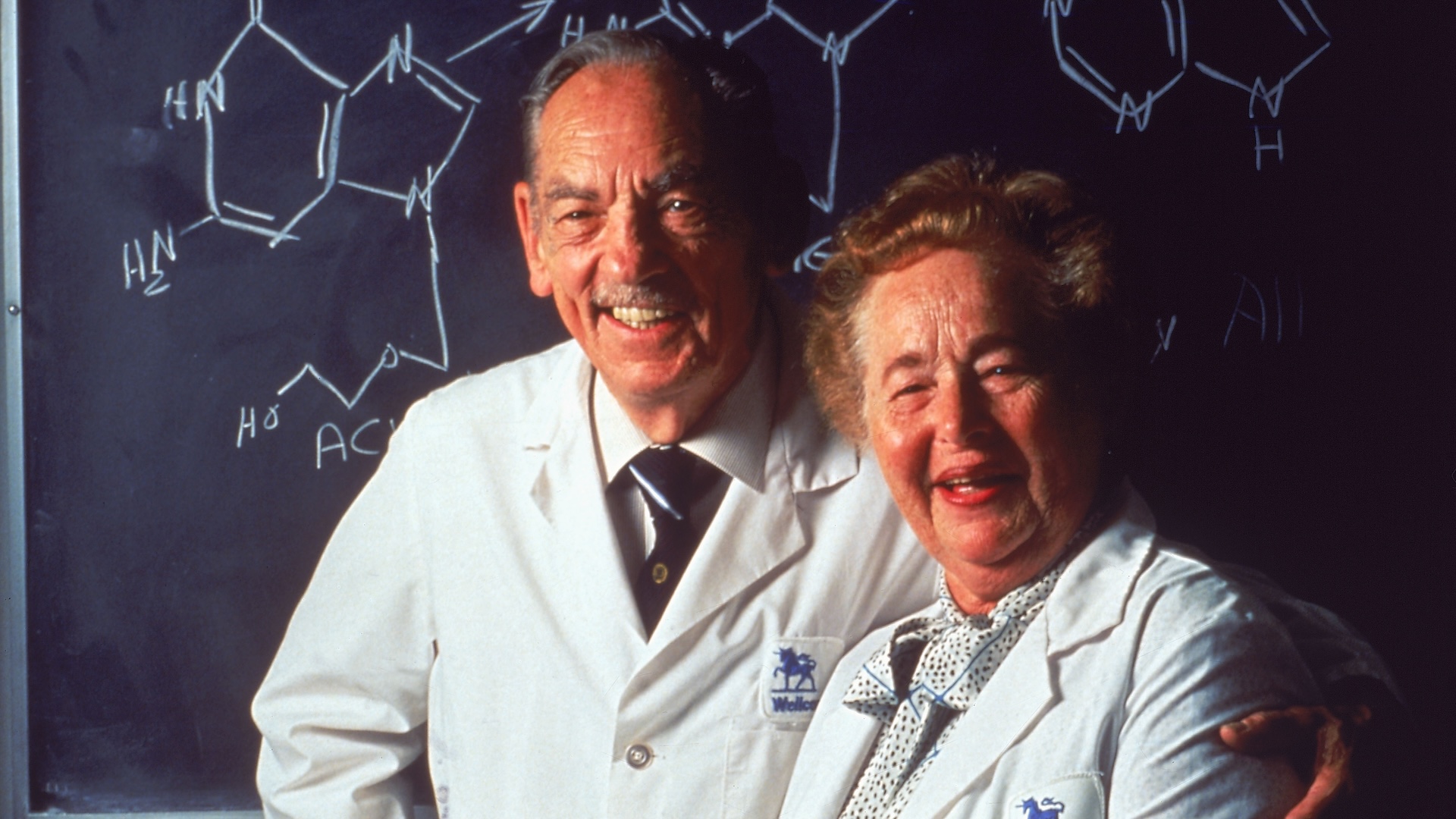
Gertrude Elion and George Hitchings pose in front of a blackboard in 1988

George Hitchings and Gertrude Elion in 1988. They would go on to win the Nobel Prize in Physiology or Medicine for their work on 6-MP and rational drug design. (Image credit: Will and Deni McIntyre/Getty Images)

In 1950, when Elion was 32, the team discovered a compound derived from purine, called 6-mercaptopurine (6-MP), which could inhibit the growth of both bacterial cells and leukemia cells in a lab dish. Over the next two years, they tested the drug in tumors in animals, finding that it slowed tumor growth. In 1952, researchers began trials in 107 patients with various types of cancer, including 45 children and 18 adults with acute leukemia. Prior to this, there was no good treatment for these children, who would usually die months after their diagnosis.

There had been a few earlier chemotherapy drugs, but many were based on highly toxic compounds, such as war gases. By contrast, the children who took 6-MP seemed to tolerate it fairly well, and 15 children went into complete remission for a few weeks to a few months. It wasn’t a huge increase, but it was more than had been possible before. Elion was elated when the children got better, and crushed when they got sick again.

Get the world’s most fascinating discoveries delivered straight to your inbox.

Hitchings and Elion were determined to pursue other, related compounds that could create a more durable remission. In the late 1950s, they hit upon a regimen that combined methotrexate — another chemotherapy drug, developed by Dr. Jane Wright and colleagues — with 6-MP to create a longer-lasting, stable remission in some kids with acute leukemia.

Over a decades-long career, Elion would go on to develop many more drugs, including azathioprine, a rheumatoid arthritis and transplant anti-rejection drug; acyclovir, an antiviral that treats genital herpes, chickenpox and shingles; and AZT, the first drug that worked against HIV/AIDS. In 1988, she earned the Nobel Prize in physiology or medicine, along with Hitchings and James Black for her work on “important principles in drug design,” including her work on 6-MP.

Share. Facebook Twitter Pinterest LinkedIn Tumblr Email
Previous ArticleThe Verge’s 2025 holiday gift guide: 110 of the best gifts we’ve found
Next Article US–China trade war traps China in structural imbalance spiral
primereports
  • Website

Related Posts

Science

Watch SpaceX launch advanced GPS satellite for US Space Force early on April 20

April 19, 2026
Science

Canadian astronaut’s bon mots help heal wounds from French language row | Canada

April 19, 2026
Science

'It would break my heart' – wind farm plans leave people divided

April 19, 2026
Add A Comment
Leave A Reply Cancel Reply

Top Posts

Global Resources Outlook 2024 | UNEP

December 6, 20258 Views

The D Brief: DHS shutdown likely; US troops leave al-Tanf; CNO’s plea to industry; Crowded robot-boat market; And a bit more.

February 14, 20264 Views

German Chancellor Merz faces difficult mission to Israel – DW – 12/06/2025

December 6, 20254 Views
Stay In Touch
  • Facebook
  • YouTube
  • TikTok
  • WhatsApp
  • Twitter
  • Instagram
Latest Reviews

Subscribe to Updates

Get the latest tech news from FooBar about tech, design and biz.

PrimeReports.org
Independent global news, analysis & insights.

PrimeReports.org brings you in-depth coverage of geopolitics, markets, technology and risk – with context that helps you understand what really matters.

Editorially independent · Opinions are those of the authors and not investment advice.
Facebook X (Twitter) LinkedIn YouTube
Key Sections
  • World
  • Geopolitics
  • Popular Now
  • Artificial Intelligence
  • Cybersecurity
  • Crypto
All Categories
  • Artificial Intelligence
  • Climate Risks
  • Crypto
  • Cybersecurity
  • Defense
  • Economy
  • Geopolitics
  • Global Markets
  • Healthcare Innovation
  • Politics
  • Popular Now
  • Science
  • Technology
  • World
  • About Us
  • Contact Us
  • Privacy Policy
  • Terms & Conditions
  • Disclaimer
  • Cookie Policy
  • DMCA / Copyright Notice
  • Editorial Policy

Sign up for Prime Reports Briefing – essential stories and analysis in your inbox.

By subscribing you agree to our Privacy Policy. You can opt out anytime.
Latest Stories
  • Top Golang Backend Frameworks for Developers in 2026
  • Decades of increased emissions from forest-fuelled BECCS
  • Virginia redistricting campaigns have left voters confused : NPR
© 2026 PrimeReports.org. All rights reserved.
Privacy Terms Contact

Type above and press Enter to search. Press Esc to cancel.