
LIVE NEWS
  • Tehran says ‘progress’ made in talks with US
  • Google and OpenAI are making a run at Claude’s desktop moat, and Anthropic is making it easy
  • DeBriefed 17 April 2026: Fossil-fuel power slumps | ‘Super’ El Niño warning | Afghanistan’s climate struggle
  • Senior official ousted over Peter Mandelson security row to face MPs
  • Scientists say this type of olive oil could boost brain power
  • The Best Smart Home Accessories to Boost Your Curb Appeal (2026)
  • Trinidad and Tobago police uncover 56 bodies, mostly children, at cemetery | Crime News
  • The best TV antennas to buy in 2024
Prime Reports
  • Home
  • Popular Now
  • Crypto
  • Cybersecurity
  • Economy
  • Geopolitics
  • Global Markets
  • Politics
  • See More
    • Artificial Intelligence
    • Climate Risks
    • Defense
    • Healthcare Innovation
    • Science
    • Technology
    • World
Prime Reports
  • Home
  • Popular Now
  • Crypto
  • Cybersecurity
  • Economy
  • Geopolitics
  • Global Markets
  • Politics
  • Artificial Intelligence
  • Climate Risks
  • Defense
  • Healthcare Innovation
  • Science
  • Technology
  • World
Home»Science»Sperm get lost in space, Australian research into microgravity impacts suggests | Space
Science

Sperm get lost in space, Australian research into microgravity impacts suggests | Space

primereportsBy primereportsMarch 26, 2026No Comments4 Mins Read
Share Facebook Twitter Pinterest LinkedIn Tumblr Reddit Telegram Email
Sperm get lost in space, Australian research into microgravity impacts suggests | Space
Share
Facebook Twitter LinkedIn Pinterest Email


Sperm in space are likely to get disoriented and lost while struggling to find their way to an egg, a new study has found.

When exposed to microgravity in experiments, sperm tumble around like an untethered astronaut, according to Adelaide University researchers.

“It causes them to flip around, to go upside down … they don’t really know which way is up or down,” researcher Dr Nicole McPherson said.

Australia is part of Nasa’s planned Artemis mission to go to the moon and on to Mars, while private companies including Elon Musk’s SpaceX plan to build human habitats on Mars. As a result there has been increasing interest in how humans might reproduce and breed animals in extraterrestrial habitats.

The Adelaide researchers used a machine to mimic microgravity – the same sort of freefall or weightlessness astronauts on the International Space Station experience. The clinostat “causes cells to not really understand or know which direction they’re going in”, McPherson said.

“With the recent advancements in space travel and international interest in deep space exploration, Mars settlement and moon mining, it is critical to investigate the effect of microgravity on early fertilisation events not only for creating viable food sources, but also maintaining human space settlements, without the need to continually re-populate from Earth,” they noted in an article published in the journal Communications Biology.

McPherson said the microgravity research also benefits earthly reproductive science.

The researchers, from the university’s Robinson Research Institute, used sperm samples from humans, mice and pigs.

They put them in a 3D clinostat machine, which spins around to negate the effect of gravity, then in a maze that was a simulation of the female reproductive tract – although in the case of human sperm, no egg was placed at the end of it due to ethical reasons.

The sperm exposed to microgravity struggled to find their way through the maze, they found.

There was about a 40% reduction in the number of microgravity-exposed human sperm that made it through compared with the control group.

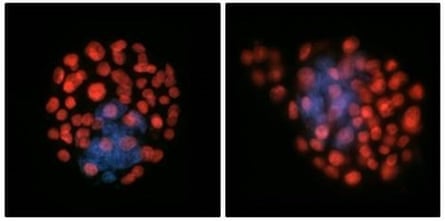
Microgravity also affected how pig and mouse embryos developed.

McPherson, the senior author, said it was the first time they had shown that gravity was an important factor in sperm’s navigational ability, and that while it had a negative effect, healthy embryos were still able to form.

“This gives us hope that reproducing in space may one day be possible,” she said.

Sperm get lost in space, Australian research into microgravity impacts suggests | Space
Exposure to zero gravity appeared to modify the number of foetal cells within the embryo. Photograph: Sperm and Embryo Biology Laboratory, Adelaide University

“We’re interested in not only understanding the effects of zero g, but also those varying gravitational forces, things that we might see on the moon or Mars, because we do know that there is a long-term plan for humans to have settlements there.

“While it may seem like a bit of sci-fi … we’re actually gaining fundamental knowledge in how sperm navigate and transverse the female reproductive tract.”

The researchers collaborated with the university’s Andy Thomas Centre for Space Resources.

“As we progress toward becoming a spacefaring or multi-planetary species, understanding how microgravity affects the earliest stages of reproduction is critical,” said the centre’s director, associate professor John Culton.

Adding progesterone helped overcome the sperms’ disorientation, which researchers think is because eggs also release it and it can help guide the sperm.

McPherson said radiation, which bombards astronauts as they leave Earth’s protective atmosphere, also affects sperm.

There is a long history of studying reproduction in space.

The Adelaide University article points to an 1987 investigation on Cosmos 1887, which found “space-exposed rats had reduced testicular mass”, and experiments on mouse embryos on the Columbia space shuttle in 1998.

In 2018 Nasa sent human sperm on the mission Micro-11 to the ISS to study the effects of weightlessness. The US space agency also runs an ongoing developmental, reproductive and evolutionary biology program.

In 2024, the New York Times reported that Musk had volunteered his sperm to help seed a colony on Mars, a claim he has denied.

In February, scientists called for more research into reproductive health in space, saying international collaboration was “urgently needed” to close knowledge gaps about the effects of microgravity and radiation and establish ethical guidelines.

Share. Facebook Twitter Pinterest LinkedIn Tumblr Email
Previous ArticleWhite House says ‘no plans’ under way to pay TSA staff without DHS deal amid turmoil in US airports – live | Trump administration
Next Article Feds sue towing company for allegedly illegally auctioning off troops’ cars — including many towed from base
primereports
  • Website

Related Posts

Science

Electric vehicle owners could earn thousands by supporting power grid

April 18, 2026
Science

700-year-old mummy from Bolivia contains earliest confirmed evidence of strep throat bacteria in the Americas

April 18, 2026
Science

Science behind the scenes

April 18, 2026
Add A Comment
Leave A Reply Cancel Reply

Top Posts

Global Resources Outlook 2024 | UNEP

December 6, 20258 Views

The D Brief: DHS shutdown likely; US troops leave al-Tanf; CNO’s plea to industry; Crowded robot-boat market; And a bit more.

February 14, 20264 Views

German Chancellor Merz faces difficult mission to Israel – DW – 12/06/2025

December 6, 20254 Views
Stay In Touch
  • Facebook
  • YouTube
  • TikTok
  • WhatsApp
  • Twitter
  • Instagram
Latest Reviews

Subscribe to Updates

Get the latest tech news from FooBar about tech, design and biz.

PrimeReports.org
Independent global news, analysis & insights.

PrimeReports.org brings you in-depth coverage of geopolitics, markets, technology and risk – with context that helps you understand what really matters.

Editorially independent · Opinions are those of the authors and not investment advice.
Facebook X (Twitter) LinkedIn YouTube
Key Sections
  • World
  • Geopolitics
  • Popular Now
  • Artificial Intelligence
  • Cybersecurity
  • Crypto
All Categories
  • Artificial Intelligence
  • Climate Risks
  • Crypto
  • Cybersecurity
  • Defense
  • Economy
  • Geopolitics
  • Global Markets
  • Healthcare Innovation
  • Politics
  • Popular Now
  • Science
  • Technology
  • World
  • About Us
  • Contact Us
  • Privacy Policy
  • Terms & Conditions
  • Disclaimer
  • Cookie Policy
  • DMCA / Copyright Notice
  • Editorial Policy

Sign up for Prime Reports Briefing – essential stories and analysis in your inbox.

By subscribing you agree to our Privacy Policy. You can opt out anytime.
Latest Stories
  • Tehran says ‘progress’ made in talks with US
  • Google and OpenAI are making a run at Claude’s desktop moat, and Anthropic is making it easy
  • DeBriefed 17 April 2026: Fossil-fuel power slumps | ‘Super’ El Niño warning | Afghanistan’s climate struggle
© 2026 PrimeReports.org. All rights reserved.
Privacy Terms Contact

Type above and press Enter to search. Press Esc to cancel.