

Global hybrid vertical land motion estimates
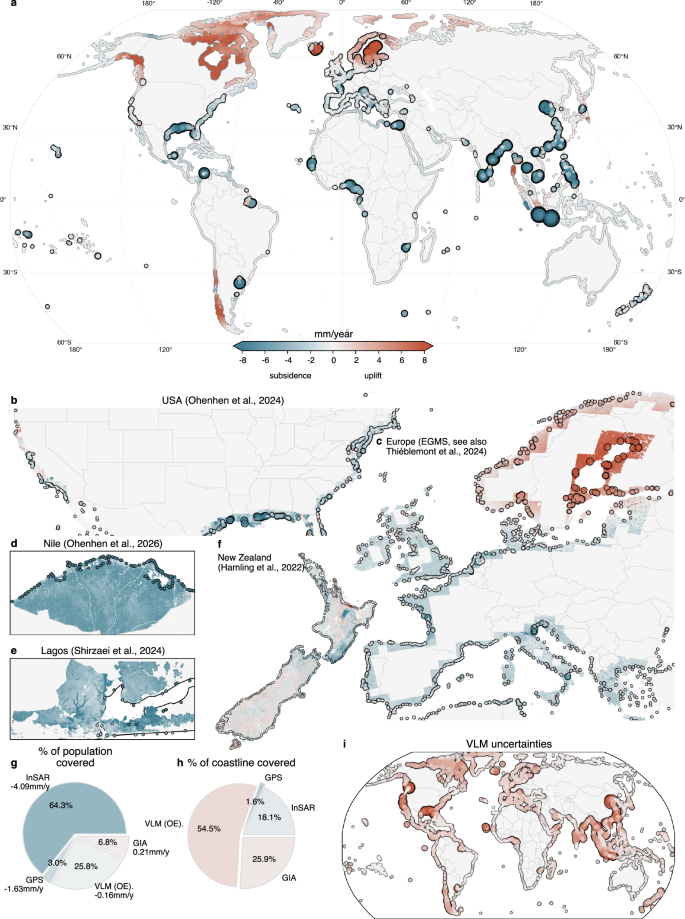
The hybrid VLM estimate is based on four different data sources. We use an interpolated VLM reconstruction based on the joint analysis of GNSS, tide gauges (TGs), and satellite altimetry (from Oelsmann et al.7, hereafter referred to as OE24) and a GIA model (from Caron et al.52). To refine the resolution of VLM in major coastal cities and the largest deltas, where VLM is often largest, we exploit InSAR VLM data from the European Ground Motion Service (EGMS, see also Thiéblemont et al.13), from Hamling et al.53, Ohenhen et al.8,9, Shirzaei et al.14, and Ao et al.15, which resolves subsidence at very small scales, and in the most populated areas where no GNSS (or tide gauge) station data are publicly available. In addition to InSAR, we use GNSS estimates (from the Nevada Geodetic Laboratory, ref. 43) for densely populated areas, where no InSAR data are available (see Figs. 1 and S1; more details can be found in “Methods”). All datasets are aggregated to the 12,148 coastal segments of the Dynamic Interactive Vulnerability Assessment (DIVA) model54, as used by NI21b.

The main map (a) shows uplift (positive signals) and subsidence in mm/year on the DIVA coastal segments. Values outlined by black circles present regions where InSAR data is available, or where single GNSS estimates are used. The points are scaled by their absolute value to highlight strong subsidence or uplift. Individual InSAR estimates for: b the United States8, c Europe from EGMS (see also Thiéblemont et al.13), d the Nile Delta9, e Lagos14, and f New Zealand53. For Europe and the United States, we show the coastal low-resolution DIVA grid points (12,148 elements), whereas for the other regions we show the high-resolution grid (247,666 grid points; see also “Methods”). g, h The fraction of the coastal population (length) covered by the individual datasets (InSAR, GIA, GPS, and the interpolated data from OE24). The colors depict the population- (or length-) weighted vertical land motion (in mm/year) of the individual datasets. i \(1\sigma \) VLM uncertainties of the datasets (using the same color scale as in a), which are computed from the formal, spatial, and cross-validation uncertainties in the InSAR data, and the provided uncertainties from OE24 and ref. 52 (see “Methods”).
Here, we rely on several assumptions: First, we assume that all reported InSAR rates reflect VLM. While this is supported by the estimated accuracies of the datasets from validations with GNSS measurements, which are usually between 1 and 2 mm/year (see also “Methods,” Fig. S2 and Table S1), several factors may violate this assumption. In particular, there is uncertainty regarding the extent to which InSAR-derived subsidence rates may be underestimated or misinterpreted, either because shallow subsidence is only partially observed (when reflectors such as buildings are founded on deeper layers), or due to the influence of vertical accretion in dynamic, non-urban landscapes12,38. Estimates of these components are usually not available on a global scale. One exception is the Mississippi Delta, where a dedicated subsidence map based on RSETs (Rod-surface elevation tables) is available55 that represents both shallow and deep subsidence, and is thus incorporated for this region in this study. Our second assumption is that trends from all data sources are representative of the changes over the entire period (1995–2020) considered here. This is a simplification, as InSAR-based VLM rates are generally derived from relatively short and variable observation periods (~5–15 years, see SI Table S1). Uncertainties arising from potentially unobserved non-linear changes, as well as from partially observed shallow subsidence and vertical accretion, are therefore discussed further in the Discussion.
Thanks to the abundance of recently published InSAR datasets, almost 65% of the global coastal population is now covered by accessible measurements (see Fig. 1). Regions where InSAR VLM estimates have been processed (highlighted by black-outlined markers) cover almost the entire US coast8, large parts of Europe (EGMS), many Chinese15 and other large coastal cities and deltas mainly in South, Southeast and East Asia9,14. These regions contain most of the coastal areas with large populations, i.e., the 40 largest deltas/estuaries, and 34 of the 48 largest coastal cities (as discussed by ref. 56, see SI Fig. S2). For the remaining 14 cities and deltas, we either use GNSS rates when available or rely on interpolated results (OE24). The present availability of InSAR data represents a substantial progress and an opportunity to observe highly localized changes, which were not possible with the existing GNSS network alone, or derived products (ref. 6, OE24). The fact that InSAR only covers about 18% of the global coastline by length, but almost 65% of the coastal population, underlines its utility to resolve VLM for human and socio-economic analyses (ref. 8).
The global hybrid VLM estimate demonstrates that coastal regions with higher population densities are, on average, subsiding (Fig. 1). Local subsidence hotspots are East/Southeast Asian cities like Jakarta (−13.7 mm/year), Tianjin (−13.5 mm/year), Bangkok (−8.5 mm/year), or African cities such as Lagos (−6.7 mm/year) and Alexandria (−4 mm/year). These estimates are derived from InSAR observations [see also SI Fig. S3] and represent coastal averages of the aggregated VLM data on the DIVA grid. However, subsidence rates can vary substantially within some of the fastest-subsiding cities. In Jakarta, for example, some areas subsided at rates of up to −42 mm/year, while more central parts experienced uplift of up to +15 mm/year [0.1th and 99.9th percentiles]. Similar, though generally less pronounced, spatial contrasts are also found in other cities such as Bangkok and Ho Chi Minh City. As a result, aggregated coastal city-scale estimates remain associated with considerable uncertainty, and local risk assessments require careful consideration of high-resolution spatial variability, as well as the specific infrastructure and populations affected. Such local effects clearly cannot be resolved with previous interpolated datasets based on GNSS (OE24), nor GIA models, and therefore strongly benefit from InSAR data as local information.
In addition to coastal cities, deltas are especially vulnerable to sea-level rise [refs. 20,30; NI21b; refs. 9,21). The InSAR estimates9 and dedicated external data sources of subsidence, including estimates based on RSETs and GNSS, (ref. 55, see also SI Fig. S5 for an overview) currently cover coastlines that contain a population of 389 million people, i.e., almost 90% of the global delta LECZ (according to the DIVA estimates), which presents a substantial improvement in terms of coverage and consistency, especially for the Southeast-Asian deltas21. We find that most of the largest deltas are subsiding with average rates (and spatial standard-deviations) of −5.4 (3.6) mm/year in the Ganges/Brahmaputra delta, −7.8 (2.9) mm/year in the Nile delta, −2.7 (2.7) mm/year in the Yangtze delta, and −5.6 (5.5) mm/year in the Mekong delta (see SI Fig. S5). While these statistical averages (over the entire deltas) are useful for a general overview of delta subsidence, they do not represent the substantial spatial variability of subsidence within the deltas, which can reach values of up to 12 mm/year (95th percentile) in the Ganges or Nile delta, for instance. Hence, the new InSAR estimates are crucial for assessing these variations, which have so far been hindered by the poor coverage by GNSS stations (SI Fig. S5).
While densely populated coastlines often experience the highest subsidence rates, we also find that these regions are associated with the largest uncertainties. VLM uncertainties can be influenced by non-linearities, technique-dependent noise, differences in observation-window length, cross-validation uncertainties (e.g., potential offsets between InSAR and GNSS rates), spatial variability and aggregation effects, and parameter uncertainty. Here, we integrate formal, spatial, and cross-validation uncertainties for InSAR VLM data (based on the comparisons with GNSS trends, SI Table S1), as shown in Fig. 1d and explained in more detail in the “Methods,” SI Figs. S6d and S7. As a result, median VLM uncertainties are generally higher in the most populated cities (2.6 mm/year) and deltas (1.8 mm/year) compared to all other regions (0.9 mm/year), largely due to InSAR uncertainties (SI Fig. S6d). Locally, VLM uncertainties can reach 7–10 mm/year, particularly in some of the most densely populated cities, such as Jakarta and Tianjin (see SI Fig. S3).
Implications of VLM-driven relative sea-level change for global coastal populations
To understand how subsidence enhances coastal RSL rise, we combine the hybrid VLM estimates with the ASL change (using gridded altimetry data from the Copernicus Marine Service, see “Methods”) and compute the contemporary RSL change rates (Fig. 2a). The spatial patterns of these changes are compared to those of the coastal population living below 10 m above sea level in the LECZ, see Fig. 2b. Most of the densely populated LECZs are situated in East, Southeast and South Asia (from Japan to Pakistan, including Malaysia and Indonesia). In these areas, the ASL change is slightly greater than the global mean sea-level change (not shown), due to redistribution of mass and associated gravitational and rotational effects, and changes in the ocean circulation (e.g., ref. 57). GIA plays a small role in these regions compared to Europe and North America58.

a RSL change [mm/year] as the combination of ASL change (from CMEMS over 1995–2020) and VLM (based on the VLM reconstruction OE24), GIA (Caron et al.52), where OE24 has missing data) and InSAR from EGMS8,9,14,15. We also show the number of people living below 10 m elevation on a logarithmic scale (black colorbar). For illustrative purposes, we applied radial basis function smoothing with a 120 km length scale to the coastal population data at the DIVA segment grid points to emphasize global population hotspots. b Cumulative distribution of the contribution of coastal length-weighted and population-weighted VLM to RSLC (positive sign = subsidence). The inverted cumulative frequency on the y-axis thus refers here to the share of the population experiencing at least the subsidence rate shown on the x-axis. Solid lines represent the hybrid VLM estimates of this study, the dashed line represents the same dataset without InSAR, and the dotted line represents the total averaged VLM estimate from NI21b. The shaded region surrounding the solid red line (i.e., the VLM estimate) denotes the 95% confidence interval. This uncertainty is estimated from a bootstrapped distribution of CDFs generated by perturbing the VLM rates using normally distributed random errors derived from the estimated uncertainties (see “Methods”). We also show the fraction of people who experience subsidence rates of >0, >1, and >2 mm/year (using estimates from the hybrid reconstruction). c Both the averaged, population-weighted RSL change per country (as indicated by the colors ranging from blue to red, i.e., low to high RSL change), as well as the total coastal population, which is displayed by the modulation in the transparency of the colors.
We follow NI21b and consider the global population-weighted mean estimates of averaged RSL change to understand what the average coastal resident experiences, as opposed to what the average coastal area experiences, which is how sea-level data is normally weighted. This distinction is important because coastal populations are highly unevenly distributed, with large numbers of people concentrated in low-lying urban and deltaic regions where RSL change can differ substantially from the mean (weighted by coastal length). Population weighting, therefore, provides a more appropriate measure for assessing human exposure to RSL change and the associated contribution of subsidence to RSL hazard on a global scale. By contrast, length-weighted estimates may be more relevant for applications focused on coastal land changes. The population-weighting is based on coastal floodplain population estimates from the DIVA model. Fig. 2d and SI Fig. S4 show population-weighted averages of RSL changes for different countries. The highest average population-weighted RSL change affects countries, such as Thailand, Bangladesh, Nigeria, Egypt, China, and Indonesia, at about 7 mm/year to 10 mm/year. The USA, Netherlands, and Italy also experience enhanced population-weighted RSL change of about 4–5 mm/year. In a few nations, geological uplift mitigates some of the current ASL change, such that lower-than-average, or even negative population-weighted RSL change rates occur (e.g., Sweden, Finland). Clearly, these country-averaged values strongly depend on the sub-national distribution of population centers and VLM, and there is often substantial variability within countries. As an example, the population-weighted standard deviation of RSL change can be as large as 7–9 mm/year for countries like China or Indonesia (see SI Fig. S4), and differences between the US Gulf and West coast (as shown in Fig. 1a) are not resolved at the country-aggregation scale. Therefore, the effects of subsidence need to be understood and quantified at a sub-national scale, and this is important to support risk assessment and evidence-based policy making5,59.
The geographical distributions of RSL trends and population density in Fig. 2a, b also indicate that, globally, higher-than-average RSL changes are generally more frequent in regions with higher population. The cumulative distribution of the population-weighted contribution of VLM to RSL change underlines this disproportionate effect of subsidence on the LECZ population (Fig. 2c): We estimate that 43% of the LECZ population is affected by subsidence of at least 2 mm/year, 55% experience rates of at least 1 mm/year, and 71% are overall subsiding. In contrast, areas that are uplifting by at least 1 mm/year contain less than 10% of the LECZ population, indicating that processes such as GIA, or tectonic uplift, as well as managed groundwater recharge (e.g., ref. 11), currently only attenuate RSL rise for a small fraction of the LECZ population. Earlier geodetic estimates (OE24) that do not include InSAR data substantially underestimate—or simply do not capture the extensive subsidence effects on human populations (see Fig. 2c, dashed line). As an example, the estimated number of people affected by subsidence greater than 2 mm/year is about ten times larger when integrating the new InSAR estimates, compared to using state-of-the-art geodetic data. In contrast, at the upper end of the distribution (for subsidence values greater than 5 mm/year), results by NI21b (dotted line, representing the average between their upper and lower estimates) substantially overestimate subsidence compared to the hybrid VLM observations (see also discussion). These results reveal that, although subsidence can be a very localized effect, it has global implications, as the majority of the global coastal population is experiencing subsidence.
To consider the global-scale contributions of VLM to RSL change, we compare the coastal-length versus the population-weighted global RSL trends, following NI21b (see Table 1 and Fig. 3). Here, we use different VLM data combinations to analyze the role of different components and approaches on the estimates of RSL changes worldwide. When only using the VLM reconstruction data (from OE24, together with GIA estimates at locations with missing data), the population-weighted average RSL change (3.8 mm/year) is about twice as large as the coastal-length-weighted average (1.9 mm/year), which is mostly caused by VLM, with a minor contribution from ASL change (see second and third rows in Table 1). When including InSAR and GNSS data estimates in large cities and deltas, this discrepancy increases substantially, such that the population-weighted RSL change of 6 (5.6–6.3) mm/year becomes about three times as large as the coastal-length weighted RSL change (2.1 (2.0–2.2) mm/year). The 1σ uncertainties of these averages are derived from a bootstrap analysis that accounts for data heterogeneity and individual data uncertainties (see “Methods”). Therefore, subsidence (with a global population-weighted average of 2.8 mm/year) currently contributes almost as much to the population-weighted RSL change as the climate-driven ASL component (3.15 mm/year). In the future, the accelerating climate-driven ASL change is widely expected to become increasingly dominant (e.g., refs. 2,60), but future subsidence rates are uncertain and need more assessment. Human-induced subsidence could increase, but equally could be reduced by active subsidence control.

a Global weighted averages of different VLM estimates (GIA (Caron et al. 201852), an interpolated estimate (OE24), InSAR and GNSS (only), and the city and delta estimates from NI21b using different weightings. The data is shown in terms of its contribution to RSL change (i.e., positive sign for subsidence, and vice versa). Here, we assume zero VLM at every coastal segment where an individual VLM dataset does not provide any data. b, c The global weighted-average trends and 1σ-uncertainties of different dataset combinations (see also “Methods”). The hybrid VLM estimate combines the components (GIA, OE24, InSAR, and GNSS) shown in (a). The transparent bars represent weighted averages for the hybrid VLM estimate, where each city and delta VLM data point is replaced by the averaged NI21b results if not directly observed by InSAR. The dashed line shows the global weighted averages obtained when using median rather than mean VLM rates during the aggregation of the InSAR data from the high-resolution to the low-resolution grid. The error bars represent the uncertainties of the global weighted averages as 1σ, corresponding to the 15.9th and 84.1st percentiles, of a distribution obtained through bootstrapping. This distribution was generated by repeatedly computing the weighted averages of random samples, each containing 50% of the original data, over 10,000 iterations. All datasets marked with an asterisk (*) include random perturbations based on their respective uncertainties, in addition to the resampling (see “Methods,” or SI Fig S7). These perturbations are derived directly from the VLM uncertainties; for RSL change, they are based on the square root of the summed squares of the VLM and ASL-change uncertainties.
Uncertainties in the global population-weighted mean subsidence (Fig. 2b) are influenced by the estimated VLM data uncertainties (contributing to ±0.45 mm/year, Fig. 2c) and by the spatial heterogeneity of VLM and population (contributing to ±0.32 mm/year). The choice of the averaging method also affects the global statistics: Using median InSAR rates instead of means when aggregating the data from the high- to the low-resolution DIVA grid (see “Methods”) reduces the population-weighted mean VLM by 0.27 mm/year (see also SI Fig. S7 for an overview). Since the population-weighted average VLM uncertainties of 3 mm/year (1σ) are substantially larger than the ASL trend uncertainties (0.9 mm/year, Fig. 2c), they dominate uncertainties in RSL estimates. However, the fundamentally different approaches to defining uncertainty in the VLM still hinder an objective comparison and therefore require consistent frameworks to assess these differences.
Besides these uncertainties, regional variations in the rates are strongly enhanced when comparing the coastal-length (population) weighted standard deviations of VLM, i.e., 3.1 mm/year (4.1 mm/year), with the standard deviations of the ASL change, i.e., 2.0 mm/year (1.1 mm/year). This is partially caused by single extremes in regional or local subsidence or uplift, leading to much longer tails in the distribution of RSL change. Therefore, VLM is the dominant driver of regional variability of current RSL changes (see also Table 1).
When we replace the InSAR and GNSS data in these estimates (OE24 + InSAR + GNSS + GIA) with the literature-based delta and city subsidence data from NI21b (i.e., the average of the upper and lower estimates), we find an even higher population-weighted RSL change (8.6 mm/year, see Table 1). This is mainly because the subsidence rates are higher in the combined literature-based city and delta data from NI21b than in the InSAR data (particularly at the upper end of the distribution, see Fig. 2c). Here, it should be noted that NI21b considers more city and delta VLM data compared to the InSAR data (which is provided at some of the largest coastal cities and deltas, but not all). Hence, to be consistent, we also compared the RSL and the hybrid VLM estimates only at the locations where both datasets contain estimates. Since this comparison yields similar results, it confirms that the city subsidence estimates from NI21b on average exceed the VLM estimates from InSAR observations. This strongly suggests that the literature-based VLM estimates are biased towards high values and stresses the benefits of a sample of VLM from InSAR measurements.
Although there are large differences between these datasets, these results reinforce the important insight that RSL rise often increases with coastal population density, mainly due to the contribution of subsidence. However, it should be emphasized that this relationship is strongly skewed, and large coastal cities (e.g., Tianjin, Jakarta, or Bangkok) and densely populated deltas (e.g., Nile and Ganges–Brahmaputra) are affected by strong subsidence and thus increased RSL change. This finding is also supported by Fig. 3a, which shows global averages of the individual VLM contributions to RSL change based on the different datasets (GIA, OE24, InSAR + GNSS, and city + delta VLM from NI21b). Here, we set the coastal VLM data to zero where no data is provided for each individual combination. As can be seen, high subsidence rates based on the global population-weighted averages from InSAR, or city and delta (from NI21b) data strongly contribute to the global population-weighted RSL changes, even though these estimates are only available for a small fraction of the world’s coastlines. On the contrary, this effect is much less pronounced when InSAR data is not considered (Fig. 3a) and only an interpolated dataset is used (OE24). This reflects the power-law distribution of coastal population, i.e., about 90% of the global coastal population (in the most densely populated regions) lives in an area that extends along only about 10% of the global coastline (e.g., refs. 61,62). The data indicate that these highly populated regions are statistically more likely to coincide with higher-than-average subsidence on a global scale, which explains why humans experience RSL changes that are significantly higher than the spatially averaged rates. However, understanding the causes of these statistical relationships requires consideration of interacting physical processes and human management decisions, including drainage policy, construction practices, soil settlement, resource extraction, and broader subsurface-use governance.
Toward community-driven advances in VLM observations, process understanding, and projections
In this paper, we assess the exposure of coastal populations to contemporary RSL changes using VLM observations. Our results qualitatively confirm recent findings of NI21b that, on average, subsidence significantly increases the RSL change experienced in highly populated areas. The contemporary population-density weighted global-mean RSL change of 6 mm/year is nearly three times the coastal-length weighted global-mean RSL change (2.1 mm/year). Since large cities and deltas are the primary epicenters of subsidence, but are usually not well covered by GNSS stations or tide gauges (see also SI Fig. S6a, b), these effects are almost completely missed or underestimated by previous assessments (ref. 6, OE24, see also Fig. 2c) or current IPCC global scale projections (e.g., ref. 2). Therefore, our results confirm that systematic consideration of coastal subsidence is essential to understand global coastal exposure, risks, and costs due to sea-level rise.
Although our analyses qualitatively align with NI21b results, quantitatively, the relative increase between the population-density and the coastal-length-weighted RSL rise is not as large as previously reported by NI21b. This indicates remaining limitations, which can be due to inconsistencies and uncertainties in current VLM observations, the partially poor data-availability, limited understanding of the underlying processes, and non-linear VLM. Differences with respect to NI21b could be either caused by overestimated subsidence rates in cities and deltas by NI21b, which were mostly derived from the literature and expert judgment rather than geodetic measurements, or by missing observations in the applied VLM observation data due to their partially sparse spatial distribution. NI21b noted the difficulty of extracting average values of subsidence from the literature, as few studies systematically derived this statistic. It is also important to recognize that our analysis here is partial in the sense that InSAR or GNSS measurements are not available at every large coastal city or delta. In contrast, NI21b considered 138 large coastal cities (more than one million people in 2005) and 113 deltas worldwide. However, they relied on expert judgments in 77 deltas and 8 cities, and lacked information on most Chinese coastal cities, which are available to this analysis. When we use NI21b delta and city VLM data wherever no InSAR data is available, we observe an additional increase in the population-weighted RSL from 6.0 to 6.9 mm/year (see Fig. 3b). Hence, given these discrepancies and remaining data gaps, there is an important need for comprehensive global analyses to refine our estimates. These should start with the regions where subsidence has the greatest impact—most notably South, Southeast, and East Asia.
With half of the world’s LECZ population living in deltas, recent advances in space-based geodetic monitoring (e.g., ref. 9) represent important milestones in covering these vulnerable landscapes with unprecedented resolution. However, delta subsidence estimates, or InSAR VLM estimates in general, are still subject to several sources of uncertainty. Next to the discussed formal, spatial, and cross-validation uncertainties, which are here treated as random non-biased effects, it remains uncertain whether InSAR measurements fully capture the combined effects of shallow and deep subsidence, or to what extent they are influenced by vertical accretion processes (e.g., ref. 12). These factors can be differentiated using in situ data (RSET, marker horizon records, e.g., refs. 55,63, or vertical well extensometers), which has been done for the Mississippi Delta and elsewhere. However, such local information is not yet available at the scale resolved by the InSAR data, which may also contribute to differences with respect to NI21b, who also aggregated data based on such in situ information. If reflectors such as buildings have different foundation depths, this can lead to high spatial variability due to differential settlement between these reflectors. Buildings with shallow foundations respond mainly to near-surface compaction, while pile-supported structures are coupled to deeper, more stable layers and primarily experience deformation occurring at depth. Because InSAR measures displacement of surface scatterers on buildings, the signal may exaggerate risk for structures founded shallowly while underrepresenting stresses affecting deep-founded buildings. This depth-dependent decoupling introduces uncertainty in hazard interpretation, particularly in cities with mixed foundation systems, and highlights the need to interpret InSAR observations together with subsurface stratigraphy and foundation information. Incomplete observation of shallow subsidence could cause an overall underestimation of the population-weighted average subsidence, since it strongly depends on InSAR estimates from the most densely populated areas and may also contribute to differences with respect to NI21b38. Expectedly, we find that the global population-weighted average subsidence (as provided in Table 1) is most sensitive to possible biases in the city and delta datasets: A hypothetical bias of 1 mm/year in either of these datasets would translate to a ~ 0.3 mm/year bias in the global population-weighted averaged VLM (SI Fig. S7).
Such remaining uncertainties underline the importance of dense, continuous global GNSS networks (e.g., as provided by the Nevada Geodetic Laboratory, ref. 43). These measurements are the prerequisite to derive comparable InSAR VLM estimates in a global reference frame and are thus fundamental to reducing biases in regional estimates. Yet many of the world’s most populated cities and deltas—particularly in South, Southeast, and East Asia, as well as major African coastal centers—still lack the observational coverage available in Europe or the United States (e.g., ref. 9; SI Fig. S6a, b), further emphasizing the need for continuous and global observations43. Comparable to limitations in InSAR estimates, GNSS reference stations with deep anchor depths may overlook shallow compaction in landscapes where such processes are significant, leading to underestimated total subsidence. Another limitation is that GNSS stations only provide point measurements and, unlike InSAR, cannot resolve fine-scale deformation patterns. Therefore, given the key role of deltas and cities in controlling the rates of sea-level rise felt by the average person, these factors must be considered, and InSAR data should ideally be analyzed in synergy with in situ (e.g., extensometers and GNSS) observations.
While these observational limitations are a major challenge in predicting future changes, in many cases, the non-linear nature of the processes themselves can affect the extent to which these changes can be projected into the future7,11,22. Especially when subsidence is human-induced, rates can be highly non-linear, as is the case for some observations in Tianjin (SI of Ao et al.15), Manila22, or other large coastal cities and deltas9,20,23. Tectonic effects have a significant influence on many coastlines, in particular around the Pacific Rim, and many locations in Southeast Asia and the Mediterranean, but are largely unconsidered in most global studies focused on future sea-level change2,10,64. VLM from tectonics varies between co-seismic, post-seismic, inter-seismic, and pre-seismic stages of the earthquake deformation cycle. The spatial footprint of earthquakes can be as large as hundreds to thousands of km, and abrupt co-seismic displacements in major subduction zones can be in the order of meters, as was the case for the 2010 Maule Earthquake65 and the 2011 Tohoku earthquake (e.g., ref. 66). A recent study demonstrated that earthquake-induced subsidence, when combined with climate-driven sea-level rise, triples coastal flood exposure along the Cascadia subduction zone of the Pacific Northwest by 210067. Ideally, the vertical changes caused by these different stages should therefore be adequately parameterized and interpreted alongside tectonic models and geological records41,68,69,70. However, such non-linear changes are poorly quantified in most of the incorporated datasets. This is partly due to the simplified models used to estimate the VLM, the sometimes short duration of observations (especially of InSAR data), and, most importantly, the lack of understanding of the processes driving the local VLM.
Thus, in addition to accurate and dense VLM observations, the most appropriate and meaningful ways to make projections must be considered (e.g., process models, statistical approaches, and assumptions of future scenarios, such as of groundwater extraction, or sediment supply in deltas9,31,51,71,72). Most importantly, the identification of human-induced VLM can motivate measures to mitigate subsidence, e.g., by groundwater regulation (NI21b; ref. 9) at a regional level.
Remaining limitations in current VLM estimates emphasize the importance of open data and community efforts, such as the International Panel on Land Subsidence [IPLS, ref. 73), to improve our process understanding as well as the quality, coverage, transparency, and consistency of the observational database. There is great potential from such efforts to enhance communication within and across the disciplines (i.e., the “sea-level community,” solid earth, ocean, social, and economic sciences) necessary to achieve these goals. While recent publications of InSAR observations8,9,13,14,15 represent important developments to fill observational gaps along the world’s coastlines and to increase confidence in the coastal VLM at a high spatial resolution, community-based efforts could lead to the creation of an open-source platform to provide a systematic overview of, or even combine, individual VLM data sources. Such a platform would represent an essential source of information for (non-)expert users, would contribute to evaluating the quality and consistency of different datasets, and would synergize information that goes beyond the analyses and datasets presented here (e.g., include geodynamic models, geological records, and in situ measurements, such as leveling, etc.).
Here, we show that subsidence causes about half of the RSL change that is currently experienced by coastal populations. Our findings reinforce earlier work highlighting the large potential to reduce RSL change by mitigating human-induced subsidence. We advocate for a reassessment of sea-level projections and impact assessment studies using a hybrid VLM data approach as presented here, incorporating and integrating all available data from different sources. Focusing future improvements on the most heavily populated and rapidly subsiding coastal regions is essential, also because VLM estimates in these areas remain the most consequential for coastal populations and yet are among the most uncertain. This would benefit from joint community efforts, which require the incorporation of the effects of local VLM and realistic and consistent data uncertainty estimates.
