

“If you are targeting people on the basis of the colour of their skin,” the Northern Ireland secretary, Hilary Benn, asked last week, “how else can you describe them? That is racist thuggery.” It is. But there is another way of describing the actions of the rioters burning people out of their homes in Belfast, though ministers somehow cannot bring themselves to say it. Terrorism.
The violence there clearly meets the government’s definition: “the use or threat” of actions designed to “intimidate the public” for the purpose of “advancing a political, religious, racial or ideological cause”. Among these actions are “serious violence against a person” and “serious damage to property”. I happen to believe that the property clause blurs the issue. But either way, in what possible world do the Belfast attacks not fit the definition?
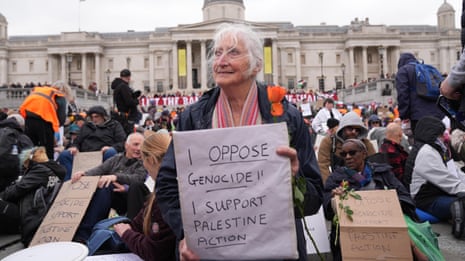
Instead, the term is largely reserved by ministers for those who challenge Israel’s actions in Gaza. Matching the official definition to the Palestine Action protests is a far tougher call than matching it to the Belfast riots. But while more than 3,000 people have now been arrested for holding up signs in support of the banned group, and many face terrorism charges, no one in Belfast or Southampton has been charged with terrorist offences. Nor have those who whipped up the riots online. In fact, the latter group hasn’t yet been charged with anything. If you say “I support Palestine Action”, they might put you in jail. If you incite a racist riot, they put you on TV.
On Monday, the court of appeal upheld the government’s ban on Palestine Action, in a ruling that seems to me to highlight both the dangerous breadth of the government’s definition and the inequality of its application. As the human rights group Liberty points out, the judgment fails to clarify which direct action targeting property would not be terrorism. The former home secretary, Yvette Cooper, decided to ban the group after some of its members spray-painted two warplanes. Damaging military equipment in the hope of preventing its deployment, especially in illegal wars, has long been treated as an act of civil disobedience motivated by conscience, and some juries have acquitted on this basis.
The court of appeal judgment managed to cast protest as terrorism and terrorism as protest. Palestine Action “is not, as it claims, a direct action civil disobedience protest group like the suffragettes operating transparently in the open”. What??? Did the suffragettes plan their bombings, arson and assassination attempts – far more extreme than anything Palestine Action has contemplated – in open meetings in Parliament Square? The entire judgment seems to me to be based on fairytales: about democracy and how it evolves, the benign nature of the state, the efficacy of polite, invisible protest, and the untroubled course of English history.
The judges stated that banning Palestine Action “will not prevent any or all demonstrations targeted at Elbit”, an arms manufacturer supplying the Israel Defense Forces, whose factories in Britain have been a primary focus for the group. Well, two days earlier, John Woodcock, the government’s former anti-extremism tsar, called for the ban to be extended to the protest group People Against Genocide, which has blocked the gates of Elbit factories. The slippage had already begun.
It could go much further. At Woolwich crown court at the end of last week, four Palestine Action protesters who broke into an Elbit factory were sentenced as terrorists. The astonishing aspect of this case? They were not charged, tried or convicted as terrorists.
In fact, the prosecutors decided not to pursue terrorism charges against them, presumably because they reckoned the jury wouldn’t convict. But never mind: the Sentencing Act 2020 allows judges to send people down for crimes for which they have not been tried, with far longer sentences and more onerous conditions.
As Amnesty International explains, until recently the conscientious motivation of protesters was treated as a mitigating factor in sentencing. Now it is treated as an aggravating factor. What makes this even worse is that such defendants can no longer explain their motivations to the court. But, once the jury is dismissed, the judge can decide why they did it, and sentence them accordingly. This is not justice.
The action for which they were convicted happened before Palestine Action was proscribed as a terrorist group. What this means is that any protesters engaging in direct action could now be sentenced as terrorists, whether or not their group has been banned.
Astonishingly, the judge, Mr Justice Johnson, possibly for the first time in history, also sought to have legal proceedings taken against the barrister representing the Palestine Action protesters for contempt of court for his summing up of the defence case. Johnson claimed that Rajiv Menon KC had defied his instruction not to tell the jury it had the right to acquit the defendants regardless of his directions: an ancient and fundamental principle of English law.
The government has lent heavily on the assault of a police officer with a sledgehammer by one of the protesters, Samuel Corner. But, reckless and severe as the attack was, he was convicted of grievous bodily harm without intent: he panicked after being sprayed in the face with the incapacitant Pava and, unable to see clearly, lunged forwards to help another protester. In other words, violence against people was not the intent of the sole perpetrator, let alone of Palestine Action.
By contrast, some of the rioters in Belfast and Southampton clearly intended to hurt police officers and others. Some were highly organised. Investigative journalists have identified several groups helping to incite or organise the violence. Good luck finding them on the government’s list of proscribed organisations.
So, in considering Benn’s question – how else can we describe what we are seeing? – there is a second relevant answer: one rule for the right, another for the left. In other words, two-tier justice. The far right’s appropriation of the term, which has been used by Black activists for at least 45 years, should not stop us from seizing it back. Two-tier justice is real and ever present. But the last people who will ever find themselves on the wrong side of it are rightwing white men.
The government and judicial system treat far-right terrorism more leniently than leftwing dissent. So perhaps this should lead us to another answer to the question of how best to describe what we are seeing. It might be a nominally Labour government. But this is rightwing authoritarianism.
