

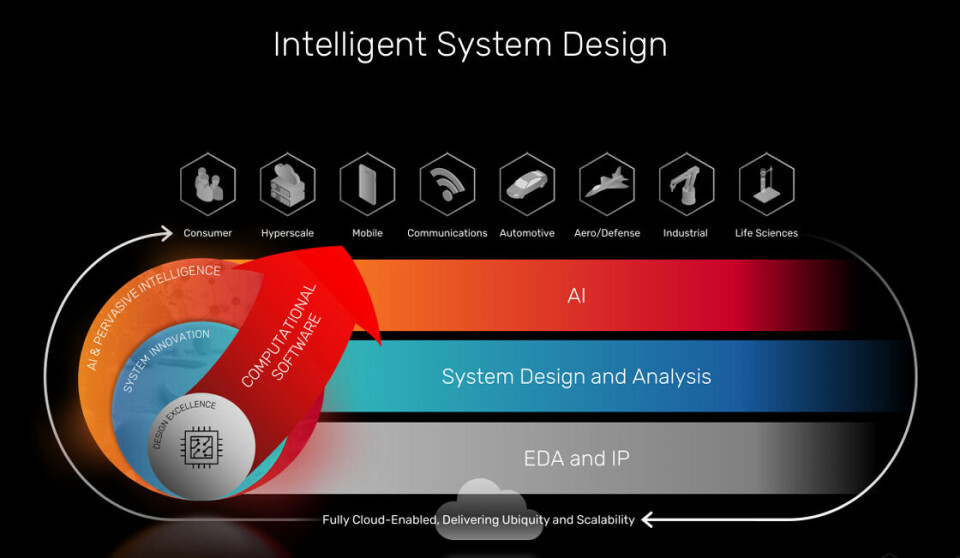
Rob Knoth harkens back to 2019, when Anirudh Devgan, then
president of Cadence Design Systems, walked to the whiteboard at the head of
the meeting room and started to draw circles. By this time, Cadence had been
around for almost three decades and was well known for designing semiconductors
and circuits
“We make the EDA software and the IP that’s critical to
today’s semiconductor and electronics industry,” Knoth, the company’s senior
group director for strategy and new ventures, tells The Next Platform. “Cadence
was in the business of helping companies make their semiconductors, helping
them make their printed circuit boards. That was really the fundamental part of
the company.”
However, things changed for the company that day seven years
ago. Devgan, who two years later also assumed the title of Cadence’s chief
executive officer, outlined how the company was going to grow and expand in the
coming years, noting that its competency in EDA software and the IP that is
critical to the semiconductor and electronics industry means its “insanely good
at simulating and optimizing incredibly complicated systems with a high degree
of precision, accuracy, and speed.”
“He saw the fact that we could grow from that core of design
excellence and start tackling full systems innovation,” he says. “It really is
just a matter of bringing in some additional expertise at the algorithm level,
but the core concepts of creating engineering software translate incredibly
well. The core ability to match an algorithm to a compute platform and get it
to accelerate or be able to deal with a designer’s thought process. Those are
all very transferable skills.”
According to Knoth, Devgan also saw the promising role AI
could play in Cadence’s ambitions and the IT industry in general, not only in
terms of products but also in the impact it would have in software, bringing
intelligence to design. Embracing the emerging technology – and more recently generative
and agentic AI – not only accelerated what the company does but also opened up
myriad verticals, from consumer tech to hyperscalers.
Cadence has been on the AI-fueled journey since. It’s got a
growing Candence.AI portfolio of AI-based tools. It includes its
Millennium M2000 supercomputer, introduced last year and powered by Nvidia’s
Blackwell GPU architecture. The system includes Nvidia’s HGX B200 systems,
RTX Pro 6000 Blackwell Server Edition GPUs, and CUDA-X libraries and solver
software, and Cadence uses it to accelerate many of its operations, including
EDA, system design analysis and molecular solvers.

The means being able to run huge simulations that the
company couldn’t before, which changes how it can approach the work it does,
from semiconductor and 3D-IC design and datacenter
digital twins to modeling for drug discovery and engineering work Cadence
is doing in other sectors it’s expanded into, including hyperscale computing,
automotive, and aerospace and defense.
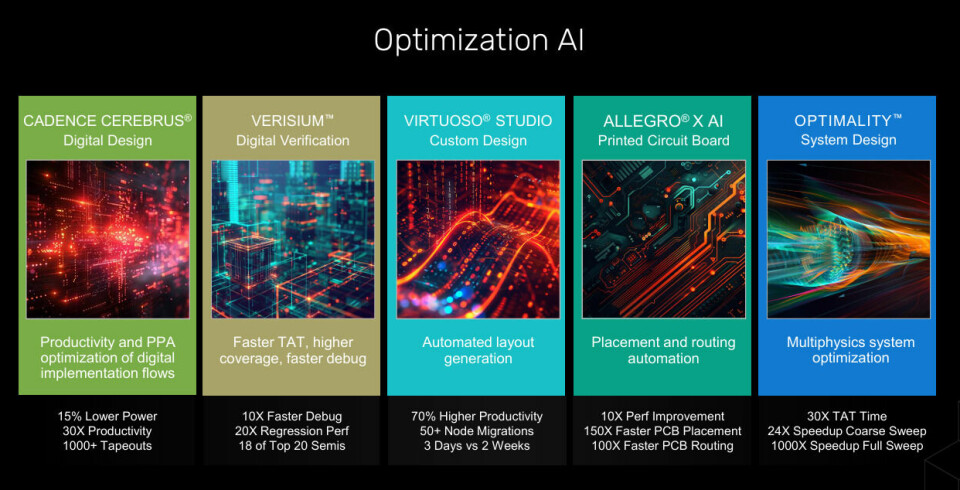
Other tools include the Verisium verification platform,
which enables algorithms to use big data and generative AI capabilities across
multiple runs and engine in security-on-a-chip (SoC) verification processes and
Allegro-X for faster PCB design. Cadence also is bringing agents into its
offerings, including Cerebrus AI Studio, which the company describes as an
agentic AI-based multi-block and multi-user SoC design platform.
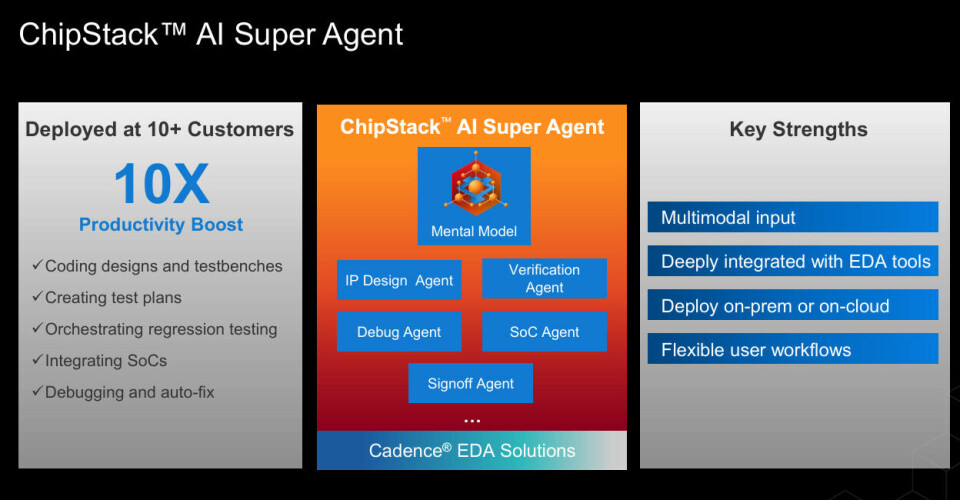
In recent months, Cadence has unveiled its ChipStack AI
Super Agent aimed at silicon design and verification and deeper integration
with Nvidia’s technologies – including its Grace CPUs – that executives say
will lead to accelerated offerings in such areas as EDA, system design
automation.
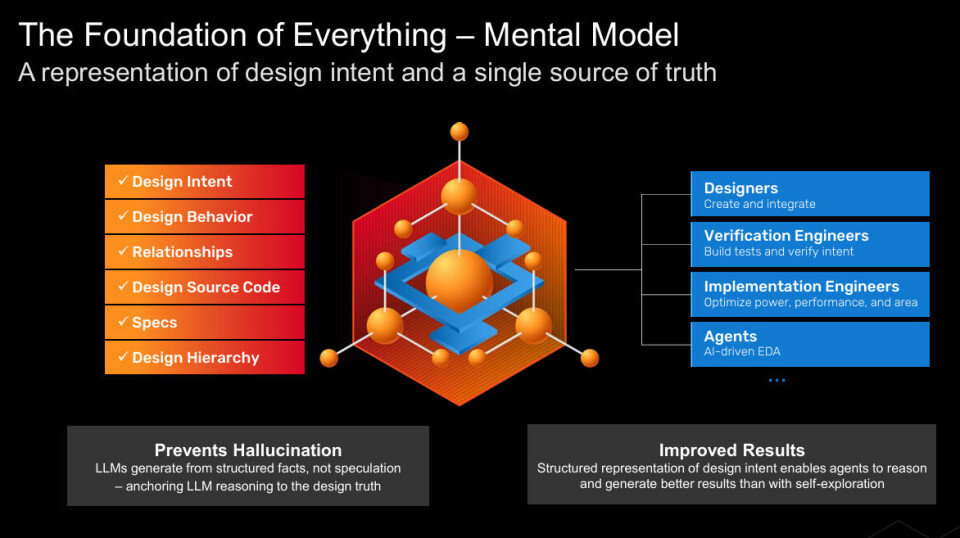
Core to ChipStack AI Super Agent is what Cadence calls its
Mental Model, which provides a structured and persistent understanding of the
intent of engineers, acting as a single source of truth that pulls in
specification, hierarchies, and relationships for AI agents, ensuring they
don’t suffer the hallucinations large language models do.
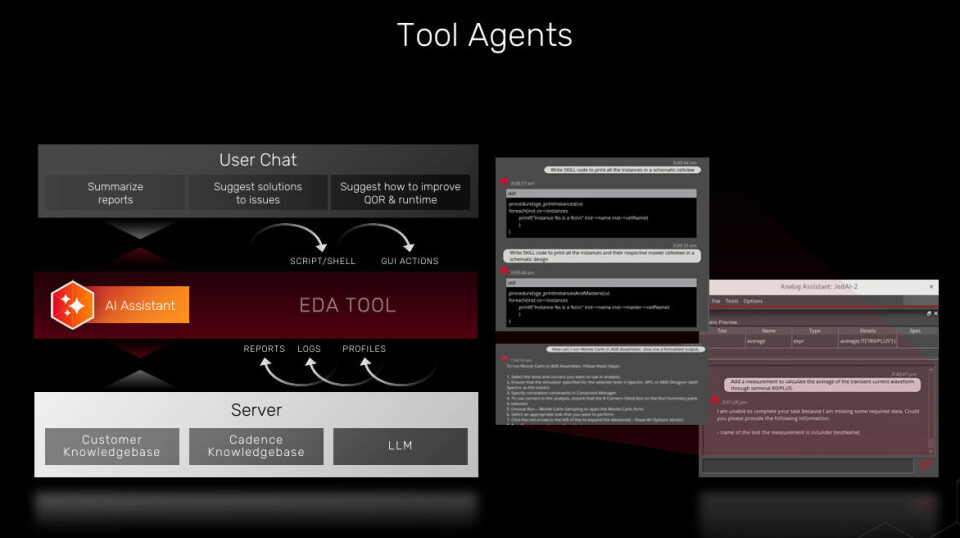
Cadence began adding agentic capabilities last year, such as
natural language interfaces, AI assistants, and basic agents, Knoth says.
ChipStack AI Super Agent was a big step.
“The whole reason for that is verification is the tall
temple in any of the major semiconductor products that are out there today,” he
says. “It’s a problem that you can throw as many resources and compute at as
possible and you never really finish it. Being able to give people more
productivity and more efficacy here, this was a natural win, and the best place
to start to apply agentic AI.”
At its CadenceLIVE 2026 show this week in San Jose,
California, Devgan and other executives announced expanded partnerships with
Nvidia and Google to expand the Cadence’s AI-powered computational software
semiconductor and system design capabilities and its reach in the area of AI
physics. Cadence and Google are integrating the hyperscaler’s
Gemini AI platform with the ChipStack AI Super Agent and it making it
available on the Google Cloud Marketplace. The goal is to offer an agentic and
scalable cloud-native platform for chip design and verification.
With Nvidia, the companies are looking to combine Cadence’s
AI-based design, EDA, and SDA offerings with CUDA-X, AI physics, and Omniverse
libraries for digital twins and running this on the Millennium M2000
Supercomputer. This will let engineers to use Cadence’s physics engines and
Nvidia AI models to train robots through digital twin technology.
This will allow Cadence to accelerate its principled solvers
and use AI physics models to generate engineering workloads that will as much
as 100 times faster than what’s offered now.
The announcements and work that Cadence already has done are
part of what the company calls its “Design for AI and AI for Design” strategy.
It’s essentially the idea of creating tools for AI workloads and using AI to
create chips, which centers on AI and agentic AI being used to improve
productivity and chip performance. Building the infrastructure – design for AI
– is what Cadence has been doing for more than 35 years.
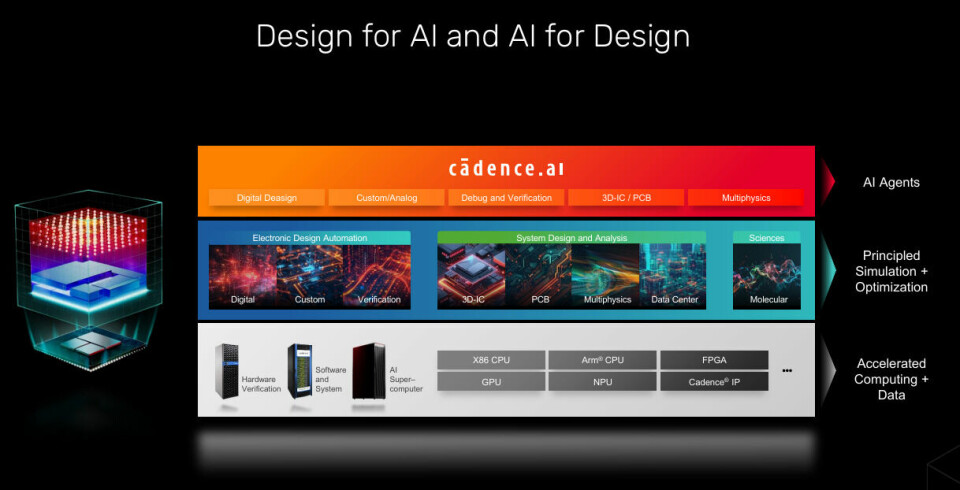
“What’s new now is the other half, where we take the AI
that’s been created and we bake it into our solutions so that they’re easier to
use, they’re more powerful, they’re more effective, and that creates a flywheel
effect where those tools help design the next generation of infrastructure,
that next generation infrastructure creates a more powerful model,” Knoth says.
“We integrate that into our tools and it just keeps on going.”
The adoption of AI in most aspects of the business also has
helped Cadence expand into markets that it wouldn’t reach before. The
industries that Cadence list on its website include aerospace and defense,
automotive, hyperscale computing, and life sciences. It’s being accomplished
both through in-house innovation and acquisition. For example, Cadence bought startup
ChipStack in November 2025, a month after closing on the purchase of Secure-IC
for its embedded security IP. In February, the company bought Hexagon AB’s
design and engineering business in a move aimed at expanding its SDA portfolio
and future in the physical AI space, which includes robots and autonomous
vehicles.
“We have expanded from that core of design excellence, which
is really that EDA side into systems where we’re designing all the world’s big
3D-ICs,” Knoth says. “We’re continuing to produce PCBs, but we’ve got
industry-leading algorithms and software now and multi-physics where people are
designing combustion simulations for energy systems or they’re doing drone
design or airplane design. They are creating digital twins of datacenters and
helping maximize tokens-per-watt and making those more effective. We have even
expanded out into molecular science.”
Cadence made the jump into molecular science with the 2022
acquisition of OpenEye Scientific Software, extending its competency in
computational software into molecular modeling and simulation. It is the move
that put into focus the vision that Devgan outlined on the whiteboard three
years earlier, Knoth says, adding that the strategy “goes to infinity. You just
find the next new solver you’re going after and you marry that with your
expertise and you’re able to enter these new markets. We don’t stray from our
center of competence. We’re still creating computational software, but the
formula is extensible, repeatable and successful.”
It seems to be working for Cadence. The company in February
reported FY 2025 results that showed almost $5.3 billion, a year-over-year jump
from more than $4.64 billion in 2024.
“Where we see this going is very rapidly,” says Knoth.
“You are going to have embodied AI moving in the world around us, sensing,
interacting, etc., and this we see mostly focused on drones, autonomous driving,
or robots, and that requires incredibly complex silicon and systems that are
co-optimized together. These horizons, the things that are happening, they
don’t stop when the next one starts. They’re building on each other, they’re
continuing to increase, and that goes even further out into applying these
domains to all of the disciplines of science, whether that’s the drug
discovery-type work that we’re doing now or material science – battery
research, environmental research. These topics are evergreen and the world has
no shortage of challenges that are out there to be solved. It’s a great place
to be.”
