

The memory market – by which we mean dynamic main memory as well as flash persistent memory – has been utterly and perhaps forever changed by the GenAI boom. Never before in the history of IT has fast and fat memory been in such high demand, and never before has it been so difficult and expensive to bring each successive generation of DRAM and flash to market.
It is a perfect mix of conditions to allow the enterprise-class memory makers of the world – all 3.25 of them doing main memory (Samsung and SK Hynix in Korea, Micron Technology in the US, and ChangXin Memory Technologies in China) and the four enterprise flash chip makers (Samsung, SK Hynix, Micron, and Kioxia/Western Digital) – to do something that they have not been able in five decades: Consistently and predictable make money without a boom/bust cycle.
It’s an amazing thing, really. And the world is not quite used to this new fact of life in the datacenter. The total addressable market for all kinds of memory is going up and up, driven a little bit by capacity increases among these memory chip foundries but driven up a whole lot more by the prices that these companies can command based on the huge surge in demand from the hyperscalers, cloud builders, AI model builders, and neoclouds of the world. The demand is not abating, there are no reasonable substitutes, and so the prices keep going up and up.
And while Micron is making a big deal about having inked five year agreements with enterprises for DRAM and flash with its sixteen largest customers, giving it a revenue backlog of over $100 billion and about getting $22 billion in cash payments upfront for that capacity, Micron is not stupid. There is no reason to presell all of its memory and flash capacity, and in fact that backlog only represents 20 percent of DRAM capacity and 33 percent of flash capacity between 2026 and 2030 inclusive. The rest of the capacity is subject to ever-increasing prices based on demand. And with Micron saying that it expects demand to outpace supply out past 2027, you can bet Elon Musk’s last hundred billion dollars that memory prices are going to keep rising and the TAM for memory will expand accordingly. But 20 percent per year manufacturing capacity increases are all we are going to get.
As long as this GenAI boom persists, the boom/bust cycles that have plagued the for memory and flash markets are dead. If the GenAI bubble bursts, it all comes crashing back down to reality. In the short term, memory will be a bigger component of a server than CPUs, and flash might be, too. (We are going to run some configurations to see when we get a moment.)
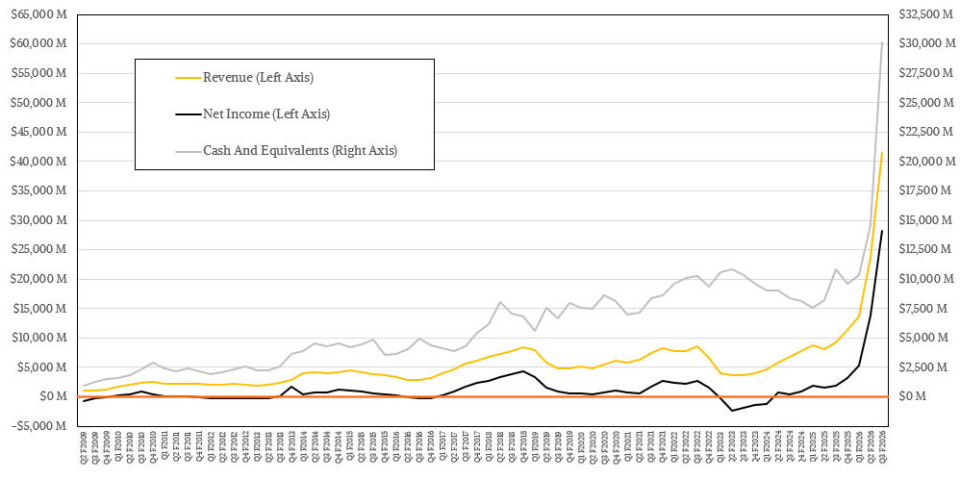
In its fiscal third quarter ended in May, Micron absolutely minted coin, and will do so for the next several years at the very least. Even if people shift their AI engines from GPUs to various XPUs, they are not going to shift away from HBM stacked DRAM memory. The need for bandwidth is too great. The AI models will have to change the way they stream and store data to be more efficient. There is always some math tricks that can be done to boost the efficiency of software, but HBM hardware is limited by physics and economics. The HBM roadmap is what it is, and there is not much that can be done to change it.
In that May quarter, Micron raked in a very impressive $41.46 billion, up by a factor of 4.5X from the year ago period and up 73.7 percent sequentially from Q2 F2026. Let that soak in for a minute. With bits shipped capacity growing at maybe 20 percent to 25 percent for both DRAM and NAND, most of that increase is a shift from NAND to DRAM and from DRAM to HBM coupled with price increases across the board. Operating income was up a staggering 15.4X to 33.32 billion, and net income rose by a mind-numbing 14X to $28.24 billion.
The world has not seen anything like this since the Spanish discovered the silver mines of the Inca Empire in Potosi, Bolivia back in 1525. All that Spanish silver caused a massive tsunami of inflation around the world, but it greased the skids for the first wave of global trade the Terran economy ever saw.
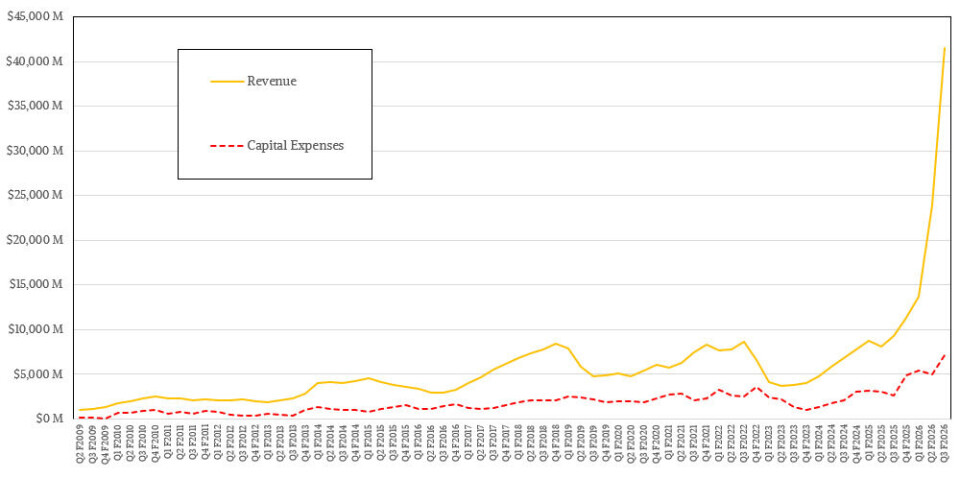
Micron spent $7.1 billion in capital expenses to boost the capacity of its foundries, and it still ended the quarter with $30.1 billion in cash and equivalents in the bank. (This does not include the cash payments from the sixteen companies driving that $100 billion in revenue backlog, which will probably be booked against research and development and capital expenses.)
As you can see, capex is not even close to growing at the pace of revenues and profits, and as we have pointed out, Micron has little incentive to blow all of its cash creating new foundry capacity. It is far better to push prices higher, particularly when Samsung and SK Hynix are doing the same thing.
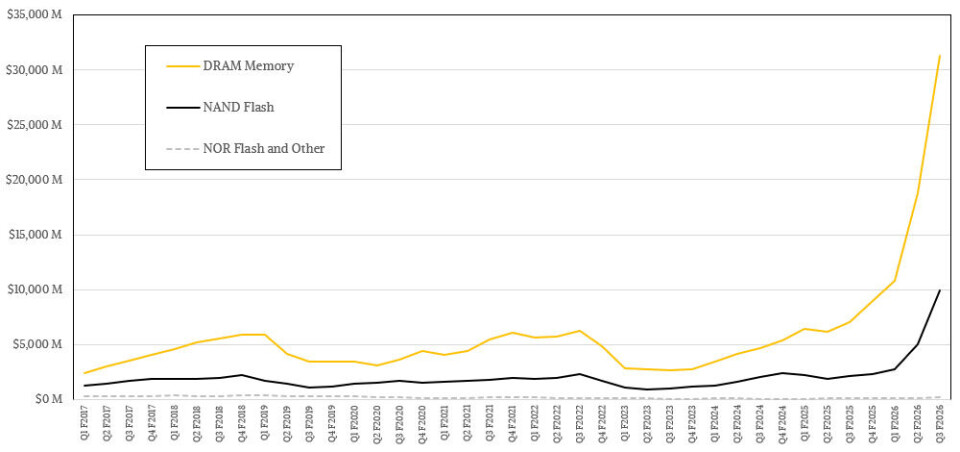
In the quarter, Micron posted DRAM sales of $31.33 billion, up by a factor of 4.3X compared to the year ago period and up 66.9 percent sequentially. NAND flash storage drove $9.94 billion in sales, and of that, slightly more than $5 billion of that was for enterprise-class flash chips and drives. NOR flash, which is used for BIOS/UEFI storage as well as for other exotic use cases where fast and cold storage is required, had $185 million in sales, 2.5X higher than NOR sales in the year ago period and nearly double sequentially.
Let’s now take a look at Micron’s sales by business groups. Here is a table that gives you a sense of the datacenter business versus other businesses concentrated on PC, mobile, auto, military, and embedded use cases:
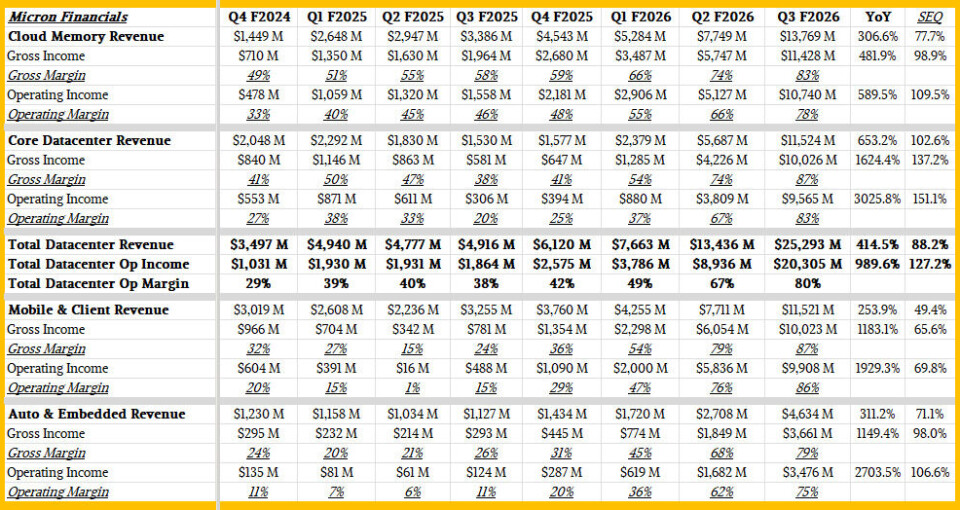
And here is a chart that shows what we care about here at The Next Platform, which is the datacenter part of Micron’s business:
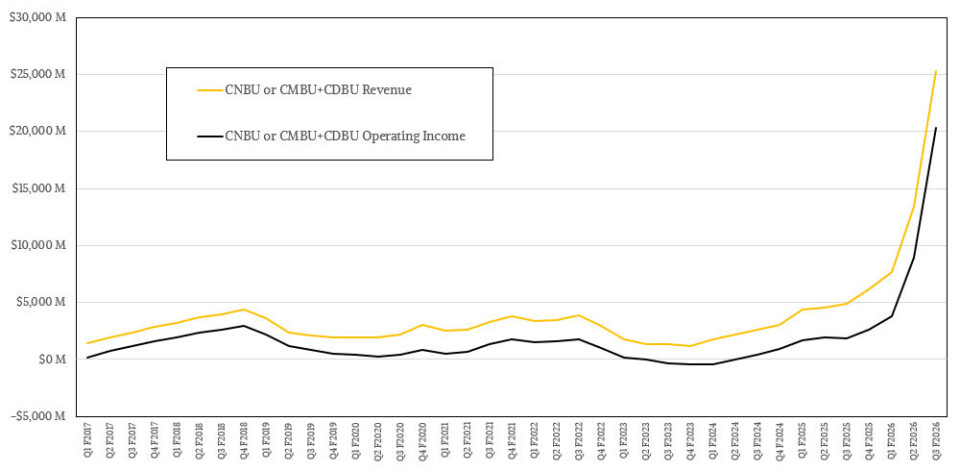
The Cloud Memory unit, which sells HBM stacked memory as well as low power LPDDR memory increasingly used in server nodes, had sales of $13.77 billion, up 4X from the year ago period, with operating income of $10.74 billion, up 5.9X year on year.
The Core Datacenter Group, which sells enterprise flash as well as normal server DRAM, had sales of $11.52 billion, up 7.5X year on year with operating income of $9.57 billion, up 31.3X year on year. (That is not a typo). Talk about opportunistic pricing to drive profits! That’s crazy.
Micron no longer talks about HBM sales distinct from high performance DRAM for servers, but I take a stab at figuring it out each quarter because this is actually important.
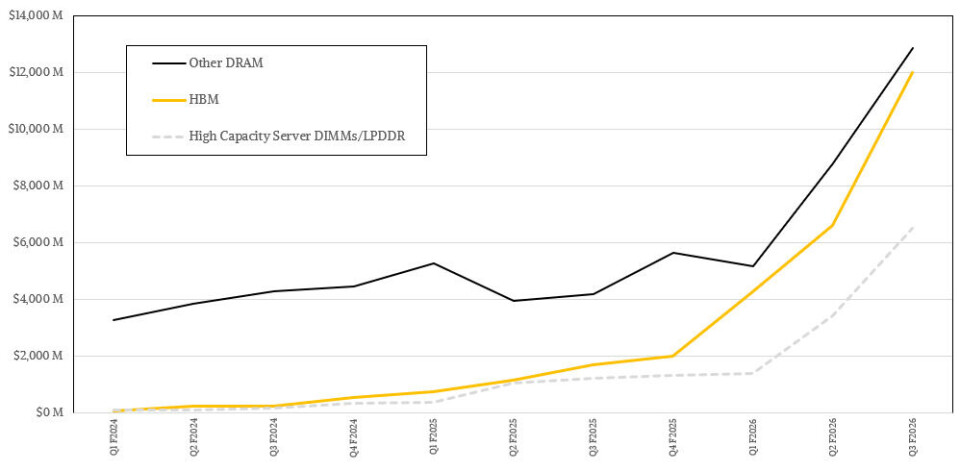
My model pegs Micron’s HBM revenues in Q3 F2026 at $11.98 billion, up 7.1X year on year and up 81.9 percent sequentially. High capacity server memory drove $6.48 billion in sales, up 5.4X compared to a year ago. I think all of the juicy memory – HBM, high capacity server memory, and LPDDR memory – drove $18.46 billion in sales, also up 6.4X year on year. If you do the math, all other DRAM – used on other devices outside of servers – accounted for $12.87 billion, up 3.1X compared to Q3 F2025.
Micron updated its HBM TAM forecast once again during its call with Wall Street this week. Here is how it has evolved over time:
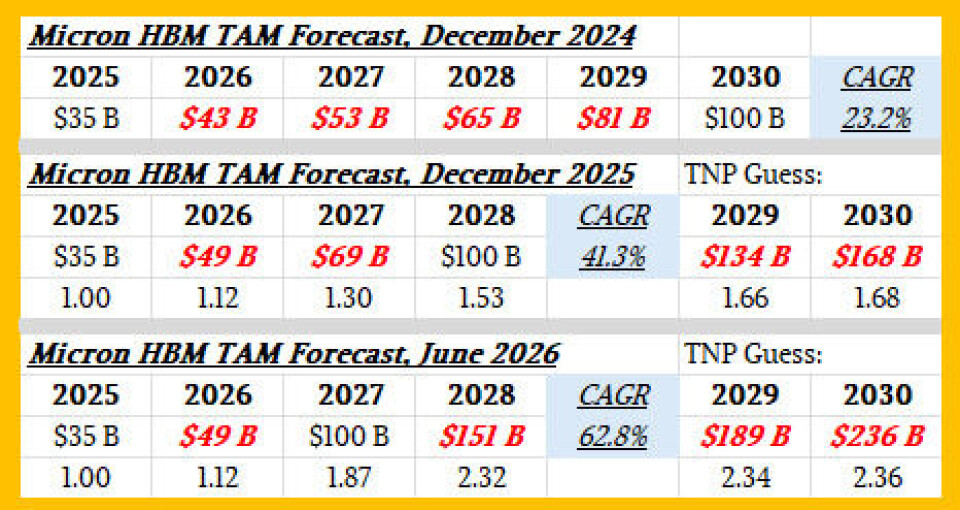
As we have said, most of this TAM increase is due to some capacity increases but a lot of price increases as everyone is chasing HBM for their AI accelerators. In the last year and a half, the HBM TAM between 2026 and 2030 has grown by 2.1X. In December 2024, Micron was expecting that aggregate TAM to be around $343 billion (if you make some assumptions in the middle years, as we did and show in bold red italics). Now, it looks like it will be around $724 billion.
Crazy, right?
Looking ahead to Q4 F2026, Micron expects for revenues to be on the order of $50 billion, give or take $1 billion. Profits will no doubt grow faster than revenues.
