

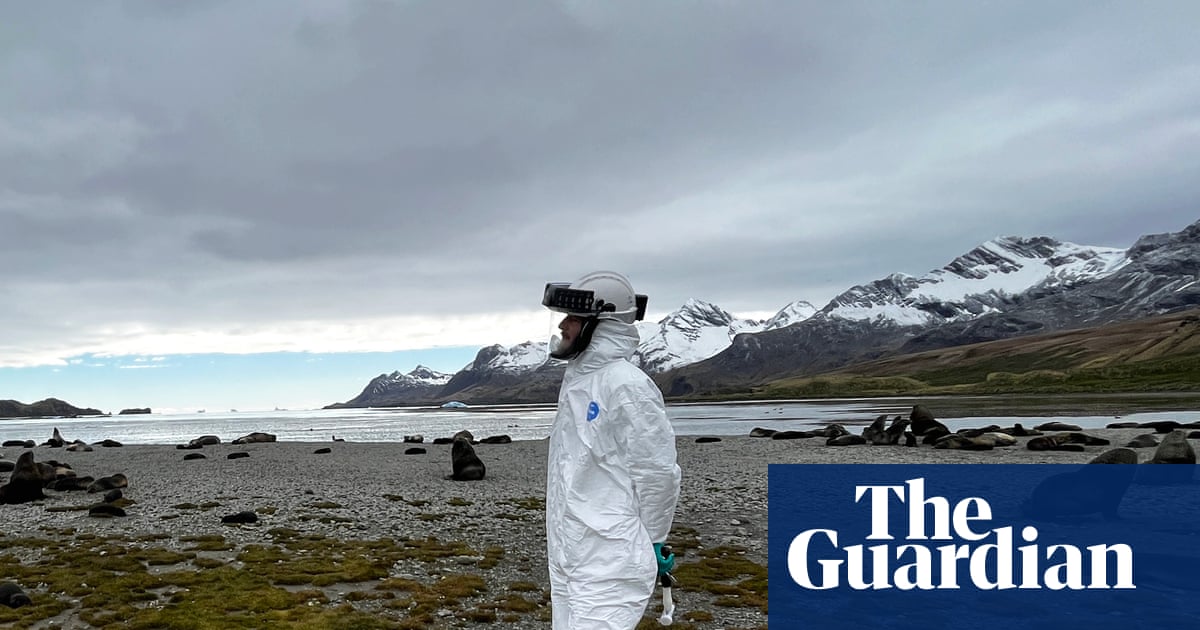
It was a rough five-day sail from the Falkland Islands and, as the science expedition approached the South Georgia coast, they found fur seal carcasses floating on the water. “There were these moments when it would hit us,” says Dr Jane Younger, remembering the expedition to the British subantarctic territory six months ago.
Younger, an ecologist at the Institute for Marine and Antarctic Studies at the University of Tasmania, was with scientists from the United States, France, South Africa and the Falklands to check on the spread of the H5N1 variant of bird flu.
The disease has cut a devastating and traumatising swathe across the planet, killing millions of birds and mammals since it took hold in Europe in 2020. More than 200 million poultry birds in the United States have been culled and tens of thousands of seals in South America have died.
The H5N1 strain was detected in migrating seabirds in the subantarctic in late 2023 and in South Georgia’s seal population in early 2024. “We were hoping because this was the third year, we might not have seen so many dead animals. But that wasn’t the case. The smell was overwhelming,” says Younger.
From one cove to the next, Younger saw hundreds of giant petrels – a scavenging seabird with a two-metre wingspan – feasting on the densely packed bodies of dead fur and elephant seals.
“We saw an adult female fur seal. It had freshly died and the pup was still trying to suckle. The male was still trying to defend her,” she says.
“It was this little family unit … that was upsetting.”
While Younger was in South Georgia, another team of scientists, led by Australia’s Antarctic program, were 6,500km (4,000 miles) east on Heard Island, discovering 13,000 dead elephant seal pups alongside hundreds of other dead seals and birds, including penguins. Disease tests were positive.
Younger and the Antarctic program scientists are all back in Australia, but it appears the virus has followed them to its final frontier. Now it has Australia’s unique wildlife in its sights.
A potential tragedy for the world
Giant petrels and brown skuas migrate from their Antarctic breeding grounds to waters off Australia in the southern winter. They rarely come ashore unless they see a chance to scavenge or are sick.
Three petrels and a skua were found dead or sick on beaches along the country’s vast southern shoreline earlier this month. This week, tests confirmed they had the deadly strain, with two more suspect cases. H5N1 has now reached every continent on the planet.
Risk to humans from the disease is low. Since 1997 there have been about 500 deaths in 25 countries, mostly among people working in commercial poultry. For context, about 1,700 people died in Australia last year from influenza.
Sea and waterbirds migrate south to Australia during the southern hemisphere spring, but also north from Antarctica in the winter. The continent is surrounded by the disease.
Now national and state governments, conservationists and scientists are anxiously waiting to see if this wave of incursions will spread into Australia’s native wildlife.
The variant presents unique challenges and risks for Australia. About half of the country’s bird species are endemic – that is, they exist nowhere else on the planet. Endemism levels are even higher in land-based mammals, at about 87%.
Losing a species to extinction in Australia means the species disappears from the planet. The high number of unique species also means little is known about how they might react to the disease.
“We’re not exactly sure what the impacts will be, but we’re very clear there will be impacts,” says Dr Fiona Fraser, Australia’s threatened species commissioner.
“These endemic species are highly valued by Australians and have enormous cultural value to our First Nations people. Any loss of these species is a tragedy for the world.”
Watching the carnage overseas, Australia established a national response plan to bird flu in 2024 and has been funding projects to reduce the risk of spread. About 100 response plans have been drawn up for both species and locations at risk.
Prof John Woinarski, an ecologist at Charles Darwin University, has spent decades documenting the decline of Australia’s threatened species to habitat loss and invasive species such as cats, foxes and pigs. About 18 months ago he started work with the government and BirdLife Australia to analyse the bird flu risk to the country’s mammals and birds.
“Sixty-odd million years of isolation has meant Australian fauna is ecologically distinctive. It’s hard to predict what might happen just from looking at mammals overseas,” he says.
More than 150 bird species are considered at “very high risk” of extinction or major population declines if they catch the disease, according to the risk analysis.
More than 10 mammals are also deemed high-risk, including the unique Australian sea lion, the Tasmanian devil, the platypus and the rakali (water rat).
“It is turbocharging the pathway to extinction, and that’s why [the government] has tried to prioritise those at risk,” he says.
“The potential for spread within Australia is likely to be very high and very rapid.”
Decades of effort to build back threatened mammal and bird populations are likely to be undone, Woinarski says. “It’s going to be a major setback.”
Like many experts the Guardian spoke to, Woinarski says if the bird flu arrivals of recent weeks do not spread into native animal populations now, it will happen sooner or later.
“It is likely to be highly confronting for most people,” he says. “People will see corpses of their favourite birds in all sorts of places.
“And it is a gruesome death. The birds lose their coordination and make these jerky movements and have a tortured death. It is not a pleasant sight.”
“It will spread across almost all of Australia in the next six to 12 months and will be recurring for three to five years. Maybe after that it will stabilise and become just another threat. But there are a lot of unknowns.”
Prof Brendan Wintle is a conservation biologist at the University of Melbourne’s The Biodiversity Council, a not-for-profit expert group. He says before the disease has a chance to spread, the government should be creating captive populations of some threatened species which could quickly become extinct if infected.
“We need insurance policies,” he says. “There has been such low funding for risk assessments and management of conservation that we are quite poorly prepared in terms of people on the ground to secure species. That needs redressing.”
More than 1,700 species and unique habitats are considered threatened in Australia.
“We have so many threatened species and so little funding,” says Wintle.
‘We’ve been on the lookout’
For 40 years, University of New South Wales ecologist Prof Richard Kingsford has been climbing into a plane every October to spend six weeks flying across a third of the country to monitor waterbirds.
On each trip he flies 38,000km (24,000 miles) – a distance that would almost circumnavigate the planet. He has already seen a decline in numbers of about 70% since the 1980s.
“The surveys give us a chance to see if there are any mass deaths. We’ve been on the lookout for [the disease] ever since it got into Asia and Antarctica,” he says.
Wetlands and watercourses are natural reservoirs for disease and also attract dense groups of birds, creating ideal conditions for spread.
Kingsford says individual waterbirds can fly huge distances, spanning the continent, meaning they could spread the disease far and wide.
Right now, good rains have seen waterbirds flocking to the country’s interior.
But an El Niño climate pattern is expected to dry out the inland in the coming months, pushing birds towards the coasts, where they will more easily come into contact with infected migrating birds.
“I worry about our waterbirds because they have been declining for years. There could be a massive whammy coming their way,” Kingsford says.
“The big question is how and when will it get into the waterbird community? Then, the pathways [for spreading the disease] are many and varied.”
