

There is no dearth of historic aircraft that helped to change the course of World War II — the B-17 Flying Fortress, the Vought F4U Corsair and the P-51 Mustang, to name a few.
But scarcely any could be called heroic.
In the case of the F4F Wildcat, usually outnumbered and almost always outclassed by its opponents, an exception can be made.
Distinctive in that it was first designed as a biplane in 1935, the U.S. Navy soon realized that the first iteration, the XF4F-1, could not compete with monoplane fighters.
Modifications continued throughout the next couple of years until the XF4F-3’s debut, which first flew on Feb. 12, 1939, about two months after the first flight of the Mitsubishi A6M1 Zero prototype in Japan.
First combat with the Wildcat was not with any U.S. service, however, but with Britain’s Royal Navy. Its first victim was German. (The Royal Navy called the aircraft the Martlet until March 1944, when it adopted the Wildcat moniker.)
According to historian Bruce Crawford, the British had shown great interest in the Wildcat as a replacement for the Gloster Sea Gladiator, and the first platforms were delivered in late 1940.
On Christmas Day that year, the stubby plane had its combat debut when it shot down a Junkers Ju-88 bomber over the Scapa Flow naval base in Scotland’s Orkney Islands archipelago.
By the close of 1940, the U.S. Navy, perhaps recognizing the effectiveness of the pugnacious plane, awarded Grumman a contract for 600 Wildcats.
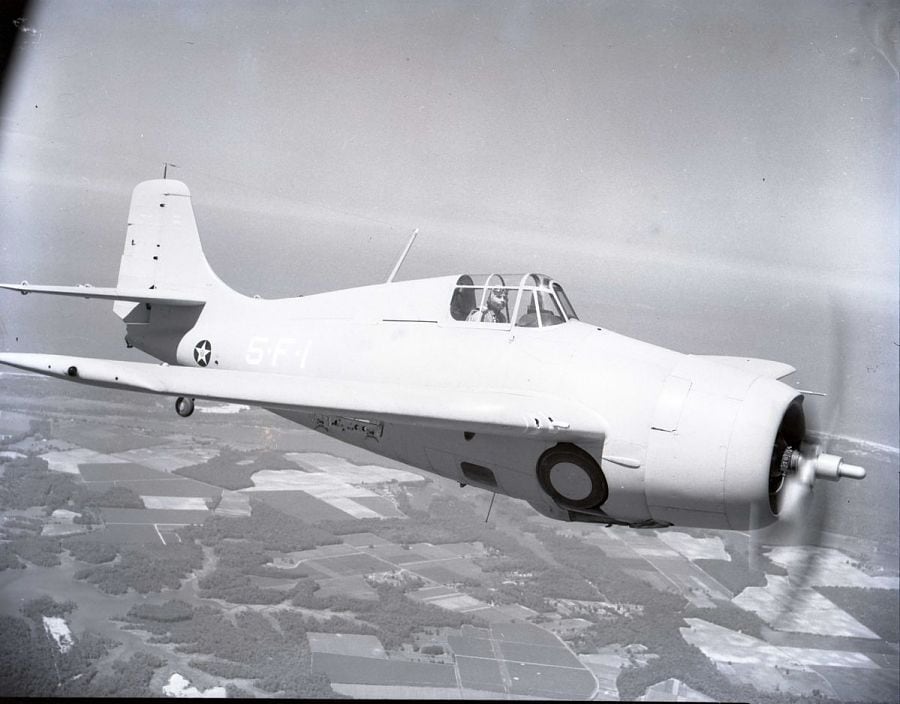
Their American debut was less than auspicious, however.
As morning dawned at Pearl Harbor on Dec. 7, 1941, 11 Wildcats were caught on the ground. Nearly all were destroyed.
It was the subsequent defense of Wake Island from Dec. 8 to Dec. 23 — by Marine squadron VMF-211 — where the Wildcat’s tenacity was first displayed.
A small, undermanned outpost 2,000 miles west of Oahu delivered what Maj. Gen. Thomas Holcomb described to Secretary of the Navy Frank Knox as “A cheery note” from Wake.
The initial Japanese attack left seven of 12 F4F3s wrecked on the field, with 23 of the squadron’s 55 men on the ground killed and 11 wounded. Not a single aircraft mechanic escaped injury. According to Ian Toll in his Pacific trilogy, VMF-211 suffered 50% casualties in the first minutes of combat alone.
Despite this, VMF-211 fought on for nearly two weeks, using its three airworthy planes — described by Toll as Frankenstein’s monster, “rattling, bullet-ridden, patched-over amalgamations of parts” — to bomb and sink the Japanese destroyer Kisaragi and eventually repel the Japanese invading force.
The plane was neither as fast as the Japanese Zero nor as aerobatic, but it was sturdy, stable and able to take severe punishment.
“I would still assess the Wildcat as the outstanding naval fighter of the early years of WWII,” British test pilot Eric M. Brown wrote in his evaluation of the Wildcat. “Its ruggedness meant that it had a much lower attrition rate on carrier operations than, say, the Sea Hurricane or the Seafire, and although it had neither the performance nor the aesthetic appeal of the latter, it was the perfect compromise solution designed specifically for the naval environment, to such a degree indeed that it was easier to take-off or land on an aircraft carrier than a runway.”
“I actually flew one sortie of four-and-a-half hours in this fighter — and fine ditching characteristics, for which I can vouch as a matter of personal experience, this Grumman fighter was, for my money, one of the finest shipboard aeroplanes ever created,” Brown continued.
Despite the carnage at Pearl, enough Wildcats had been received by the fleet that as carrier operations began in February 1941, the Wildcat was ready and the plane’s latest iteration, the F4F-4, carried with it a new innovation: folding wings.
The new mechanism allowed for carriers to accommodate 27 of the fighters — nine more than before, but at a cost. The addition of two more machine guns caused a falloff in climb and maneuverability, and the .50-caliber machine guns fired for only 22 seconds before ammunition was expended, down from 40 seconds in earlier versions.
“That, in combination with the placement of the cockpit high on the fuselage to give good vision,” writes Crawford, “helped give the Wildcat its distinctive, pugnacious appearance.”
Nearly 85 Wildcats flew from Yorktown, Enterprise and Hornet during Midway. And while it was the Douglas SBD Dauntless dive bomber that made a name for itself at the historic naval battle, the stubby Wildcat continued to make significant contributions to the American victories at the battles of Guadalcanal, the Solomons and in the Battle of the Atlantic.
A large part of the Wildcat’s success was tactics.
“The agile Zero, like most Japanese army and navy fighter craft, had been designed to excel in slow-speed maneuvers,” writes Crawford. “U.S. Navy aviators realized early on that the Zero’s controls became heavy at high speeds and were less effective in high-speed rolls and dives.
“Navy tacticians like James Flatley and James Thach preached that the important thing was to maintain speed – whenever possible – no matter what the Zero did. Although the Wildcat was not especially fast, its two-speed supercharger enabled it to perform well at high altitudes, something that the Bell P-39 and Curtiss P-40 could not do.”
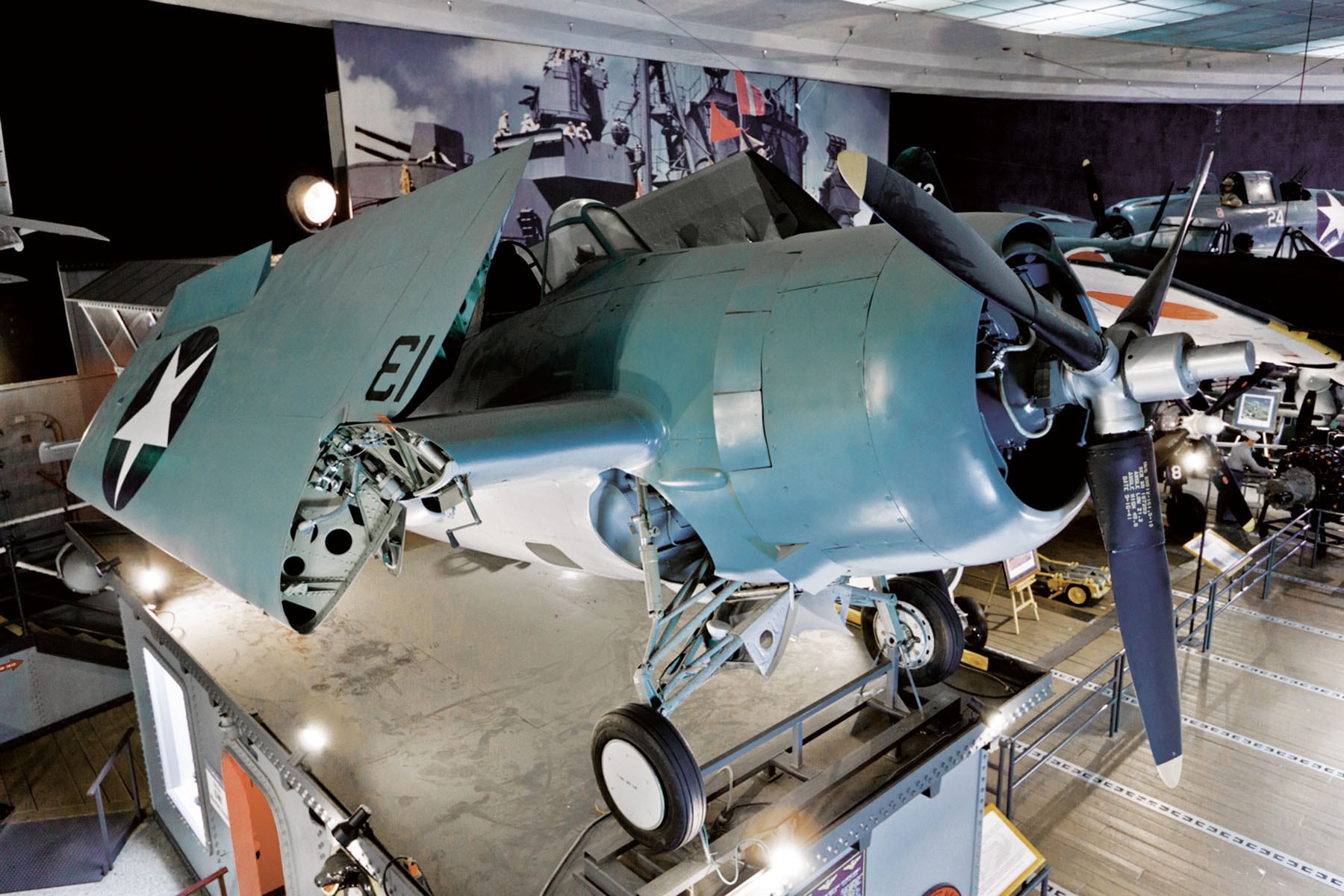
So rugged was the F4F that terminal dive airspeed was not redlined, meaning that the Mitsubishi A6M Zero’s 7.7mm cowl guns and 20mm cannons were only effective at point-blank range.
Conversely, the Wildcat’s .50-caliber wing guns were enough to cause the complete disintegration of a Zero.
By 1942, the F4F kill-to-loss ratio for air combat was 5.9 to 1; for the entire war, the ratio was 6.9 to 1, according to the U.S. Naval Institute. The impressive ratio was earned despite the Wildcat being the only carrier-based fighter operated by the Navy during the first half of the war in the Pacific. Forty-eight Marine pilots would become WWII aces in Wildcats.
Two problems would continue to plague the F4F throughout its life, however. The manual landing gear retraction mechanism required 30 turns with a hand crank to retract — with one slip resulting in a serious wrist injury.
It also, in the ensuing years, was unable to be modified to keep pace with wartime fighter development.
While the Wildcat continued to fly for the duration of the war, by 1943 it had become largely supplanted aboard carriers by the F6F Hellcat.
Yet the burly fighter had one more fight left in it as it helped contribute to eliminating the U-boat menace in the Atlantic as its ruggedness and range — enhanced by two 58-gallon drop tanks — continued to make it ideal for use off small escort carrier decks, according to Crawford.
By the numbers, the F4F’s kill tally was less than the Corsair and significantly less than the Hellcat. But in the early days of the war, when the Japanese’s march through the Pacific seemed unstoppable, it was the bite of the Wildcat — the rugged, unflappable fighter — that delivered moments of heroic victory to a beleaguered nation.
Claire Barrett is an editor and military history correspondent for Military Times. She is also a World War II researcher with an unparalleled affinity for Sir Winston Churchill and Michigan football.
