

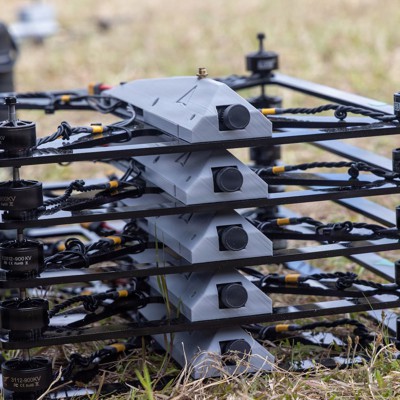
The Pentagon announced the Replicator Initiative with fanfare in 2023, aiming to field vast numbers of affordable, expendable drones as a strategic counter to China. However, by 2025, the program was limping along due to congressional criticism over stalled progress and the absence of a permanent institutional home or consistent funding.
The Pentagon officially dissolved Replicator in late 2025, absorbing it into the newly minted Defense Autonomous Warfare Group, or DAWG. Originally allocated a modest $225.9 million in the fiscal year 2026 budget, DAWG was widely expected to be just another iterative defense working group.
But the Trump administration’s FY27 budget request has shattered those expectations. The White House is requesting a staggering $54.6 billion for DAWG—a near 24,000 percent increase in a single fiscal year. Reflecting on the scale of the surge, retired general and former CIA Director David Petraeus noted that DAWG represents the “largest single commitment to autonomous warfare in history.”
This is no longer a pilot program. The Pentagon has stopped treating autonomous warfare like a startup project and is now funding it like a permanent branch of the American military apparatus.
Why did Replicator fail?
The unprecedented scale of DAWG’s budget is a direct response to the limitations that stalled its predecessor.
The Replicator Initiative rushed to procure specific, ready-built drone platforms. However, Replicator’s chosen drones suffered from persistent technical issues, struggled to integrate with existing military command-and-control systems, and were far too expensive and slow to manufacture in the quantity needed.
Furthermore, the Pentagon was paralyzed by its own procurement process. It struggled with up-front vetting, finding that many systems were entirely unfinished or purely conceptual. Perhaps most critically, Replicator failed to procure software able to orchestrate and command massive swarms of different drones.
Compounding these technological hurdles was an institutional homelessness. Because Replicator never possessed its own dedicated line-item budget, defense officials were forced to constantly reprogram. Frustrated by the lack of transparency regarding long-term lifecycle costs, Congress increasingly pushed back.
Managing the $54 billion operational whiplash
DAWG is designed to rectify the past mistakes of the Replicator Initiative, but its sudden financial windfall has only introduced more questions. How does an office that managed $225 million last year suddenly oversee $54.6 billion?
Pushing this massive sum through traditional Pentagon procurement pipelines risks a bottleneck. DAWG simply does not possess the infrastructure (contracting officers, lawyers, program managers etc.) to obligate that volume of capital in a twelve-month cycle. To prevent this, the Pentagon divided DAWG’s funds.
Of the $54.6 billion request, only $1 billion sits in the standard, highly restricted base budget. The remaining $53 billion has been tucked away into a flexible future reconciliation pot. This gives DAWG up to five years to obligate the funds. Instead of being forced to frantically dump billions into obsolete hardware before the fiscal clock runs out, DAWG can instead dole out cash incrementally as autonomous technology matures. To ensure long-term viability, DAWG will emphasize procurement, operations, maintenance, training, and sustainment over the first few years before scaling back to ensure active manufacturing lines while avoiding the risk of overproduction.
Will DAWG be different?
There are some early signs that the institutional shift to DAWG will be different from the Replicator experience. Unlike Replicator, which sat precariously under the Defense Innovation Unit as a pilot program, DAWG is getting more permanent institutional teeth. Defense Secretary Pete Hegseth recently announced the impending creation of a dedicated Sub-Unified Command for Autonomous Warfare. Simultaneously, U.S. Southern Command has established its own autonomous warfare command, which will work closely with DAWG to identify available expertise and capabilities required for operations.
Architecturally, the focus has shifted from hardware to software. Acting Pentagon Comptroller Jules Hurst describes DAWG as a “pathfinder,” embedded with private tech firms, live-testing “orchestration tools for autonomy” and providing real-time combat feedback. This software-focused mentality is demonstrated by the recent announcement that Shield AI has been tapped to integrate its Hivemind AI pilot software into the military’s new Low-Cost Uncrewed Combat Attack System, or LUCAS. Unlike Replicator, DAWG has introduced a new divergent priority to develop sophisticated software that can be flashed onto any cheap drone frame.
Yet, lawmakers are starting to raise major red flags. There is a growing anxiety in Congress that the Pentagon’s foundational policy on AI weapons, DoD Directive 3000.09, is completely unequipped for this scale of deployment. The directive mandates “appropriate levels of human judgement,” but when orchestrating thousands of autonomous systems simultaneously, human-in-the-loop oversight becomes a mathematical impossibility. An uncomfortable reality is beginning to emerge: the Pentagon is throwing a military-branch-sized budget at autonomous swarms before deciding on the rules of engagement.
Ultimately, the creation of DAWG represents a structural shift rather than a guaranteed technological revolution. By shifting the ad-hoc, hardware-first approach of the Replicator Initiative to a permanent, software-focused funding line, the Pentagon is attempting to fix a broken acquisition pipeline that has historically been unable to move at the speed of commercial technology.
However, funding and execution are different. DAWG’s ambitious plans still heavily rely on a congressional reconciliation process that faces a complicated and uncertain political path. Even if the $54.6 billion request is approved, the Pentagon must still solve the immense logistical challenge of integrating thousands of autonomous systems into a joint force that lacks established doctrine for swarm warfare.
The Pentagon has clearly signaled where it believes the future of warfare lies. But as DAWG moves from a budget proposal to an operational reality, its success will not be measured by the size of its funding pot, but by whether the military can safely and effectively integrate these algorithmic tools into the reality of modern combat.
