

“Iran’s power is the Hormuz Strait.” Those were Iranian foreign minister Abbas Aragchi’s words on state television last week. He wasn’t wrong. Four weeks into this conflict, the United States has struck more than 10,000 Iranian targets, destroyed roughly 80% of Iran’s air defense capabilities, and eliminated its navy as a fighting force. Yet the strait remains effectively closed — and Iran’s drones and missiles are keeping it that way.
Tehran’s goal is to impose persistent economic and political costs until Washington concludes that continuing the war is not worth it. To achieve that, Iran is exploiting a gap in U.S. Air Force doctrine — the distinction between air superiority and air denial, and between the blue skies and the air littoral. So far, it is working.
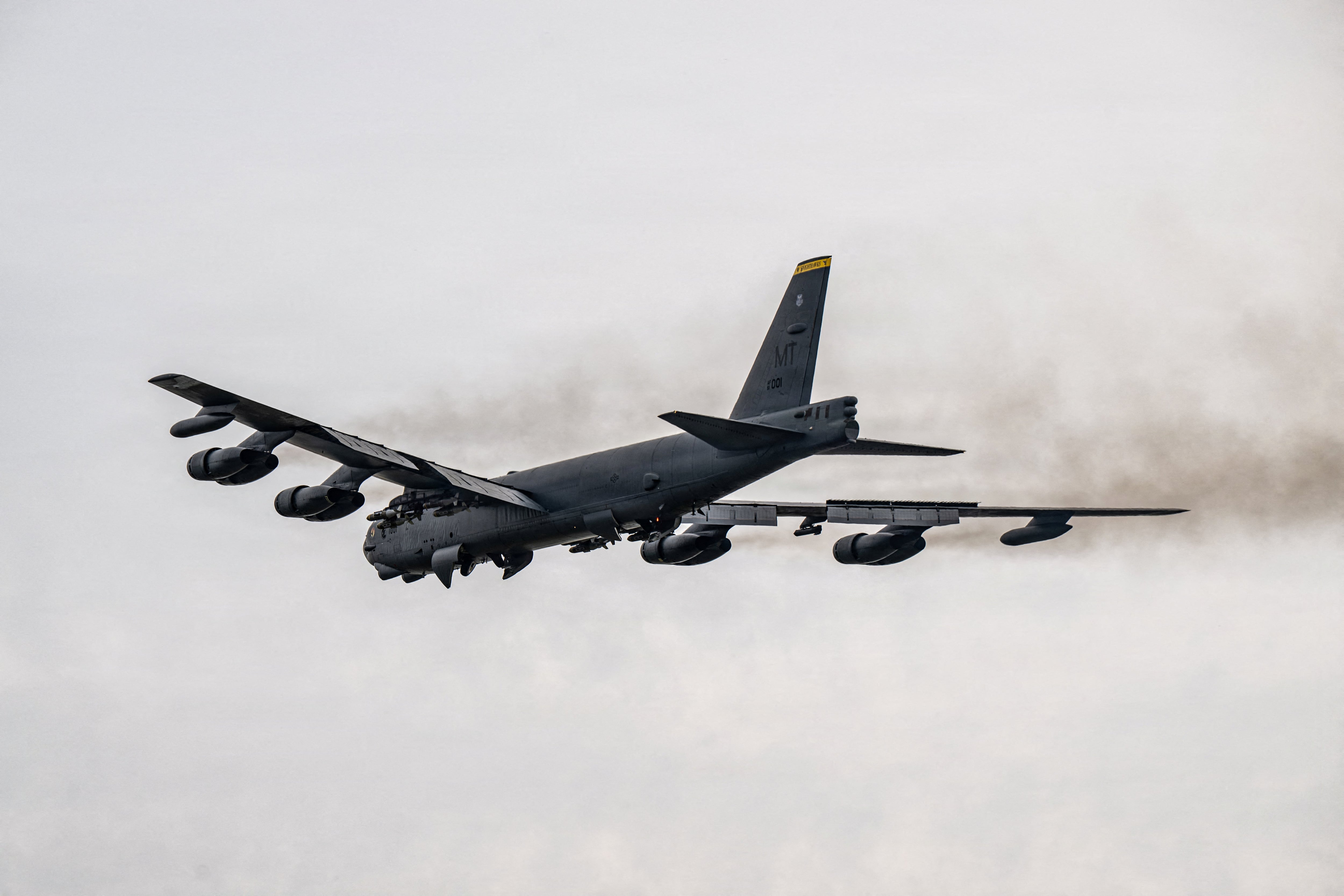
Air superiority — the control that permits operations at a “given time and place without prohibitive interference from air and missile threats” — is what the United States has achieved over southern and western Iran and is now working to extend eastward. That control allows large-scale strikes and freedom of maneuver at medium and high altitudes. As Gen. Dan Caine, chairman of the Joint Chiefs of Staff, noted on Tuesday, “Given the increase in air superiority, we’ve successfully started to conduct the first overland B-52 missions.”
By that measure, the campaign has been a success. But the strait is still closed.
RELATED

Air superiority is meant to assure freedom of action not just in the air, but across all domains for the entire joint force.
Air Force Doctrine Publication 3-0 is explicit on this point: air superiority “prevents enemy air and missile threats from effectively interfering with operations of friendly air, land, maritime, space, cyberspace, and special operations forces.” That includes the Navy’s ability to escort commercial vessels through the Strait of Hormuz.
By that measure, the United States does not have air superiority where it counts.
Iran’s drone and missile campaign has already forced American forces back. In 2003, the bulk of U.S. combat and support aircraft operated from forward positions in Kuwait, Qatar and Saudi Arabia while carriers patrolled the Persian Gulf. Today, carriers increasingly operate from the Red and Arabian Seas while land-based airpower has shifted toward bases farther from the strait, leaving U.S. forces positioned for the high-altitude fight over Iran, not the persistent-close-in coverage the strait requires to keep shipping lanes open under continuous drone and missile threat.
Iran’s strategy of air denial is why.
Air denial is a strategy of contesting control of the air without achieving air superiority outright. It leverages the advantages of large numbers of low-cost and mobile systems employed in a distributed way to keep the air domain too dangerous, too costly and too uncertain for joint forces to operate. Critically, the barriers to achieving air denial are considerably lower than those required to gain and sustain air superiority, yet it can impose disproportionate costs.
In the Strait of Hormuz, Iran is putting this strategy into practice. Tehran is exploiting the air littoral above the strait, employing drones and missiles capable of reaching oil tankers and naval vessels in minutes. Iran has struck more than 20 commercial vessels in and around the strait since the war began, killing at least seven sailors. This action has effectively halted traffic through the strait, except for a handful of ships that Iran has let pass — in many cases, for a hefty fee. The U.S. Navy has reportedly declined requests from the shipping industry for military escorts, citing the ongoing threat.
Iran’s strategy appears to be working. Gas prices have risen a dollar a gallon in a month, U.S. stock markets have entered correction territory, and the White House is under growing pressure to wind down the conflict. Iran planned for exactly this.
Tehran built this playbook, funded it, and watched it succeed. The lessons come straight from the Red Sea, where Houthi proxies used cheap, distributed drones and missiles to impose costs that more than 800 U.S. airstrikes between 2024 and 2025 could not eliminate. Now, Iran is running the same playbook over the Strait of Hormuz.
The United States has no ready answer. Achieving and maintaining air superiority in the air littoral above the strait demands the very layered defense capabilities in which the Pentagon has systematically underinvested: large numbers of low-cost, attritable systems to continuously attack launch locations and dispersed manufacturing; mobile air defenses rapidly and persistently deployable near threatened waterways; low cost persistent airborne platforms capable of detecting and destroying waves of drones; and interceptors capable of sustaining high engagement rates without exhausting inventories.
These are precisely the capabilities decades of procurement choices never built at scale, in favor of the small number of exquisite platforms that have performed so well in the blue skies above Tehran. The gap is not an accident. It is the result of choices. The Strait of Hormuz is one of their consequences.
Addressing this gap requires building low-cost, attritable systems at scale to contest and control the air littoral — not in small numbers as an afterthought, after the high-end aircraft are bought and paid for, but as a core mission — which inevitably means scaling back legacy platforms. The window to absorb that lesson is open now, while the cost is measured in closed shipping lanes and rising gas prices.
Maximilian K. Bremer is a nonresident fellow with the Reimagining US Grand Strategy Program at the Stimson Center and head of Mission Engineering and Strategy for Atropos Group.
Kelly A. Grieco is a senior fellow with the Reimagining US Grand Strategy Program at the Stimson Center and adjunct professor in the Center for Security Studies at Georgetown University.
