

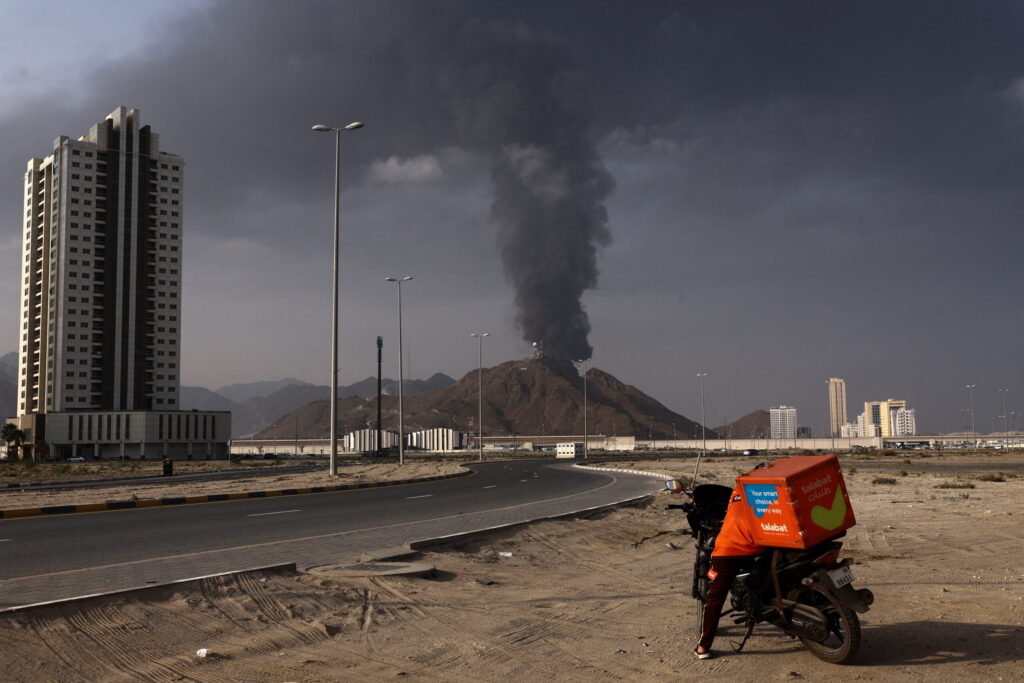
The Gulf Arab states are geographically close to the sites of some of the world’s most devastating recent conflicts, including Syria, Gaza, Lebanon, and Yemen. Though some of them have faced attacks from the Houthis, they were largely spared significant, persistent spillover attacks from Iran inside their borders. All that changed on February 28, with the launch of the US-Israeli conflict with Iran.
Iran retaliated by targeting Gulf Cooperation Council (GCC) countries with about 83 percent of its total missile and drone strikes during the war, with the United Arab Emirates (UAE) receiving the most attacks out of any country, including Israel. The shock from the war and worries over future strikes threaten the sense of security, prosperity, and opportunity that Saudi Arabia and the UAE in particular have spent years and billions of dollars cultivating as they seek to diversify their economies away from oil. As a longtime investor in the region told me: “The perception of the Gulf Arab states as safe havens in a tough region is shattered and will be challenging to reverse for some time. They likely will have a higher risk premium in the eyes of most investors and companies. I cannot see an outcome of the war that completely eliminates this reality—they have been exposed.”
A new security paradox
Gulf states must now confront a paradox: They are reliant on the United States for security, and there is no good alternative. At the same time, the actions the United States and Israel have taken in this war introduce new security issues for Gulf states. There are two main scenarios going forward:
- The cease-fire holds. In this scenario, the United States and Iran reach a framework deal addressing discrete issues, such as reopening the Strait of Hormuz. This could potentially extend the cease-fire and lead to more comprehensive negotiations.
- The cease-fire breaks down. If the United States and Iran fail to reach a deal, this could result in escalation, such as more attacks on the GCC or strikes on Iran’s energy facilities.
No matter which scenario occurs, Gulf Arab states now face a vast landscape of new security and economic challenges.
SIGN UP FOR THIS WEEK IN THE MIDEAST NEWSLETTER
What will the Gulf Arab states do?
- They will push to ensure that the Strait of Hormuz is not controlled by Iran and that the United States or Israel do not adopt a policy of periodic strikes on Iran. If Iran controls the strait, this gives it a new financial lifeline in the form of tolls that could total fifty billion dollars per year, and 80-95 percent of the tolls would likely be paid by the Gulf states, cutting into their oil revenue. If the United States or Israel adopt a “mow the grass” strategy of periodic strikes on Iran, this would mean a looming threat of war that would fundamentally undermine GCC states’ security and their business model.
- Different Gulf states will adopt different strategies. Some may be more open to dialogue and deals with Tehran while others may harden their stance. For example, Oman congratulated the new Iranian supreme leader and held a call with Iran’s president despite coming under attack. Saudi Arabia has expelled some Iranian diplomats from the kingdom, but it has not closed its embassy in Tehran (unlike the UAE). The UAE may take a harder-line approach toward Iran as discussed below.
- They are unlikely to become more unified because of this war. Some analysts have argued that this war will bring Saudi Arabia and the UAE closer, but that is not likely. The relationship between the two states’ leaders is too frayed, their policy disagreements in Yemen and Sudan remain, they will continue to compete head-to-head in multiple business sectors, and now they may also take divergent approaches to responding to the Iran threat. The GCC states may now also compete with each other to replenish US-made defensive weapons, which are in short supply globally.
- Though there has been some discussion about developing joint, local defense capacities, any effort to develop a NATO-like alliance among the GCC states is not likely to get off the ground because both Saudi Arabia and the UAE would want to lead it and neither would accept the other as head.
- Gulf Arab states will not want to fundamentally pull away from the United States. Regional governments have pledged some two trillion dollars in US investment, while also prioritizing closer ties to US President Donald Trump, from investing in family businesses to gifting a luxury airplane for presidential use. All this work to cozy up to Trump did not yield a veto over the current war, but GCC states may still try to pull closer to the United States in the aftermath, such as through buying more defensive weapons systems and conducting more bilateral joint training and security integration. The war has shown the reliability and excellent performance of US technology, and Gulf Arab states will view access to this equipment as vital for their security.
- The UAE and Saudi Arabia in particular may also try to influence the United States’ policy approach toward both Israel and Iran. The leaders of Saudi Arabia and the UAE have a track record of influencing Trump’s policy decisions in the region including on Syria, access to advanced US artificial intelligence (AI) chips, and Sudan.
- Gulf Arab states will continue to have close economic relationships with China, but will want to avoid crossing US redlines such as allowing China to build military bases, because they will not want to jeopardize their access to cutting-edge AI chips or US military equipment and cooperation. Reports that Iran used Chinese satellites to locate US bases in GCC countries and that China might send weapons to Iran are a reminder of the limits of any partnership with China compared to what the United States offers.
- Saudi Arabia may emerge from the conflict with a desire to bolster ties with not just the United States but also with Pakistan and Turkey. Pakistan has played a surprisingly crucial role in facilitating negotiations with Iran, and Saudi Arabia this month said it will provide three billion dollars to help Pakistan pay off its debt to the UAE. Saudi Arabia has a defense pact with Pakistan, but that did not stop Iran from launching attacks on Saudi Arabia, showing the minimal deterrence value of such accords unless they are seen as credible. Turkey, meanwhile, is hoping to make six billion dollars in defense sales to Saudi Arabia.
How the UAE may diverge from its neighbors
The UAE may adopt the most significant policy changes due to this war. Geographic proximity probably played a role in why it sustained the most Iranian attacks, but a more likely explanation is the UAE’s dominance in the region as a global financial, business, transit, and tourism hub, as well as its participation in the Abraham Accords with Israel. Iran likely wanted to shatter the sense of safety in the UAE to chill foreign investment and tourism.
After seeking to improve diplomatic relations over the past few years, the UAE has hit a new low point of mistrust with Iran. UAE President Sheikh Mohamed bin Zayed Al Nahyan, known as MBZ, called Iran an “enemy” in March. The UAE closed its embassy in Iran and withdrew all diplomatic staff the day after the war began and has also closed Iranian institutions inside the UAE, such as schools and cultural centers. The UAE also said it would contribute to military efforts to reopen the Strait of Hormuz.
Following the cease-fire, a slight thaw took place: The UAE’s deputy prime minister and the Iranian speaker of parliament held a call. Anwar Gargash, a top advisor to the UAE’s president, explained: “The UAE does not close the doors of diplomatic communication, but we judge by actions, not words.”
The attacks on the UAE have been so significant and so publicized that it may have to work the hardest out of all the GCC states to rebuild investor trust and attract tourism. This will likely need to be done through a combination of military spending, enhanced defensive missile and drone capabilities, investments in new defensive technologies, and the hardening of business and civilian targets, including perhaps placing data centers underground.
If an enduring and comprehensive cease-fire is achieved or if Iran eventually embarks on a different, more positive path in the future, that could speed up the timeline for the UAE’s—and the whole region’s—much hoped-for economic recovery.
Stefanie Hausheer Ali is an Atlantic Council nonresident fellow and a senior director at international affairs consulting firm Rice, Hadley, Gates & Manuel LLC. The information in this article represents the views and opinions of the author and does not necessarily represent the views or opinions of Rice, Hadley, Gates & Manuel LLC.
Further reading
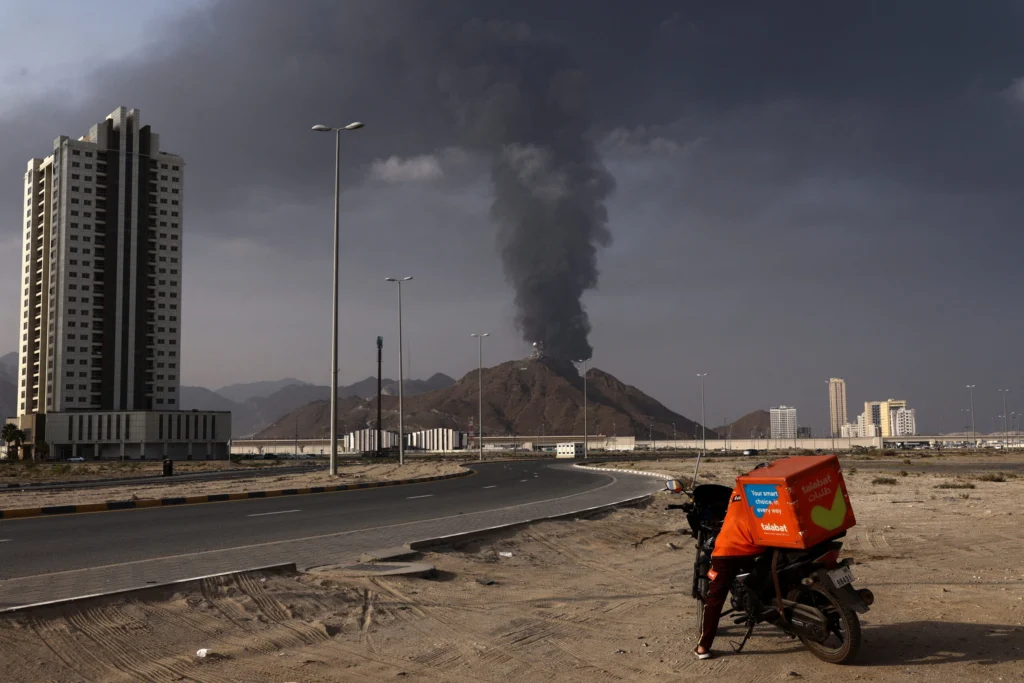
Image: A person stands next to a motorcycle as smoke rises in the Fujairah oil industry zone following a fire caused by debris after interception of a drone by air defenses, according to the Fujairah media office, amid the U.S.-Israel conflict with Iran, in Fujairah, United Arab Emirates, March 3, 2026. (REUTERS/Amr Alfiky)
