

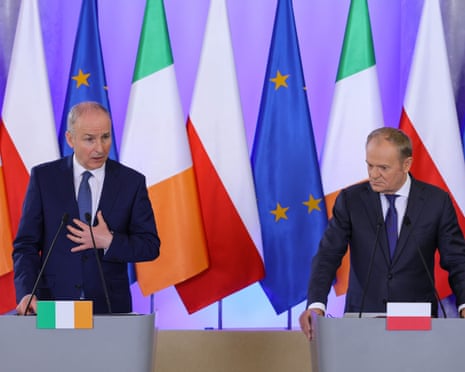
Poland’s Tusk and Ireland’s Martin blast Hungarian foreign minister’s ‘repulsive’, ‘sinister’ and ‘unacceptable’ backchannel talks with Russia
Separately, Ireland’s Martin and Poland’s Tusk very strongly criticised the latest disclosures on Hungarian foreign minister Péter Szijjártó’s relations with Russia, calling his conversations with his Moscow counterpart “repulsive” and “sinister.”

Earlier today, a group of five European media outlets published what they said was a phone call between Szijjártó and the Russian foreign minister, Sergei Lavrov, discussing their plan to amend the EU’s sanctions list to Moscow’s liking (11:10).
The investigation also alleged further contacts between the minister and Russian officials.
Tusk and Martin said the tone of the recorded conversation showed “unacceptable” and “deferential tone” from the EU country’s minister, with the Irish PM saying it “confirmed what many suspected” about Hungary “doing the bidding for Russia” within the bloc.
In unusually strong comments, Tusk said:
“What we have heard, and what we had already suspected, is merely a confirmation of the deeply disturbing political dependence of Viktor Orbán’s government and his foreign minister, Mr Szijjártó, directly on the authorities in Moscow.
It has been a long time, if ever, since I have heard something so disheartening. What these recordings have revealed is more than just the political dependency of the Budapest government on Moscow; it has exposed just how unacceptable and bizarre this relationship truly is.
A foreign minister of a European nation – a member of the European Union – reporting to the Russian foreign minister on the completion of a task and asking for patience because he knows he still has several more tasks to carry out? One could hardly imagine anything more repulsive. It is absolutely disqualifying. …
Poland loves Hungary, and Poles love the Hungarian people; ours is a friendship that has endured for decades and centuries. That is why it is so important to me that everyone in Hungary hears this: nothing has changed on our end. We are glad to be part of the European community alongside the Hungarian people.
The tragedy is that Viktor Orbán’s government – certainly Orbán himself and minister Szijjártó – effectively left the European Union a long time ago.”
Martin joined in, adding:
“I think it is a very sinister development.
It confirms what many suspected that the Hungarian government has been doing the bidding for Russia within the European Union for quite some time.
The deferential tone in the conversation was alarming, and it really is a very serious situation that within the European Union you have that type of behaviour and it is very revealing of the relationship between the Hungarian government and the Russian government. … It’s unacceptable.”
Key events
Closing summary

Jakub Krupa
… and on that note, it’s a wrap for today!
Several EU leaders have strongly criticised Hungary after a media report disclosed new details about Hungarian foreign minister Péter Szijjártó’s conversations with his Russian counterpart Sergei Lavrov.
A joint investigation by five European outlets revealed what it said were alleged conversations between Szijjártó, Lavrov, and another Russian official, in which they seemed to discuss amending the EU sanctions lists, among other things (11:10).
Szijjártó dismissed the findings, saying they only confirm that “I say the same publicly as I do on the phone,” pointing to his previous criticism of the bloc’s sanctions regime.
Poland’s prime minister Donald Tusk said the disclosure was “a confirmation of the deeply disturbing political dependence” of Hungary on Russia, calling out “unacceptable” and “repulsive” tone of the reported conversations.
Ireland’s prime minister Micheál Martin said it was “a very sinister development,” which “confirms what many suspected” about Hungary “doing the bidding for Russia” within the EU (16:50).
Czech president and former Nato general Petr Pavel said the incident should prompt the Czech authorities to re-evaluate its relations and sharing of confidential information with Hungary, but his criticism got dismissed by the government (17:33).
Separately, the EU’s top diplomat spoke with Szijjártó to remind him of the expectation of confidentiality for all EU discussions held behind the closed doors, the European Commission said (12:46).
In other news,
US president Donald Trump and US secretary of state Marco Rubio criticised European Nato allies for their refusal to support US offensive operations against Iran, after France, Italy and Spain reportedly denied requests to use their airspace or bases for these purposes (11:59, 12:03, 13:24, 14:36, 15:30, 16:12).
The European Union has reaffirmed its support for Ukraine, marking the fourth anniversary of the liberation of Bucha, with a call to make Russia accountable for its war crimes in Ukraine (13:21).
The Finnish prime minister, Petteri Orpo, has said the war in Ukraine has “come close” after two drones fell on Finnish territory, but insisted that it did not constitute a military threat (11:55), after similar incidents were reported across the Baltics in recent days.
If you have any tips, comments or suggestions, email me at jakub.krupa@theguardian.com.
I am also on Bluesky at @jakubkrupa.bsky.social and on X at @jakubkrupa.
Fico says sanctions list can be only amended with support of all countries, argues there are ‘weak legal cases’
But the Slovak prime minister, Robert Fico, was much less critical of Hungary, stressing to reporters that any decision to remove someone from the sanctions list requires a unanimous agreement of all member states.
He sidestepped the question on the tone of the alleged conversation between Hungary’s foreign minister Péter Szijjártó and his Russian counterpart Sergei Lavrov, focusing on what he sees as a broader issue with the accuracy of the sanctions list.
He recalled that a Slovak citizen, Jozef Hambálek, was briefly listed too, and “being on that list completely destroyed his life,” even though “it was blindingly obvious there was no reason for him to be on that list.”
The EU originally said that he was “the president of the Europe chapter of the nationalist motorcycle club Nightwolves MC based in Slovakia,” alleging his close links to Vladimir Putin and that “his ongoing activities, which allegedly include training Nightwolves members for active combat in Ukraine on his properties and actively promoting pro-Russian propaganda in Europe can be deemed as a security threat for Ukraine and the EU.” He was later removed from the list in 2024.
Fico said that because Slovakia “was the first to raise this issue and speak about the so-called ‘weak legal cases’, others started reaching out to us,” and he received representations from Turkey and other “presidents in Central Asia.”
He continued:
“It must be stated very clearly: to remove someone from the sanctions list, you need the agreement of all 27 EU member states. Therefore, you cannot accuse anyone of being a Russian agent.
If you do, you would have to accuse all 27 member states of being Russian agents for agreeing to a decision – such as the one in the past regarding the sister of the well-known businessman Usmanov [reportedly discussed between Hungary and Russia]. …
So, the explanation for the whole story is simple: all 27 member states must agree. It is impossible to accuse anyone here of ‘doing favors’ or overstepping.”
Czech president urges government to ‘re-evaluate’ relations with Hungary over Russia ties disclosures
Czech president Petr Pavel has also responded to the latest disclosure on Hungary, urging the Czech government to “re-evaluate” its relations with the Hungarian government as a result of “unacceptable” discussions between Budapest and Moscow.
Pavel, a retired senior Nato general and former chair of the alliance’s military committee, is well known for his critical view of Russia and its increasingly assertive stance in the region and interference in European politics.
Talking to Česká Televize, he said:
“I find it absolutely unacceptable for an EU and Nato member state to circumvent the rules in this way and share sensitive, if not classified, information with our adversary.
We should certainly re-evaluate our relationship with Hungary based on this, specifically regarding what we do and do not share with them, because of course is simply wrong for a Nato member to undermine our security in such a way.”
Asked what he wanted the government to do, Pavel added:
“I’m not sure about a formal statement, but on a practical level – at least from my perspective – this should mean scaling back all ties with Péter Szijjártó. He is completely untrustworthy, and Viktor Orbán certainly knew about it as well. I believe that things like this simply cannot be allowed to slide.”
But the Czech foreign minister, Petr Macinka, dismissed his calls, telling iDnes.cz that as foreign policy remains a prerogative of the government, Pavel’s comments were “irrelevant.”
Poland’s Tusk and Ireland’s Martin blast Hungarian foreign minister’s ‘repulsive’, ‘sinister’ and ‘unacceptable’ backchannel talks with Russia
Separately, Ireland’s Martin and Poland’s Tusk very strongly criticised the latest disclosures on Hungarian foreign minister Péter Szijjártó’s relations with Russia, calling his conversations with his Moscow counterpart “repulsive” and “sinister.”
Earlier today, a group of five European media outlets published what they said was a phone call between Szijjártó and the Russian foreign minister, Sergei Lavrov, discussing their plan to amend the EU’s sanctions list to Moscow’s liking (11:10).
The investigation also alleged further contacts between the minister and Russian officials.
Tusk and Martin said the tone of the recorded conversation showed “unacceptable” and “deferential tone” from the EU country’s minister, with the Irish PM saying it “confirmed what many suspected” about Hungary “doing the bidding for Russia” within the bloc.
In unusually strong comments, Tusk said:
“What we have heard, and what we had already suspected, is merely a confirmation of the deeply disturbing political dependence of Viktor Orbán’s government and his foreign minister, Mr Szijjártó, directly on the authorities in Moscow.
It has been a long time, if ever, since I have heard something so disheartening. What these recordings have revealed is more than just the political dependency of the Budapest government on Moscow; it has exposed just how unacceptable and bizarre this relationship truly is.
A foreign minister of a European nation – a member of the European Union – reporting to the Russian foreign minister on the completion of a task and asking for patience because he knows he still has several more tasks to carry out? One could hardly imagine anything more repulsive. It is absolutely disqualifying. …
Poland loves Hungary, and Poles love the Hungarian people; ours is a friendship that has endured for decades and centuries. That is why it is so important to me that everyone in Hungary hears this: nothing has changed on our end. We are glad to be part of the European community alongside the Hungarian people.
The tragedy is that Viktor Orbán’s government – certainly Orbán himself and minister Szijjártó – effectively left the European Union a long time ago.”
Martin joined in, adding:
“I think it is a very sinister development.
It confirms what many suspected that the Hungarian government has been doing the bidding for Russia within the European Union for quite some time.
The deferential tone in the conversation was alarming, and it really is a very serious situation that within the European Union you have that type of behaviour and it is very revealing of the relationship between the Hungarian government and the Russian government. … It’s unacceptable.”
Supply shock caused by Iran war ‘probably worst ever,’ Irish PM warns
Irish prime minister Micheál Martin has warned that the oil supply shock caused by the US-Israeli attack on Iran is “probably the worst ever,” as he sounded alarm over the supply and inflationary impacts on the global economy.
He also said there will be “ongoing advice in terms of conservation of energy” with the government “urging people to use it as wisely as possible.”
Speaking in Warsaw alongside Poland’s prime minister Donald Tusk, Martin said:
“It’s very serious, and the supply shock is probably the worst ever, much more severe than even in the 1970s supply shock. On two fronts, inflation, inflationary impacts, and on supply implications.
We’ve set up a subgroup to look at the supply issue and there will be ongoing advice in terms of conservation of energy and urging people to use it as wisely as possible, and that is being kept under constant review.
On the economic impacts, we are concerned … We are very concious that this could go on, no one is quite certain what is round the corner, so we have to be cautious in terms of how we intervene.
But we are very concerned in terms of secondary impacts on economy … and that is why we would urge that the war would end. The implications are … first of all, it is causing too much death, construction and injury to people, but as well as that it’s causing huge economic dislocation around the world with very serious consequences for people’s livelihoods and that is a concern for us.”
In response, Tusk said the situation was “extraordinary” as he talked about his government’s move to cap fuel prices among other measures responding to the crisis.
Italy to postpone shutdown of coal-powered plants by 13 years
In other news from Italy, the country is set to postpone to 2038, 13 years later than originally planned, the permanent shutdown of its coal-fired power plants, according to a bill passed by the lower house of parliament today, Reuters reported.
The move signals the willingness of prime minister Giorgia Meloni’s right-wing government to dial down anti-climate change policies in the face of growing energy supply challenges triggered by the conflict in Iran.
Italy has four coal-powered plants currently on stand-by, three of which are owned by the country’s largest utility Enel.
Energy minister Gilberto Pichetto Fratin said this month they could be reactivated if the conflict in the Middle East were to provoke an energy crisis.
‘Relations with US are solid,’ Italy insists after decision to block use of Sicily base for Iran operations
Meanwhile, the Italian government has sought to play down any suggestion of tensions with the US over its decision to deny the use of its airbase in Sicily (12:03).
The government said in a statement that Italy was “acting in full compliance with current international agreements and the government’s guidelines expressed in parliament.”
“Each request is carefully examined on a case-by-case basis, as has always been the case in the past. There have been no critical issues or friction with international partners. Relations with the United States, in particular, are strong and based on full and loyal cooperation,” it added.
Spanish defence minister asserts Spain’s right to deny US use of bases for Iran strikes

Stephen Burgen
Margarita Robles, the Spanish defence minister, has reiterated her country’s commitment to Nato and multilateralism saying that the US and Israel “can’t be the ones who, without anyone’s support, not even of their allies, decide what type of rules or peace apply in the world”.
Speaking to congress, she said “we are faced with a scenario that the government defines as a war that runs contrary to international law and to which our response has been firm and consistent.”
“Our position is supported by the majority of people, and not just Spanish but European,” she added.
Defending the decision to deny the US use of its bases in Spain to pursue the war, she said the prohibition applied “exclusively” to the war on Iran.
This decision absolutely doesn’t imply a break with our transatlantic links. The bases continue to function.
Spain feels no obligation to join an illegal war whose objectives, 30 days into the conflict, have yet to be defined, she said.
“No one knows what will happen with this war,” Robles said.
“Two countries went to war and expected us to join them,” adding that “we don’t accept lectures from anyone in regard to our commitment to peace”.
France refused Israel use of airspace to transfer US weapons for Iran war – report
We also have a bit more from Reuters on the French decision that triggered Trump’s anger earlier (13:24).
France did not allow Israel to use its airspace to transport American weapons to be used in the war against Iran, a western diplomat and two sources familiar with the matter told Reuters on Tuesday.
The sources said the refusal, which happened at the weekend, was the first time France had done this since the start of the conflict in Iran.
Neither the French presidency nor the foreign ministry were immediately available for comment.
We are getting a bit more on Italy’s decision to deny the use of its Sicily airbase to US aircraft carrying weapons for Iran war.
Reuters is reporting that the prospect of the US using its military installations in Italy for the war against Iran has sparked outrage, with centre-left opposition parties urging the government to block any such request.
“Minister Crosetto’s decision to deny landing permission is a significant and appropriate step that confirms the validity of the concerns we raised,” said Anthony Barbagallo, the Sicilian head of the centre-left Democratic party (PD).
Poland says will not relocate Patriot batteries to Middle East after media claims of US pressure
Meanwhile, Poland’s defence minister Władysław Kosiniak-Kamysz said the country’s Patriot air defence batteries will not be relocated anywhere after a media report claimed that US officials had informally suggested to the Polish government they should consider redeploying one of them to the Middle East.
The Rzeczpospolita newspaper reported that the US had been “sounding out” Poland about moving one of the two Polish-owned Patriot batteries to the Middle East.
A Polish defence ministry spokesperson denied the newspaper’s report, saying “The Americans are not putting any pressure on [us] on these matters.”
Wiesław Kukuła, Chief of the General Staff of the Polish Armed Forces, also denied it on X, saying “No one is asking for it.”
The newspaper separately suggested that future deliveries of contracted US interceptor missiles to Poland could be hit by delays caused by the Iran war; again, a claim denied by an army spokesperson.
In a post on X, Kosiniak-Kamysz said:
“Our Patriot batteries and their armament are used to protect Polish skies and Nato’s eastern flank. Nothing is changing in this regard, and we are not planning to relocate them anywhere! Our allies know full well and understand how important the tasks we have here are. Poland’s security is an absolute priority.”
