

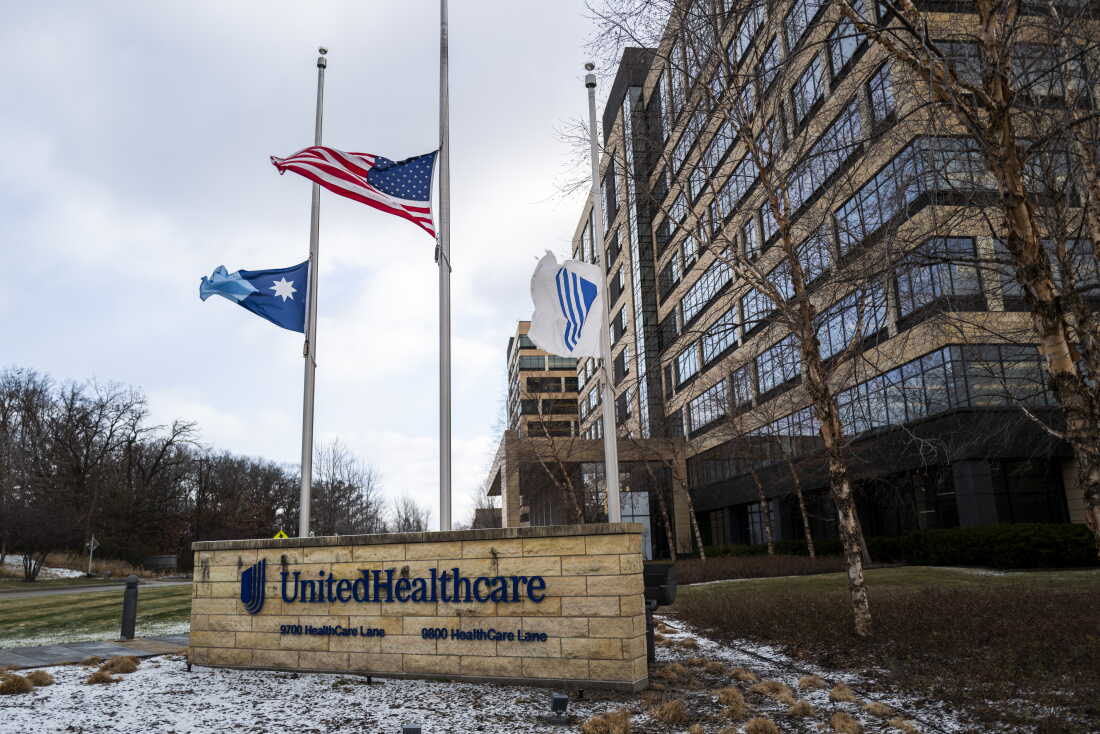

Flags fly at half-staff outside the UnitedHealthcare corporate headquarters in Minnetonka, Minn., on Dec. 4, 2024, after CEO Brian Thompson was shot dead on a street in New York City. The shocking act of violence sparked a widespread consumer outcry over U.S. health care costs and denied claims.
Stephen Maturen/Getty Images
hide caption
toggle caption
Stephen Maturen/Getty Images
One year after UnitedHealthcare’s CEO was shot and killed, the crisis in U.S. health care has gotten even worse — in ways both obvious and hidden.

People increasingly can’t afford health insurance. The costs of both Obamacare and employer-sponsored insurance plans are set to skyrocket next year, in a country where health care is already the most expensive in the developed world.
Yet even as costs surge, the companies and the investors who profit from this business are also struggling financially. Shares in UnitedHealth Group, the giant conglomerate that owns UnitedHealthcare and that plays a key role in the larger stock market, have plunged 44% from a year earlier. (It was even worse before a rally in UnitedHealth shares on Wednesday.)
“UnitedHealth’s reputation in the investment community, before December 4 last year, was [as] a safe place to put your money. And that basically got all blown up,” says Julie Utterback, a senior equity analyst who covers health care companies for Morningstar.
Then, on Dec. 4, 2024, UnitedHealthcare CEO Brian Thompson was shot on a Manhattan street on his way to an investor event. The shocking act of violence sparked a widespread consumer outcry over U.S. health care costs and denied claims, and plunged UnitedHealth Group into a public relations disaster.

But that was only the start of the business woes for the company and its entire industry — which are facing regulatory scrutiny, tightening margins, and investor skepticism. Many of UnitedHealth’s top competitors have also seen their shares suffer in the past year, at a time when the stock market in general has been hitting tech-driven record highs. The S&P 500’s healthcare index has lagged the larger market. And some Wall Street analysts are bracing for another rocky year in the business of health care.
“Near term, there’s a lot more volatility to come,” says Michael Ha, a senior equity research analyst who covers health care companies for investment bank Baird.
Dec. 4 started to reveal the depth of U.S. health care problems
This wide-ranging crisis for both consumers and businesses underlines the brokenness of the U.S. health care system: When neither the people it’s supposed to serve nor the people making money from it are happy, does it work at all?
“We’re really at an inflection point,” says Katherine Hempstead, a senior policy officer at the Robert Wood Johnson Foundation and the author of a book about the insurance industry.
“Every segment of the health insurance business right now is stressed,” she adds.
These stresses became brutally visible a year ago — and persist today. Luigi Mangione, the 27-year-old suspect in Thompson’s killing, was in court this week for hearings ahead of his trial.
But the crisis in U.S. health care is much bigger than his case. Here are three main ways it’s playing out this year, from Main Street to Wall Street.
Prices are going up — and people are getting ready to go without medical care
No matter how you get your health insurance, it will likely cost more next year.
For the roughly 24 million people who get their insurance through the government’s health care exchanges, Affordable Care Act subsidies are set to expire at the end of the year — sending premiums soaring. Another 154 million people are insured through their employers — and premiums for those plans are also set to skyrocket.

Costs are increasing for several reasons: Drug companies have developed more effective cancer treatments and weight-loss drugs, which they can charge more for. More people are going back to the doctor after the pandemic kept them away, which is creating more demand and allowing providers and hospitals to increase prices. And some hospitals, doctors’ offices, insurance companies and other businesses within the health care system have merged or consolidated, often allowing the remaining businesses to raise prices for their services.
The end result is that nearly half of U.S. adults expect they won’t be able to afford necessary health care next year, according to a Gallup poll published last month.
Jennifer Blazis and her family are among them.
“It just always blows me away, how much I have to consider cost when something happens with the kids,” the 44-year-old nonprofit worker and mother of four told NPR this fall in an interview for its Cost of Living series.

Blazis and her family live in Colorado Springs and get their insurance through her husband’s small property-management business. She says she’s postponing leg surgery that would address a condition that’s causing her pain, but which her doctors say is not yet urgent.
“We wait to go to the doctor because we know if we do, we’re going to get hit with just a massive bill,” Blazis says. “And this is with … a really good health insurance plan that our [family] company pays a ton of money for.”
Yet even the biggest businesses selling these services are struggling
Some of those increased costs are also hitting insurers — even the ones that also control other parts of the health care ecosystem.
UnitedHealth Group is far more than just the owner of the largest U.S. health insurance company. It’s one of the largest companies in the world, and it’s involved in almost every part of how Americans access health care — from employing or overseeing 10% of the doctors they see to processing about 20% of the prescriptions they fill.


It’s also one of the most influential stocks on Wall Street. UnitedHealth Group is one of 30 companies that makes up the blue-chip Dow Jones Industrial Average — so what happens with its shares helps determine what happens with the overall stock market.
The company has had a miserable year on both fronts. The reasons come down to profits, more than PR: UnitedHealth and its competitors have been facing rising costs in the Medicare Advantage businesses that allow private insurers to collect government payments for managing the care of seniors.
These programs were once widely seen as moneymakers for big health insurers, but now they’ve gotten UnitedHealth embroiled in financial and regulatory trouble, including a Department of Justice investigation into its Medicare business. The company abruptly replaced its CEO in May, a few months before it acknowledged that it was facing the government probe.
Now UnitedHealth is trying to get rid of about 1 million Medicare Advantage patients — and otherwise move on from the past year’s many problems.
“We want to show that we can get back to the swagger the company once had,” Wayne DeVeydt, UnitedHealth’s chief financial officer, told investors last month.
One prominent investor is betting it can: In August, Warren Buffett’s Berkshire Hathaway disclosed that it had bought more than 5 million shares in UnitedHealth Group. The news helped lift the stock from its depths — but it still has a long way to go for both its share price and its profits to recover from this year’s slump.
Chief Executive Stephen Hemsley acknowledged as much in October, promising investors “higher and sustainable, double-digit growth beginning in 2027 and advancing from there.”
Spokespeople for UnitedHealth declined to comment for this story.
Wall Street used to think health care was safe. It’s waiting for a turnaround
Health care spending accounts for about a fifth of the U.S. economy, making the for-profit companies that earn this money some of the most powerful in the world.
That’s helped their appeal to investors, who traditionally tend to consider health care stocks “defensive,” or safe, investments. That appeal sometimes overrides the industry’s current financial challenges: In the past month, as Wall Street had its now-quarterly panic over the artificial intelligence bubble, health care stocks actually outperformed the broader market for a few weeks.
Still, health care is massively lagging the market in the long term.
Morningstar’s Utterback is optimistic that the industry can eventually turn around its deeper financial, regulatory and reputational problems. She even calls most health care stocks “undervalued” currently — but she warns that investors will have to have a lot of patience if they want to see bets on the sector pay off.
“My explicit forecast period is 10 years. It’s not three,” she says. “There’s a murky outlook here for the next couple years, at least.”
