

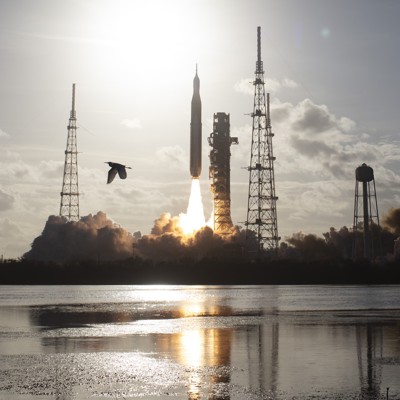
CAPE CANAVERAL, Florida—The guardians manning screens in the mission-ops center here oversaw the launch of five types of rockets in April, a new record that involved NASA’s Artemis II, the first reused New Glenn booster, and a Falcon 9 lofting the final GPS III satellite. But tomorrow’s Space Force may have no time to mark even epochal missions. Within a decade, service leaders say, Cape Canaveral Space Force Station will be launching hundreds of rockets a year.
To facilitate the Pentagon’s fast-growing demand for orbital capability, the Space Force is looking for more launch sites, more money, more troops, and more AI.
“In 2025, the Space Force saw a drastic increase in mission requirements across space access, global mission operations, and space control. This trend shows no signs of slowing,” Gen. Chance Saltzman, the Space Force’s top uniformed leader, told House lawmakers last week. “The Space Force we have today is not the Space Force we will need in the future.”
Nestled on a thin stretch of land just miles from nature preserves and cruise-ship ports, the historic Cape Canaveral facility launched 36 rockets in 2021, its first year as a Space Force facility. Last year, it sent 110 into the heavens, while its California counterpart, Vandenberg Space Force Base, launched another 65.
This year, Space Force leaders intend to launch more than 200 rockets from their two main launch sites. And by 2036, they project, the pair will launch as many as 3,000 annually, according to a service document released last month.
That’s going to take more launchpads.
“As far as other launch locations, that’s something that we’ve looked at quite a bit as well,” said Col. Ryan Hiserote, who leads Space Systems Command’s System Delta 80 and runs the National Security Space Launch program. “In terms of heavy launch, it’s really just the two bases we have now—with Vandenberg and the Cape—I don’t have a good solution for that one yet. But we’re certainly open to other locations, and the team has been exploring those.”
Hiserote said he was initially focusing on sites for smaller vehicles, like Rocket Lab’s work out of NASA’s Wallops Island flight facility.
Walt Lauderdale, System Delta 80’s system program director for the Falcon product line, said the service might use private sites such as SpaceX’s Starbase in Texas.
But even as the Space Force looks to spread its launches around, Lauderdale said, it also needs to expand and improve its two main bases and “pivot to invest in ways we never did before.”
Pushing policy
The Space Force’s top brass has been making that pitch as well.
Last month at the Space Symposium in Colorado, Chief of Space Operations Gen. Chance Saltzman unveiled “Objective Force 2040,” an ambitious vision with a section on expanding the service’s launch capabilities.
“As the space domain becomes increasingly linked both to national security and to economic
prosperity, the importance of space access grows commensurately,” the document said. “This is a significant challenge because the Space Force has supported exponential growth in launch cadence over the past few years using the same physical infrastructure first built decades ago. The future operating environment will only exacerbate this strain, with booming government and commercial demand as well as new mission requirements for responsive and scalable space access.”
The document noted that the service will “expand and certify state, commercial, and private launch sites to address routine launches, increase surge capacity, and provide geographic diversity,” but also noted some spaceports won’t be fully suitable for some missions.
“These sites will increase overall launch capacity, but security and mission assurance requirements will limit their suitability for the most sensitive national security launches,” the document said.
And the document adds a warning about overreliance on Cape Canaveral and Vandenberg, which “creates enduring vulnerability to natural hazards, operational disruption, and degraded performance during periods of peak demand.”
Defense space expert Todd Harrison agreed.
“It would make sense to diversify, because right now we are incredibly dependent on just two locations,” said Harrison, a fellow at the American Enterprise Institute. “One is at risk of hurricanes, and the other is at risk of wildfires and earthquakes.”
Last year’s National Defense Authorization Act directed the Space Force to analyze the long-term suitability of Cape Canaveral and Vandenberg and develop a list of alternative locations. Lawmakers have floated Wallops Island; Pacific Spaceport Complex, Alaska; and Spaceport America in New Mexico, as potential alternative national-security launch sites.
In this year’s NDAA, lawmakers directed the service to report on the maintenance costs and age of infrastructure at Cape Canaveral and Vandenberg, as well as “potential strategies to mitigate adverse environmental effects.” The deadline was March 31.
Space Force launch officials said in April that their extensive report had not yet been delivered to Congress. A service spokesperson did not respond to a request for an update.
People problems
Increasing the number of launches will require more than money. Top Space Force officers have recently called for doubling the service’s end-strength over the next decade.
But even that won’t be enough, they say. Guardians will need to lean on AI to help.
“Our manpower is going to change,” said Air Force Col. Douglas Oltmer, commander of Cape Canaveral’s 45th Weather Squadron. “It’s going to have to change to be able to flex to that launch cadence, but we will not be able to do the job in the future the way we’re doing it now. We’re going to have to leverage technology, AI tools a lot more than we’re doing now.”
The Objective Force document calls for a service that can “operate at machine speed, leveraging artificial intelligence and autonomous systems while maintaining the primacy of human judgment for critical decisions.”
While Congress debates the future of the Space Force’s launch sites and service leaders push space-launch goals to new heights, guardians at Cape Canaveral said they don’t feel those additional pressures weighing down on them. Hiserote, of System Delta 80, said he’s working with what he’s got until new resources and manpower come.
“It will mean more missions for us, so we’re working through how to balance that with the resources that we have and look at areas where we can accept more risk that maybe traditionally we haven’t before,” Hiserote said. “I think there’s a lot that we can do to automate some processes so we can handle a larger manifest with a team that we have.”
