
LIVE NEWS
  • Calls for Global Digital Estate Standard as Fraud Risk Grows
  • An ode to craftsmanship in software development
  • Global economy must stop pandering to ‘frivolous desires of ultra-rich’, says UN expert | Environment
  • Some Middle East Flights Resume but Confusion Reigns From Iran Strikes
  • Clinton Deposition Videos Released in Epstein Investigation
  • Elevance stock tumbles as CMS may halt Medicare enrollment
  • Wild spaces for butterflies to be created in Glasgow
  • You can now adjust how your caller card looks for calls on Android phones
Prime Reports
  • Home
  • Popular Now
  • Crypto
  • Cybersecurity
  • Economy
  • Geopolitics
  • Global Markets
  • Politics
  • See More
    • Artificial Intelligence
    • Climate Risks
    • Defense
    • Healthcare Innovation
    • Science
    • Technology
    • World
Prime Reports
  • Home
  • Popular Now
  • Crypto
  • Cybersecurity
  • Economy
  • Geopolitics
  • Global Markets
  • Politics
  • Artificial Intelligence
  • Climate Risks
  • Defense
  • Healthcare Innovation
  • Science
  • Technology
  • World
Home»Science»Beneath the ice: Satellites help map Antarctica’s subglacial surface like never before
Science

Beneath the ice: Satellites help map Antarctica’s subglacial surface like never before

primereportsBy primereportsJanuary 16, 2026No Comments3 Mins Read
Share Facebook Twitter Pinterest LinkedIn Tumblr Reddit Telegram Email
Beneath the ice: Satellites help map Antarctica’s subglacial surface like never before
Share
Facebook Twitter LinkedIn Pinterest Email


One of the least-mapped planetary surfaces in our solar system is closer to home than you might expect: the continent of Antarctica.

While Antarctica‘s icy surface is fairly well-studied, its subglacial bedrock landscape — located up to 3 miles (4.8 km) beneath the ice — is more difficult to discern. Current methods of mapping require expensive ground-based and airborne surveys, and such activities are few and far between.

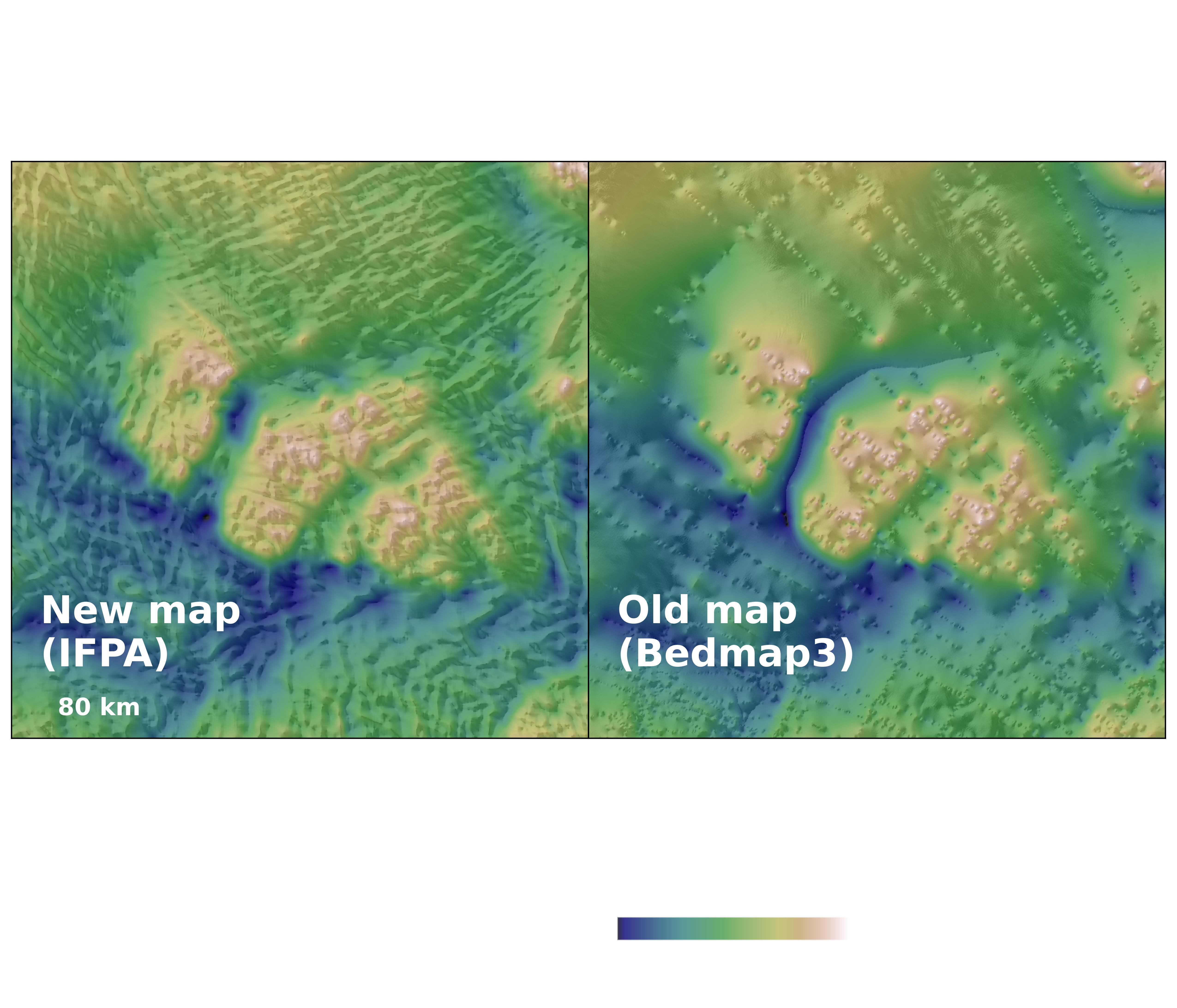
To create the most detailed map of Antarctica’s subglacial topography yet, a team of researchers led by Helen Ockenden, of the University of Edinburgh and the Institut des Geosciences de l’Environnement in France, applied a modeling technique known as Ice Flow Perturbation Analysis (IFPA). IFPA uses detailed satellite observations of the ice surface and the physics of ice flow to infer the topography that exists below the ice.


You may like

“Our IFPA map of Antarctica’s subglacial landscape reveals that an enormous level of detail about the subglacial topography of Antarctica can be inverted from satellite observations of the ice surface, especially when combined with ice thickness observations from geophysical surveys,” wrote the team in a new paper on their research.

In creating the map, the researchers discovered previously unknown or poorly resolved geologic features, from steep-sided channels possibly linked to mountain drainage systems to deep valleys reminiscent of U-shaped glacial valleys elsewhere on Earth. These features might provide insight to an ancient, pre-glacial Antarctica.

Maps like these are key to understanding the movement of the ice above across the continent, which ultimately allows researchers to predict how Antarctic ice might contribute to global sea-level rise.

But while this new IFPA map reveals unprecedented details about Antarctica’s hidden topography, there is still room for greater precision. The reconstruction resolves features at the mesoscale — about 1.2 to 18.6 miles (2 to 30 km) — meaning that smaller landforms remain beyond its reach.

Breaking space news, the latest updates on rocket launches, skywatching events and more!

A blue and green heatmap showing blobs of yellow against a green and blue background with two images side by side. The one on the left is labeled "new map" and the one on the right is labeled "old map"

This composite image demonstrates the higher resolution of the new IFPA maps of Antarctica’s subglacial topography (left) compared to a previous map (right). (Image credit: Courtesy of Helen Ockenden)

“Our landscape classification and topographic map therefore serve as important guides toward more focused studies of Antarctica’s subglacial landscape, informing where future detailed geophysical surveys should be targeted, as well as the extents and resolutions (e.g., flight-track spacing) required to capture the fine details required for ice flow modeling,” the team wrote.

And there’s no better time than the present to prepare those future surveys. “The upcoming International Polar Year 2031-2033 presents a timely opportunity for international efforts to integrate expansive observation and modeling approaches to better understand ice sheet and bedrock properties, guided by methods similar to that of Ockenden et al,” Duncan Young, of the University of Texas Institute for Geophysics, wrote in a “Perspective” piece accompanying the new study.

The team’s research was published in the journal Science on Jan. 15.

Share. Facebook Twitter Pinterest LinkedIn Tumblr Email
Previous ArticleI’ve been thinking a lot about dog poo | Adrian Chiles
Next Article Lockheed delivered record 191 F-35s as it cleared out TR-3 backlog
primereports
  • Website

Related Posts

Science

Wild spaces for butterflies to be created in Glasgow

March 2, 2026
Science

Rapamycin can add years to your life, or none at all – it’s a lottery

February 25, 2026
Science

2,800-year-old mass grave of women and children discovered in Serbia reveals ‘brutal, deliberate and efficient’ violence

February 24, 2026
Add A Comment
Leave A Reply Cancel Reply

Top Posts

Global Resources Outlook 2024 | UNEP

December 6, 20255 Views

The D Brief: DHS shutdown likely; US troops leave al-Tanf; CNO’s plea to industry; Crowded robot-boat market; And a bit more.

February 14, 20264 Views

German Chancellor Merz faces difficult mission to Israel – DW – 12/06/2025

December 6, 20254 Views
Stay In Touch
  • Facebook
  • YouTube
  • TikTok
  • WhatsApp
  • Twitter
  • Instagram
Latest Reviews

Subscribe to Updates

Get the latest tech news from FooBar about tech, design and biz.

PrimeReports.org
Independent global news, analysis & insights.

PrimeReports.org brings you in-depth coverage of geopolitics, markets, technology and risk – with context that helps you understand what really matters.

Editorially independent · Opinions are those of the authors and not investment advice.
Facebook X (Twitter) LinkedIn YouTube
Key Sections
  • World
  • Geopolitics
  • Artificial Intelligence
  • Popular Now
  • Cybersecurity
  • Crypto
All Categories
  • Artificial Intelligence
  • Climate Risks
  • Crypto
  • Cybersecurity
  • Defense
  • Economy
  • Geopolitics
  • Global Markets
  • Healthcare Innovation
  • Politics
  • Popular Now
  • Science
  • Technology
  • World
  • About Us
  • Contact Us
  • Privacy Policy
  • Terms & Conditions
  • Disclaimer
  • Cookie Policy
  • DMCA / Copyright Notice
  • Editorial Policy

Sign up for Prime Reports Briefing – essential stories and analysis in your inbox.

By subscribing you agree to our Privacy Policy. You can opt out anytime.
Latest Stories
  • Calls for Global Digital Estate Standard as Fraud Risk Grows
  • An ode to craftsmanship in software development
  • Global economy must stop pandering to ‘frivolous desires of ultra-rich’, says UN expert | Environment
© 2026 PrimeReports.org. All rights reserved.
Privacy Terms Contact

Type above and press Enter to search. Press Esc to cancel.