

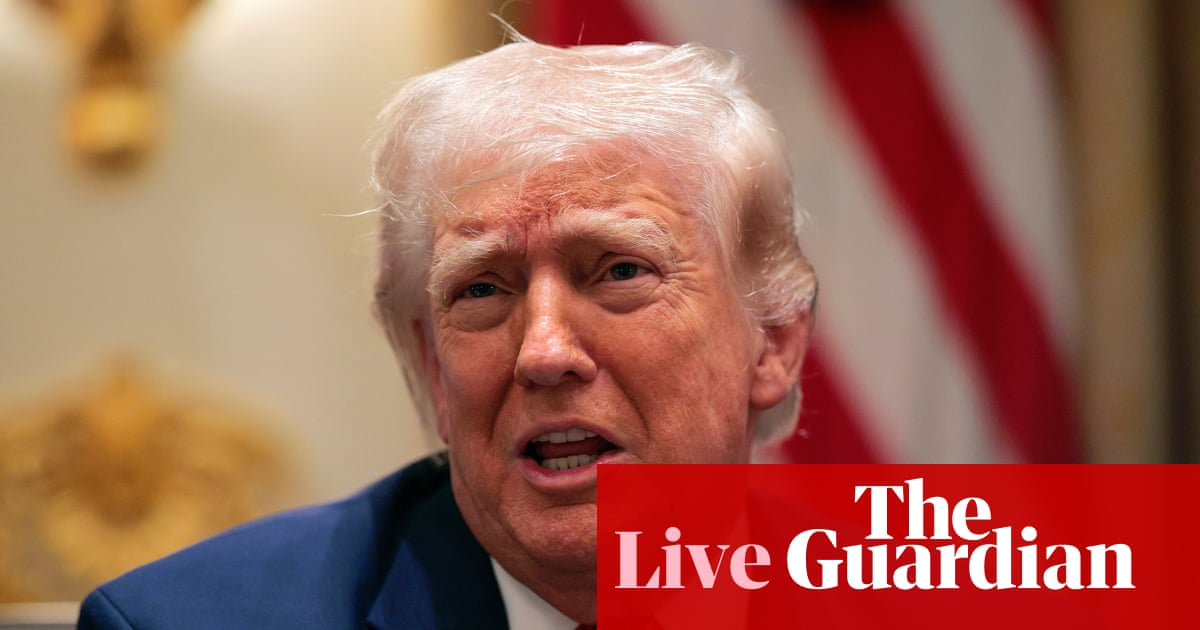
Trump further extends pause on striking Iran’s energy infrastructure for 10 days
Donald Trump has said he will extend his pause on his threat to attack Iran’s energy infrastructure for 10 days until 6 April, claiming that the request came from Tehran.
In a post on Truth Social, the US president claimed talks are going “very well” and repeated his attacks on the “fake news media” for reporting to the contrary (Iran has also reported to the contrary).
Trump threatened last Saturday to would strike Iranian energy infrastructure if Tehran did not reopen the strait of Hormuz.
Then, on Monday he postponed his threat for five days (until Friday), citing “very good and productive conversations” with Iran on ending the war (which Tehran dismissed as “fake news” designed to “manipulate” the oil markets).
So, he’s now pushing that deadline back, again.
Here’s the post:
As per Iranian Government request, please let this statement serve to represent that I am pausing the period of Energy Plant destruction by 10 Days to Monday, April 6, 2026, at 8 P.M., Eastern Time. Talks are ongoing and, despite erroneous statements to the contrary by the Fake News Media, and others, they are going very well.
Key events
Ship stuck in strait of Hormuz – report
A Thai-flagged cargo ship that was hit by unknown projectiles in the strait of Hormuz earlier this month has run aground off Iran’s Qeshm Island, Iran’s Tasnim news agency said on Friday.
Thailand said 20 crew members were rescued by the Omani navy, while three were missing after an explosion in the stern of the ship, Mayuree Naree, caused a fire in the engine room, Reuters reports.
The UN food and agriculture agency’s top economist has warned of serious impact if the Iran war lasts three to six months
Maximo Torero said markets would absorb the Iran war’s impact if the conflict ended in the next two weeks or so. But if it continued for three to six months, it would not only impact food security and energy but other sectors as well because prices would rise.
And those rising prices, and the fall in remittances from overseas workers, would affect economic development and growth across the world, the chief economist for the UN Food and Agriculture Organisation told a UN press conference Thursday.
The Associated Press reports that he said an El Niño climate phenomenon – which tends to increase global temperatures – was also expected soon. A strong El Niño could significantly exacerbate the economic situation, he said.
Torero said in the video press conference:
My message is, we need to find a way to resolve this problem as soon as possible. Because, if not, the consequences … could be very dramatic, even worse that what happened in the Ukraine war.
More here from Lauren Aratani on US markets having their biggest slump since the start of the Iran war as Donald Trump said the conflict’s impact on oil prices had not been as bad as he expected.
The Dow closed 450 points down while the S&P 500 dipped 1.7%. The tech-heavy Nasdaq fell 2.3%, plunging into correction territory, which happens when an index falls at least 10% below its most recent peak.
Oil prices have surged since the start of the conflict, reaching levels not seen since Russia’s invasion of Ukraine pushed up global oil prices in 2022 and 2023. At the end of day on Thursday, Brent crude oil – the global benchmark – was about $107 a barrel while US crude hit $93 a barrel.
Despite the soaring prices, Trump said that oil prices “have not gone up as much as I thought” during a cabinet meeting on Thursday. “It’s all going to come back down to where it was, and probably lower,” he added.
The president also predicted the impact on the stock market would reverse once the conflict ends.
Markets have been growing weary of Trump as he has continued to give an extremely mixed picture of where the US stands in negotiations with Iran.
See the full story here:
The day so far
Donald Trump said he will extend – once again – his pause on his threat to attack Iran’s energy infrastructure for 10 days until 6 April, claiming that the request came from Tehran and that talks were going “very well”. The US president threatened last Saturday to would strike Iranian energy infrastructure if Tehran did not reopen the strait of Hormuz. Then, on Monday he postponed his threat for five days (until Friday), citing “very good and productive conversations” with Iran on ending the war (which Tehran dismissed as “fake news” designed to “manipulate” the oil markets). Now, he’s pushing that deadline back, again.
The price of Brent crude also dropped following Trump’s latest announcement. Oil prices rose to their highest level this week, with Brent crude trading at roughly $108 a barrel after Trump’s cabinet meeting earlier on Thursday.
A day after Tehran dismissed Trump’s 15-point ceasefire plan, the US president claimed that Iran was “begging to make a deal,” and that he wasn’t the one pushing for negotiations. Earlier, he told Tehran to “get serious soon” on negotiating a deal to end the war.
Trump rejected reports that he was looking for an exit ramp, as oil prices soar and political pressure mounts to avoid the kind of drawn-out Middle East war he once spurned. “I read a story today that I’m desperate to make a deal,” Trump told reporters. “I’m the opposite of desperate. I don’t care.”
A US proposal for ending nearly four weeks of fighting is “one-sided and unfair”, a senior Iranian official told Reuters on Thursday.
However, Trump said Iran is allowing some oil tankers through strait of Hormuz as a sign of good faith for talks. He said that Iran allowed 10 oil tankers to pass through the strategic strait as a “present” to show it was serious about negotiations to end the war.
Stocks on Wall Street suffered their biggest daily loss since the US-Israeli war on Iran began almost a month ago.
The S&P 500 stock index fell 1.7% on Thursday, the steepest daily decline since January, putting the index on track for its fifth straight week of losses for the first time in four years.
Oil prices rose to their highest level this week, with Brent crude trading at roughly $108 a barrel.
Iran bans sports teams from travelling to ‘hostile’ countries over safety fears
Iran has banned its national and club sports teams from travelling to “countries that are considered hostile”
The sport ministry said safety concerns prompted the decision, which would remain in place “until further notice”.
“The presence of national and club teams in countries considered hostile and unable to ensure the security of Iranian athletes and team members is prohibited until further notice,” it said.
Iran’s national football team is scheduled to play at the upcoming FIFA World Cup, which is being co-hosted by the US, Canada and Mexico.
Earlier this month, Donald Trump (extraordinarily) said he did not believe it was “appropriate” for Iran to participate in the tournament – “for their safety” – after the Iranian sports minister said the team would “under no circumstances” be taking part.
Iran says Trump is ‘negotiating with himself’: what next for the war? – podcast
Donald Trump insists Iran is still interested in cutting a peace deal despite Tehran rejecting the US plan. Iran has now put forward a five-point counterproposal and says the war will end on its own terms.
In today’s edition of The Latest podcast, Lucy Hough speaks to the Guardian’s senior international correspondent, Julian Borger.
In the last hour, Saudi Arabia’s defence ministry said it had intercepted and destroyed two drones over the country’s eastern province.
Trump further extends pause on striking Iran’s energy infrastructure for 10 days
Donald Trump has said he will extend his pause on his threat to attack Iran’s energy infrastructure for 10 days until 6 April, claiming that the request came from Tehran.
In a post on Truth Social, the US president claimed talks are going “very well” and repeated his attacks on the “fake news media” for reporting to the contrary (Iran has also reported to the contrary).
Trump threatened last Saturday to would strike Iranian energy infrastructure if Tehran did not reopen the strait of Hormuz.
Then, on Monday he postponed his threat for five days (until Friday), citing “very good and productive conversations” with Iran on ending the war (which Tehran dismissed as “fake news” designed to “manipulate” the oil markets).
So, he’s now pushing that deadline back, again.
Here’s the post:
As per Iranian Government request, please let this statement serve to represent that I am pausing the period of Energy Plant destruction by 10 Days to Monday, April 6, 2026, at 8 P.M., Eastern Time. Talks are ongoing and, despite erroneous statements to the contrary by the Fake News Media, and others, they are going very well.
Strikes near Iran nuclear plant could trigger ‘major radiological accident’, warns IAEA chief
The head of the UN nuclear watchdog has expressed “deep concern” over recent military strikes near Iran’s Bushehr nuclear power plant – and warned that any damage to the operating facility could cause a “major radiological accident affecting a large area in Iran and beyond”.
International Atomic Energy Agency (IAEA) director general Rafael Grossi reiterated his call for “maximum restraint” to avoid the risk of a nuclear accident.
The most recent reported strike took place on Tuesday night, when the Atomic Energy Organization of Iran said a projectile had struck the grounds of the nuclear power plant. The IAEA previously confirmed a strike on 17 March. No damage to the plant was reported in either incident.
Analysis: the delusion of easy victory from the air may have seduced the US into another war
Aram Roston
To explore the roots of Donald Trump’s Iran military strategy and the pugnacious rhetoric of his defense secretary, Pete Hegseth, means looking back 105 years.
In 1921, a year before Benito Mussolini and his blackshirts marched on Rome to launch the Fascist era, an Italian general named Giulio Douhet published The Command of the Air, proposing a revolution in warfare.
Victory in the future, he said, would no longer come from the grinding trench combat of the great war. Instead it meant large-scale aerial bombardments, targeting not just combatants but civilians and civilian infrastructure and logistics.
Douhet’s theories, which emphasized “blows to the morale of civilian populations”, inspired Hitler’s deployment of airpower – and attacks such as that seen in Guernica and the sustained bombing of London. But likewise it attracted technologically bent American air strategists such as Gen Curtis LeMay, who oversaw the firebombing of dozens of Japanese cities, the aerial mining of Japan’s waterways called Operation Starvation, and the nuclear attacks on Hiroshima and Nagasaki, and who later ran the US Air Force Strategic Air Command.
It is unclear if Pete Hegseth has ever heard of the book Douhet wrote, but the threads of the long-dead Italian officer’s thinking appear woven through the secretary’s bombastic briefings about Epic Fury, the air war Trump is waging against Iran.
Despite Hegseth’s claims of a new type of American strategy, and his slap-down of the “foolish political leaders and foolish military leaders of the past”, his promise of “the most lethal and precise air power campaign in history” appears to be less an innovative approach to warfare than a recycled version of the same old thing.
Douhet was obsessed with promoting a sheer volume of bombs from the sky, “to inflict the greatest damage in the shortest possible time”. Hegseth’s briefings are resonant with that theme of more and more and more. “Quantity has a quality all its own,” he said. “In fact, today will be yet again the highest volume of strikes that America has put over the skies … The number of sorties and number of bomber pulses, the highest yet, ramping up and only up.”
And then there was Douhet’s focus on bombing civilian infrastructure – a practice he thought would cause the population to revolt against their leaders. Hegseth, too, dwells on that destruction of civilian morale, though he has not pushed for striking civilians themselves.
We are warriors, trained to kill the enemy and break their will … Speaking of people, we hope the Iranian people take advantage of this incredible opportunity. President Trump has been clear: now is your time.
Read more here:
Here are some images coming out of Lebanon on Thursday, amid Israel’s ongoing offensive that has brought mass destruction and forcibly displaced more than a million people.
In an update from our earlier post, the Israeli military has said that two soldiers were killed during combat operations in southern Lebanon amid ongoing clashes with Hezbollah along the border.
This brings to four the number of Israeli soldiers killed there, after the military said two were killed on 8 March.
Doctors treating the casualties of Israeli airstrikes in Lebanon have urged world leaders to take action against violations of international law – warning of the horrifying parallels between Israeli actions in Gaza and what it is now doing in Lebanon.
British surgeon Dr Tom Potokar, who was inside Gaza’s European hospital near Khan Younis when it was bombed by Israel ten months ago, told Sky News on Thursday:
The violation of international humanitarian laws has become normalised.
Once again we’re seeing attacks on the medical infrastructure, just like we saw in Gaza, but this time in Lebanon. Once again, we’re seeing attacks on hospital staff, ambulance workers and first responders.
He said there was the familiar “condemnation and words from political leaders, yet no action – nothing is done to stop these violations”.
Hospitals should be places of refuge where you can receive treatment and are protected under international law. Yet they and first responders continue to be subject to attack.
As my colleague William Christou reported earlier this week, Lebanese healthcare workers and officials have said that Israeli bombings have deliberately targeted medical workers and facilities in south Lebanon, including through the use of double-tap strikes, in what they describe as a systematic effort to make the area unliveable. (Indeed, Israel has since announced another occupation of southern Lebanon – describing a so-called “defensive buffer” running up to the Litani river).
Since Israel renewed its offensive on Lebanon three weeks ago, it has struck at least 128 medical facilities and ambulances across south Lebanon, killing at least 42 healthcare workers and wounding at least 107, according to the country’s health ministry.
Per William’s report, most of Israel’s strikes on medics happened while they were sitting in ambulances or at first aid centres, several of which have been destroyed in south Lebanon. Israel has also carried out at least five double-tap strikes, a tactic in which an initial strike is followed by a pause, allowing medical workers to arrive before the area is bombed for a second time.
Medical workers and hospitals are protected under international law and deliberately targeting them could constitute a war crime. Amnesty International said on Thursday that, regardless of political affiliation, medical workers are considered civilians and targeting them is unlawful.
As of Thursday, Israeli attacks have killed at least 1,116 Lebanese people, wounded at least 3,229 others, and displaced more than a million – nearly one in five of the population – since 2 March.
Meanwhile, Kuwait’s defence ministry earlier said it had detected multiple incoming threats over the past 24 hours with no direct impact inside its designated “threat area”.
Officials said six ballistic missiles fell outside the threat zone while air defences also intercepted and destroyed a drone.
The United Arab Emirates engaged 15 ballistic missiles and 11 drones on Thursday, the country’s defence ministry has said.
“UAE air defences are dealing with Iranian ballistic and cruise missiles and drones,” it said in a post on X.
Its air defences targeted 372 ballistic missiles, 15 cruise missiles, and 1,826 drones since Iranian attacks began, the ministry added.
