

We
live in the future, and sometimes it is just amazing how different things are
today from two decades ago when the age of accelerated computing got its start
in the HPC ModSim arena, eventually being adopted as the architecture of choice
for AI applications.
The
market is utterly transformed, or rather, a new set of infrastructure suppliers
have taken over AI system manufacturing and distribution and the venerable companies
peddling systems of record – IBM, the various parts of Hewlett Packard Enterprise
that started out as Tandem and Digital Equipment, Sun Microsystems – are either
gone or have businesses that are so much smaller relative to a much embiggened
systems market that they do not even rise to the top vendor rankings.
I
have spent some time building this chart below, which shows the sweep of
changes in datacenter compute leading up to the Dot Com boom, when Internet
technologies were first broadly commercialized and when the tremendous amounts
of data to train AI models was first being digitized and amassed. The data is quarterly
server revenues as reckoned by the box counters at IDC, which is the dataset
that has been most broadly available to the public and arguably the most useful
over the decades that IDC gave out summary data to help peddle its deeper market
research and keep its name out there as an IT expert.
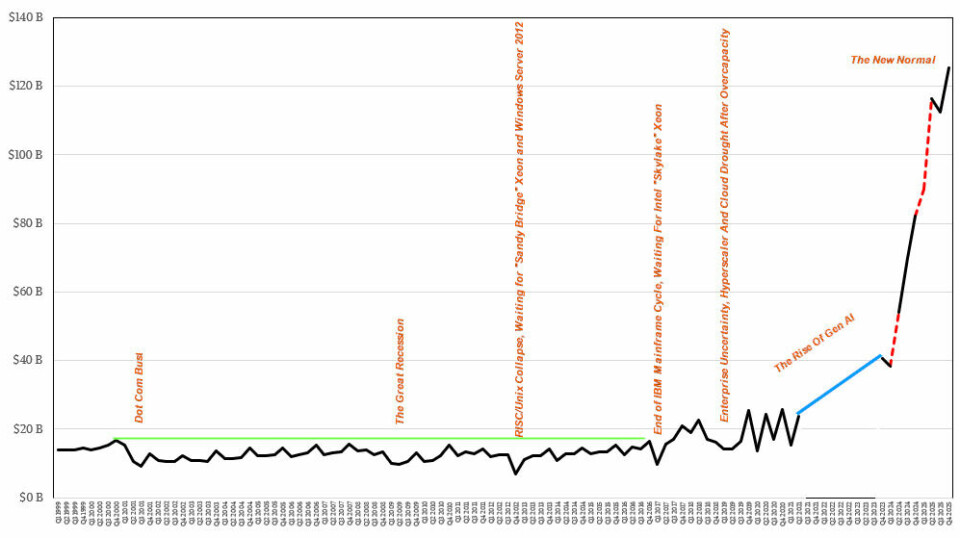
During
the rise of GenAI, both IDC and Gartner stopped giving out public data, and the
blue line in the chart shows that gap. IDC recently started giving out quarterly
data, and we have added this to the data set and filled in some gaps with estimates.
We have not adjusted this data for inflation, but probably should. All it would
do is rotate the data around whatever year you picked as the normalized US
dollar. The data to the left of the normalized year would lift further as you
moved to the left into the past, and the data to the right of this
normalization point would be pushed down with increasing vigor as you move to
the right – both due to the effects of inflation.
The
green line shows the peak of server revenues during the Dot Com boom, a level
that in absolute dollars was not reached consistently for two decades. Assuming
the market for systems of record is relatively stable at around somewhere
between $15 billion and $18 billion a quarter– for most back office systems,
Moore’s Law advances plus packaging and networking enhancements offer more
incremental capacity than they could ever dream of using – then the remaining
more than $100 billion in sales of systems are for AI capacity or the front
office and back office systems that feed into them. In that sense, AI is
driving far more than half of the revenues in the server market.
What
is immediately obvious is that if the GenAI bubble bursts, as many worry it
might, there is going to be enough soap for many, many companies to drown in. The
server bust will make the Dot Com Bust, the Great Recession, and other
collapses in the server space look like a joke, as you can plainly see. Nvidia
will be hit the hardest, but many OEMs and ODMs, countless chip suppliers, all
the clouds big and small, up and down the value chain, will take their own
hits.
The
magnitude of such a collapse is hard to grasp. This GenAI boom in its totality
– datacenters and equipment, but also power, cooling, land, and financial vig –
is a significant driver of the global economy, and is largely a phenomenon of
the United States, with China to a less degree (which is odd, but more on that
in a moment) and sovereign nations starting to catch the GenAI religion.
The
good news, if you want to global economy to somehow hold itself together, is
that it looks like demand is well exceeding supply, and the gargantuan AI
projects that have been outlined are still moving ahead.
In
the fourth quarter of 2025, the most recent data just released by IDC, server
sales grew by 52.4 percent to $125.3 billion, which also represented an incredible
11.4 percent sequential increase from Q3 2025. Based on what IDC said in its
report, we calculate that of this vast and expensive pile of machinery, $70.65
billion was for GPU-accelerated systems, which represented 56.4 percent of all
server revenues. We do not know how many XPU-accelerated system sales are in
there, but it would have to be a substantial amount. We do not think that IDC
is mixing revenues of systems with GPUs and XPUs, or it would have said as
much. We wish IDC would clarify this because we have a hard time believing
there was $54.65 billion in back office and front office system sales in the
quarter.
What
IDC did say – and which is a distinction that is not all that useful any more, but
you never throw away data – is that X86 CPUs were used in $69.8 billion of
machinery in Q4 2025 (up 16.9 percent year on year) compared to $55.5 billion in
non-X86 servers. While IBM’s Power Systems and System z mainframes are some of
that non-X86 iron, the vast majority by far is now Arm-based servers made by
the hyperscalers, the cloud builders, and now the AI model builders. That was
2.5X growth year on year for the non-X86 camp, and it will not be too long
before the value of machines based on Arm will exceed the value of machines
based on X86.
Mostly
because of the value of the GPUs attached to the Arm systems, but some of it is
indeed Arm-based infrastructure servers that have no accelerators.
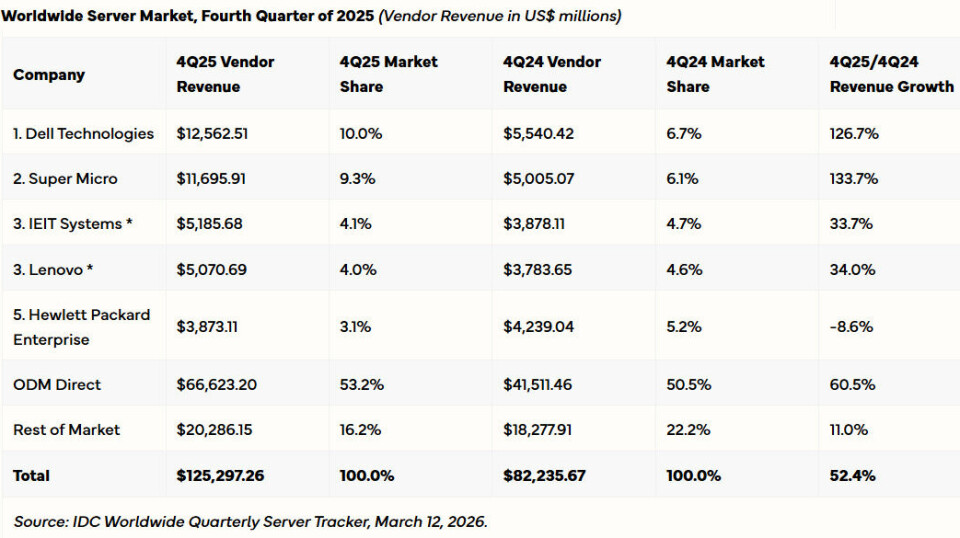
Dell
is by far the largest of the server OEMs now, bringing in $12.65 billion in
sales, up by a factor of 2.3X year on year thanks to some large AI system deals.
Supermicro, despite its current difficulties with the
US government over alleged smuggling of sanctioned GPU systems into China, had
a very good Q4, with server sales of $11.7 billion, also up 2.3X year on year.
IEIT Systems, an upstart server maker out of China that is now the number three
OEM in the world, had $5.19 billion in sales, up 33.7 percent. Sino-American
system maker Lenovo, which is ranked number four, had $5.07 billion in server revenues,
up 34 percent, while HPE, which is getting more and more picky about deals
because it doesn’t want to take lower margins on AI deals, had $3.87 billion in
sales, down 8.6 percent year on year but up 14 percent sequentially.
Other
OEMs comprised $20.29 billion in server revenues in Q4 2025, up 11 percent as a
group, while the ODMs – Foxconn, Inventec, Quanta, WiWynn, Jabil, and others –
as a group shipped $66.62 billion in server gear, down a smidgen sequentially
but up 60.5 percent year on year.
Which
brings us to the geopolitical part of servers.
“The
United States is the fastest growing region in the server market, with an
increase of 72.4 percent compared to the fourth quarter of 2024, fueled by 80.1
percent growth in the accelerated server segment,” IDC wrote in its report. “Canada
grew 70.7 percent, pushed by the same reason. EMEA and APeJC also showed double
digit growth, with 43.6 percent and 27.9 percent, respectively. PRC and Latin
America showed smoother but healthy growth of 17.7 percent and 12.8 percent
each while Japan declined by 4.7 percent as it couldn’t match an important
investment a year ago.”
What IDC doesn’t tell us is what the server spending
amounts are by country, but clearly China is now growing its server budgets
anywhere near the rate that we are seeing among the tech titans in the United
States. This seems perplexing to us. If China is so much smarter about AI, as
many contend it is and
as
the DeepSeek model first demonstrated back in January 2025
, then maybe the
total addressable market in China is not as big as we might be led to believe.
