

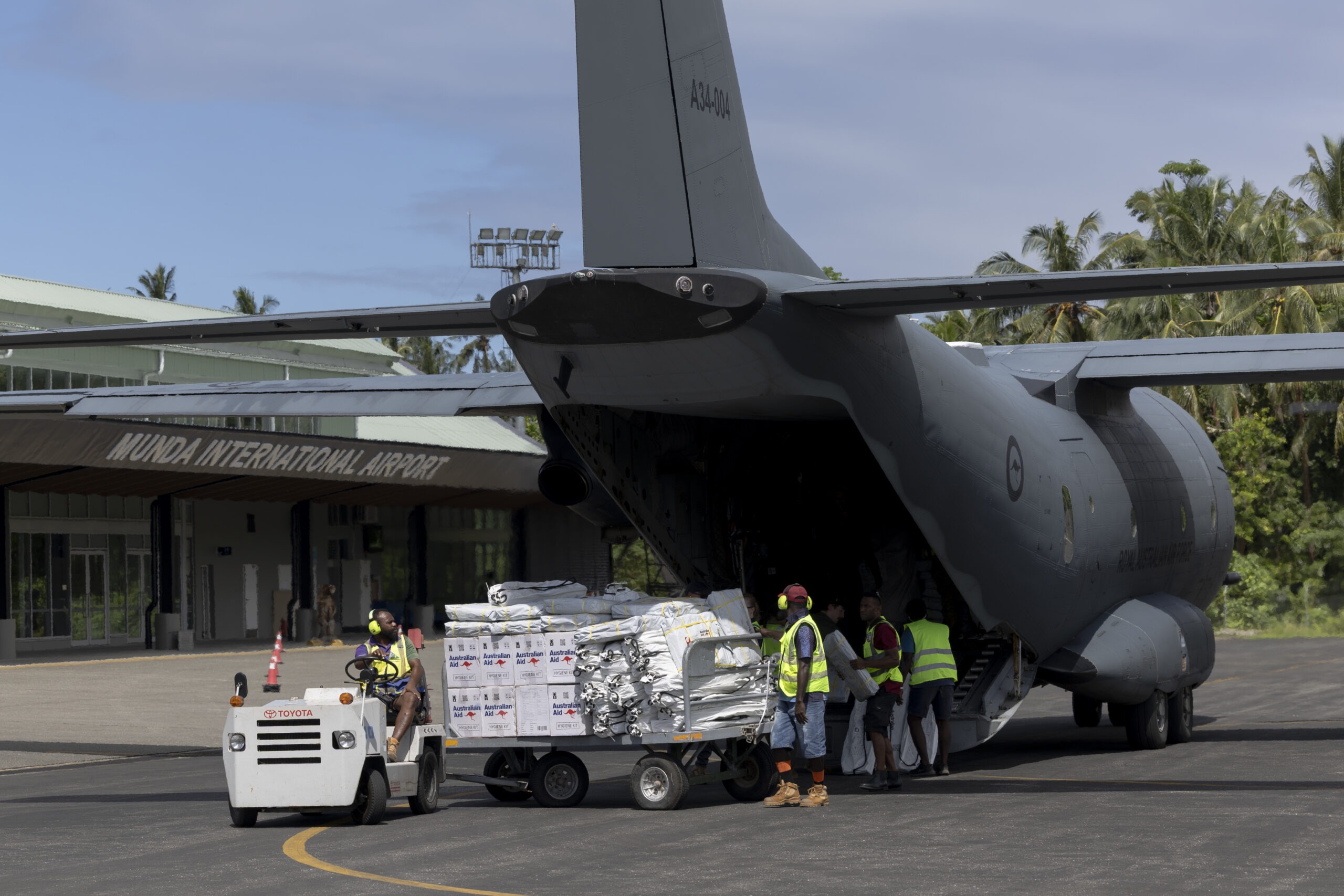
Australian defence policy focuses too much on the risk of high-intensity, mostly conventional conflict at large cost to capabilities for peacekeeping and humanitarian support, its most likely military operations.
Many costly new equipment priorities, such as nuclear submarines, strike missiles and frigates, have little to no role in peacekeeping or humanitarian assistance and disaster relief (HADR) missions. Meanwhile, decisions such as the one in the 16 April National Defence Strategy to replace C-27J Spartan light airlifters with commercial aircraft will diminish Australia’s capacity in these low-intensity military roles.
The Australian Defence Force’s persistent personnel retention and recruitment problems worsen the problem. In missions where a human face is important, equipment will not replace an experienced soldier on the ground.
The strategic focus on the growing possibility of Australia being engaged in a large-scale, conventional conflict in the near term has prioritised the needs of a potential future conflict over the needs of definite future missions for the ADF. But the experience of more than 30 years, in which the ADF’s main operational tasks have been HADR and responding to low-intensity civil conflicts, tells us that those are the most likely missions in coming years.
Civil unrest remains a strong possibility in the island states, particularly in the face of growing economic and physical pressures resulting from climate change, with more frequent and severe natural disasters increasing the need for Australian assistance.
Despite the frequency of past deployments and near certainty of future missions of this type, the Australian government has spent little on capabilities for them. Of the capabilities outlined in the latest Defence spending plan, the 2026 Integrated Investment Program, almost all have no or limited use in peacekeeping or HADR missions. Submarines, including uncrewed ones like Ghost Sharks, don’t help with land-based peacekeeping, nor do frigates. Long-range artillery may be useful for counter-insurgency operations in places like Afghanistan but would be of little use in the Pacific.
One of the most important enablers for missions in our region is the ability to reach areas where help is needed. But Australia’s reach into remote or disaster-affected areas is limited by restricted sealift and airlift capabilities. The decision to replace the C-27J Spartan airlifters with commercial aircraft will make it difficult to reach island locations serviced by short, poor-quality runways. New landing craft capable of unloading on beaches will be welcomed for peacekeeping and HADR, but the Royal Australian Navy’s assault ships have suffered from poor management and the government’s Pacific support vessel has little value in disaster relief.
ADF projection into the Pacific islands relies on those islands having satisfactory, operational ports and airstrips from which C-130 Hercules can operate, and it’s not clear how the ADF intends to move into and sustain operations where that infrastructure is missing or damaged. This capability mismatch may also have a political impact. Potential partner governments and militaries in the Pacific would likely be much more interested in working with Australia if it had aircraft that can reach their remote regions.
Exacerbating the lack of technological and material capability development for peacekeeping and HADR missions is difficulty in maintaining the ADF’s human capability. While the 2026 National Defence Strategy highlights people as Defence’s ‘most important capability’, the ADF has struggled to recruit and retain personnel; it operates with an unusually high proportion of senior officers. Experienced, hands-on personnel are the most valuable asset in complex, culturally challenging conflicts and missions, but cultural and linguistic training relevant to the Pacific islands is lacking in the ADF. Other capabilities such as unmanned and autonomous systems may relieve some of the manpower pressures on conventional operations, but they do not replace the human touch required for peacekeeping and humanitarian assistance.
The problem is not that defence policy has focused on preparing for a future high-intensity, conventional conflict. It is that this focus has become singular and all encompassing. This has led to a decline in Australia’s ability to respond to civil unrest, low-level conflict and natural disasters in those countries that are closest to and most reliant on us. Correcting this capability gap should become a priority before Australia finds itself unprepared for a mission it should have seen coming.
