

Like
so many other IT suppliers to the tech titans, it will not be long before AI
networking will be the largest part of the business at Arista Networks. In
fact, if the company can get more supplies of switch ASICs and other
components, it could happen this year. If not, the cross over with the core
datacenter networking business that has defined the company in its first decade
and a half will be eclipsed by AI networking for scale up, scale out, and scale
across fabrics in 2027 for sure.
Given
the shortages in the IT industry for all kinds of components, Arista has
visibility into its hyperscaler and cloud builder customers, and not because
these customers are generous with their capacity planning, but because if they aren’t
honest about what they need a year early, Arista can’t get the components scheduled
and the gear built.
We
don’t know what the supply constraints are for the Arista products, but we do
think it is telling that Arista raised its guidance for 2026 from $11.25
billion to $11.5 billion and its for AI-related networking from $3.25 billion
to $3.5 billion when talking about its first quarter results ended in March. That
is another way of saying that the rest of the business is stuck in the mud.
Which is why Wall Street was not happy with Arista when the numbers came out.
To
get a better picture of where Arista is going and where it has been, we put
together this summary by product category a few quarters ago, and we have
updated it with the most recent guidance:
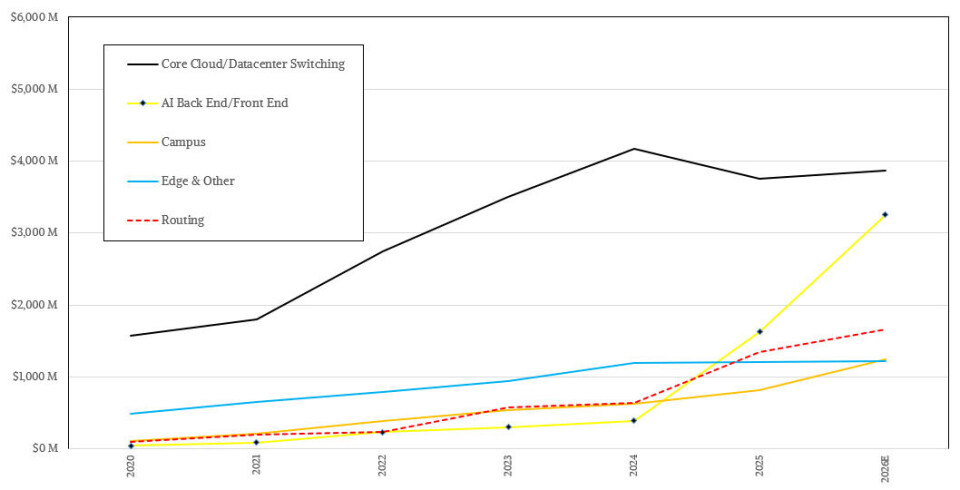
And
here is the raw data behind that chart:
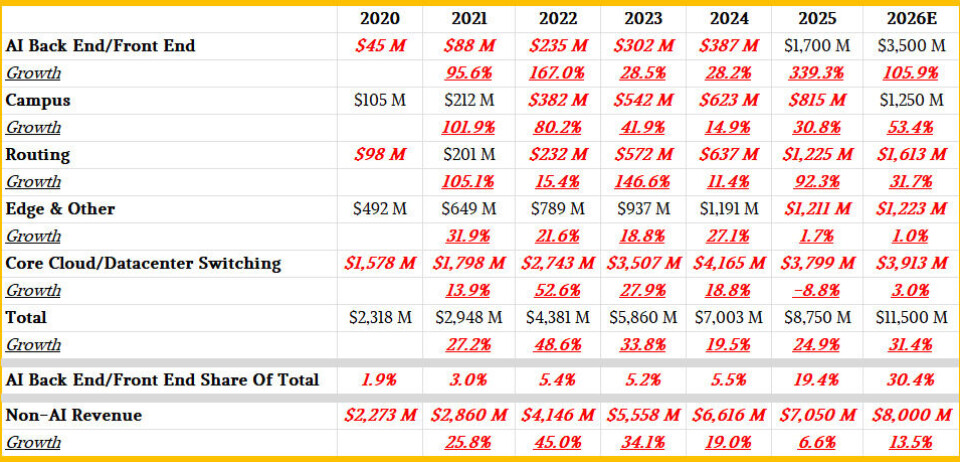
Here’s
the thing, though. Arista has actually turned in good numbers, and it is positioned
to benefit mightily from the GenAI boom, particularly as it moves from
supplying scale out Ethernet fabrics to supporting the ESUN scale up protocol
on switches beginning in 2027 as well as scale across Ethernet fabrics that
glue datacenters together for very large scale AI systems, which the company
can sell now.
Jayshree
Ullal, Arista’s chief executive officer, explained that opportunity on the call
with Wall Street analysts thus:
“The
advent of ESUN, Ethernet for Scale-Up Networking, specifications allows for
increasing or decreasing computing power in a flexible manner with Ethernet to
automatically adapt to workload demands. Scale up will be a new entry for
Arista in 2027 and beyond, where we will be working closely with our customers
to build AI racks with very fast interconnects for co-packaged copper, CPC, or
open co-packaged optics, CPO, as well as supporting collectives and memory
acceleration.”
“Scale-out
or horizontal scaling involves adding more machines to a leaf/spine fabric,
moving workloads across multiple servers or nodes or even connecting other
elements like storage or CPUs. As you scale out massive datasets, bottlenecks
can be resolved with collective and protocol acceleration at L2, L3, and cluster
load balancing, all at wire rate. The system must deliver consistent
performance without degradation as more nodes participate. Arista is a shining
example here with greater than a hundred cumulative customers to date in 800 Gb/sec
Ethernet deployments, and we expect the addition of 1.6 Tb/sec in 2027 at
production scale.”
As
for scale up and scale across network sales, Ullal did not make any specific
predictions, but she did say that in the mid-term, scale across would drive at
least a third of the company’s AI sales to two thirds for normal scale across
Ethernet networking. She offered no guidance on ESUN scale up switch sales on
top of that, and said that was really going to not be material until 2027 and
into 2028. Ullal did say that the majority of customers getting ready for early
trials are waiting for 1.6 Tb/sec ports, but a few customers are experimenting
with ESUN atop 800 Gb/sec gear.
As
for the supply chain issue that is governing Arista’s sales to a large extent,
Ullal said that it started out with a DRAM problem that might be a few
quarters, and now it is a wafer and package fabrication problem that is
affecting the whole chip industry and it may take one or two years to
normalize. Hence the rise in purchase commitments at Arista, which we presume
customers are prepaying with deferred revenues, also double compared to this
time last year, to help cover those costs and lock in prices now as best can be
done.
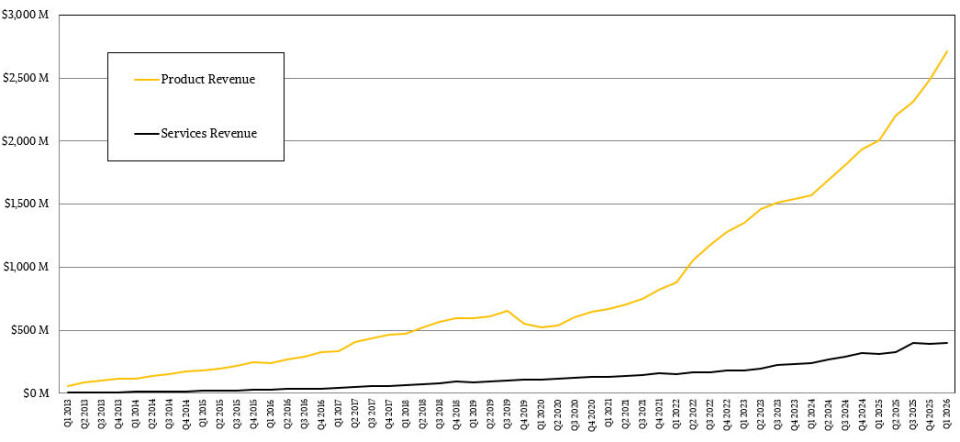
In
the March quarter, Arista had $2.31 billion in product revenues, up 36.6
percent year on year and up 10.3 percent sequentially. That is a pretty good
first quarter for any IT supplier in terms of growth. Services revenues rose by
27.3 percent to $397.7 million, up a smidgen sequentially.
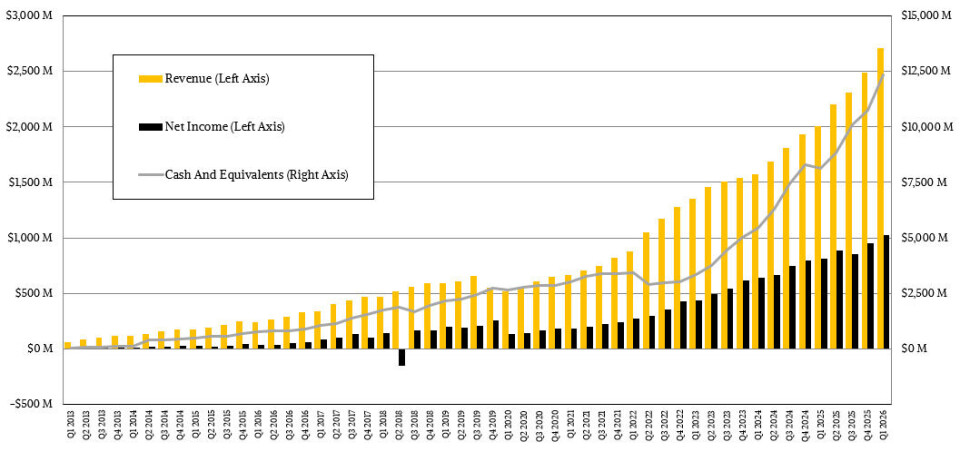
Add
them up and Arista had $2.71 billion in revenues, up 35.1 percent year on year
and up 8.9 percent from Q4 2025. Operating income was $1.16 billion (up 34.8
percent) and net income was $1.02 billion (up 25.7 percent, and representing
37.8 percent of revenues.
Arista
ended the March quarter with $12.35 billion in cash and equivalents, up by 51.6
percent since last year and giving it huge latitude in what it does and does
not do. Including prepaying for components to make sure it has a fair share of
supply.
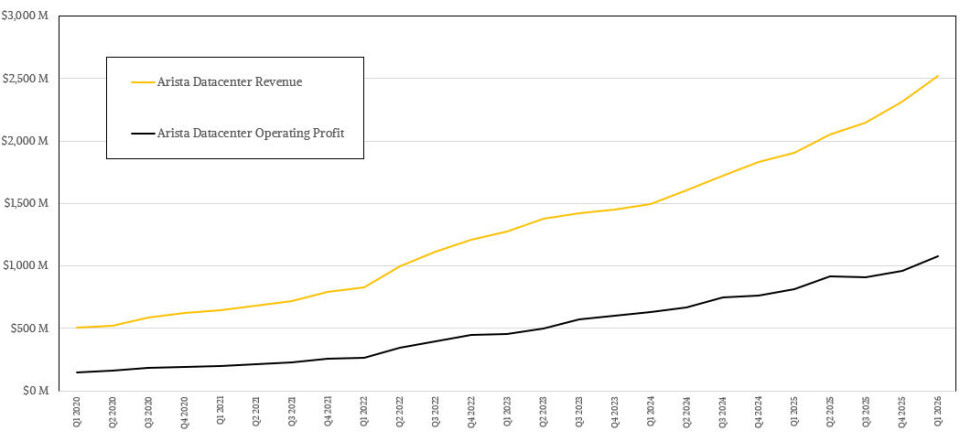
My
model suggests that Arista had $2.52 billion in datacenter revenues in Q1 2026,
up 32.3 percent, with operating income of $1.08 billion, up 32 percent.
It is hard to find a company that is expanding into
new markets and yet keeping an even keel and does it as well as Arista does.
