

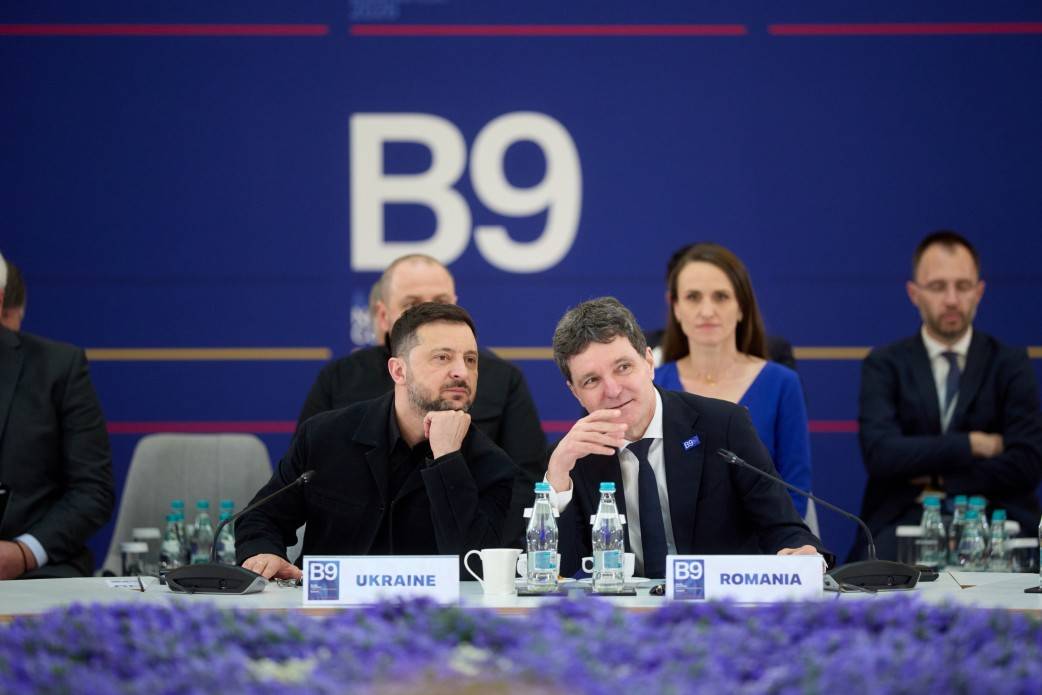
BUCHAREST—The growing strategic relevance of NATO’s eastern and northern flanks was on display last week, as Romania hosted the Bucharest Nine (B9) and Nordic Allies Summit.
Held in Bucharest at a moment of sustained military pressure from Russia against Ukraine and heightened concerns regarding hybrid threats, airspace violations, critical infrastructure vulnerability, and long-term deterrence, the summit brought together leaders from Central and Eastern Europe, Nordic partners, NATO Secretary General Mark Rutte, and Ukrainian President Volodymyr Zelenskyy. The broader political message emerging from the summit was clear: NATO’s eastern flank is no longer operating as a peripheral security zone but increasingly as one of the Alliance’s strategic centers of gravity.
For Romanian President Nicușor Dan, hosting the summit—a preparatory meeting ahead of July’s NATO Summit in Ankara—carried both strategic and political significance, as Bucharest faces internal political instability with a frail government led by Ilie Bolojan that lost a vote of confidence in parliament two weeks ago.
Strategically, Bucharest reinforced its role as a key platform for regional coordination on security and defense issues. Since the creation of the B9 format in 2015 by Romania and Poland following Russia’s annexation of Crimea, the initiative has evolved from a consultation mechanism into an increasingly influential political framework inside NATO. The participation of Nordic allies this year reflected the emergence of a more integrated northern-eastern security architecture stretching from the Arctic and Baltic regions to the Black Sea.
This evolution reflects a structural transformation within European security thinking. Threats facing NATO’s eastern flank are increasingly interconnected across geography and domains—from drone incursions and missile defense challenges to cyberattacks, sabotage operations, military mobility, and defense industrial resilience. The summit discussions emphasized the need for stronger air and missile defense capabilities, expanded defense investment, and closer coordination between allied defense industries.
Importantly, the summit unfolded simultaneously with Black Sea Defense Aerospace 2026, Romania’s largest defense, aerospace, and security exhibition, which gathered hundreds of defense companies from Europe, the Middle East, Asia, and the United States in Bucharest. This year, non-EU countries such as Turkey, South Korea, and Israel were present with multiple companies and pavilions, showing increased interest and relevance in Europe’s booming defense budgets. Together, they reflected a broader strategic trend increasingly visible across Europe and the Black Sea region: Deterrence is no longer discussed only in military or political terms but also through industrial capacity, supply chains, procurement coordination, and the rebuilding of transatlantic defense production ecosystems.
In this context, discussions around what some officials and analysts described informally as “NATO 3.0” became particularly relevant. The concept does not refer to a formal doctrinal transformation of the Alliance but rather to an emerging political understanding: Europe is expected to assume greater responsibility for conventional defense and industrial capacity, while maintaining the United States as the indispensable strategic anchor of transatlantic security. As Rutte described it in Bucharest: “A stronger Europe in a stronger NATO, through increased defense spending and defense production, and with European allies taking more responsibility for their own conventional defense, backed by American power.”
This perspective was articulated clearly during the summit. Polish President Karol Nawrocki stressed that “there is no NATO without the United States,” reflecting a broader consensus among eastern flank allies that stronger European defense capabilities should complement—not replace—US strategic engagement in Europe.
At the same time, the summit also reflected the changing dynamics of the transatlantic relationship itself. While the United States remained politically engaged, Washington was represented in Bucharest at a lower political level than the strategic significance of the meeting might have suggested, through Under Secretary of State Thomas DiNanno. This was widely noticed among regional stakeholders and reinforced ongoing European discussions regarding burden-sharing and the long-term sustainability of the US security commitment to Europe.
Nevertheless, the overall atmosphere in Bucharest was not one of transatlantic rupture but of recalibration. Eastern European allies increasingly understand that preserving US engagement will require Europe to demonstrate greater strategic seriousness—through defense spending, industrial readiness, military modernization, and political cohesion.
This broader message was also visible in the summit’s political positioning ahead of the NATO Summit in Ankara. The joint messaging from B9 states sought to underline that there is no contradiction between stronger European defense integration and a strong transatlantic alliance. On the contrary, the strategic objective increasingly promoted by eastern flank states is to strengthen the European pillar inside NATO precisely in order to preserve the credibility of the Alliance as a whole.
The post-summit statement also reaffirmed continued support for Ukraine and increasing attention to the security vulnerability of Moldova, particularly in the context of Russian hybrid operations and regional destabilization efforts. For Romania, these issues carry direct strategic relevance given its geographic position on NATO’s southeastern frontier and its growing role in Black Sea security.
Domestically, the summit carried additional symbolic weight. Romania hosted one of the most important regional security gatherings of the year during a period marked by political uncertainty and institutional tensions at home. Following the lost no-confidence vote, Dan announced he will begin consultations with parties for a new parliamentary majority that remains pro-Western and reform-oriented, amid difficulties that have caused the ruling coalition to fracture. Political maturity needs to prevail to avoid the rise of populist-extremist leaders, similar to the circumstances around Romania’s canceled elections in December 2024. In this context, the summit became not only an exercise in foreign policy visibility but also a test of Romania’s ability to project predictability and strategic coherence to allies and investors alike.
This dimension was frequently discussed in conversations surrounding the summit and adjacent security events hosted in Bucharest throughout the week, including the Black Sea and Balkan Security Forum hosted by the New Strategy Center. A recurring theme among regional and transatlantic stakeholders at these events was that Romania’s growing strategic relevance must ultimately be matched by internal political stability and institutional credibility if Bucharest wants to consolidate its role as a stable economy and long-term security and defense hub in the region.
The broader significance of the 2026 B9 Summit, therefore, goes beyond diplomatic coordination. It reflects the emergence of a new geopolitical reality inside NATO: Eastern and Northern European allies are increasingly shaping the Alliance’s strategic agenda on deterrence, resilience, industrial preparedness, and long-term confrontation management with Russia.
For Romania, this represents both an opportunity and a responsibility. By hosting the summit in Bucharest, Romania positioned itself not simply as a participant in regional security debates but as an increasingly active hub and contributor to defining the future direction of the Euro-Atlantic security architecture.
