

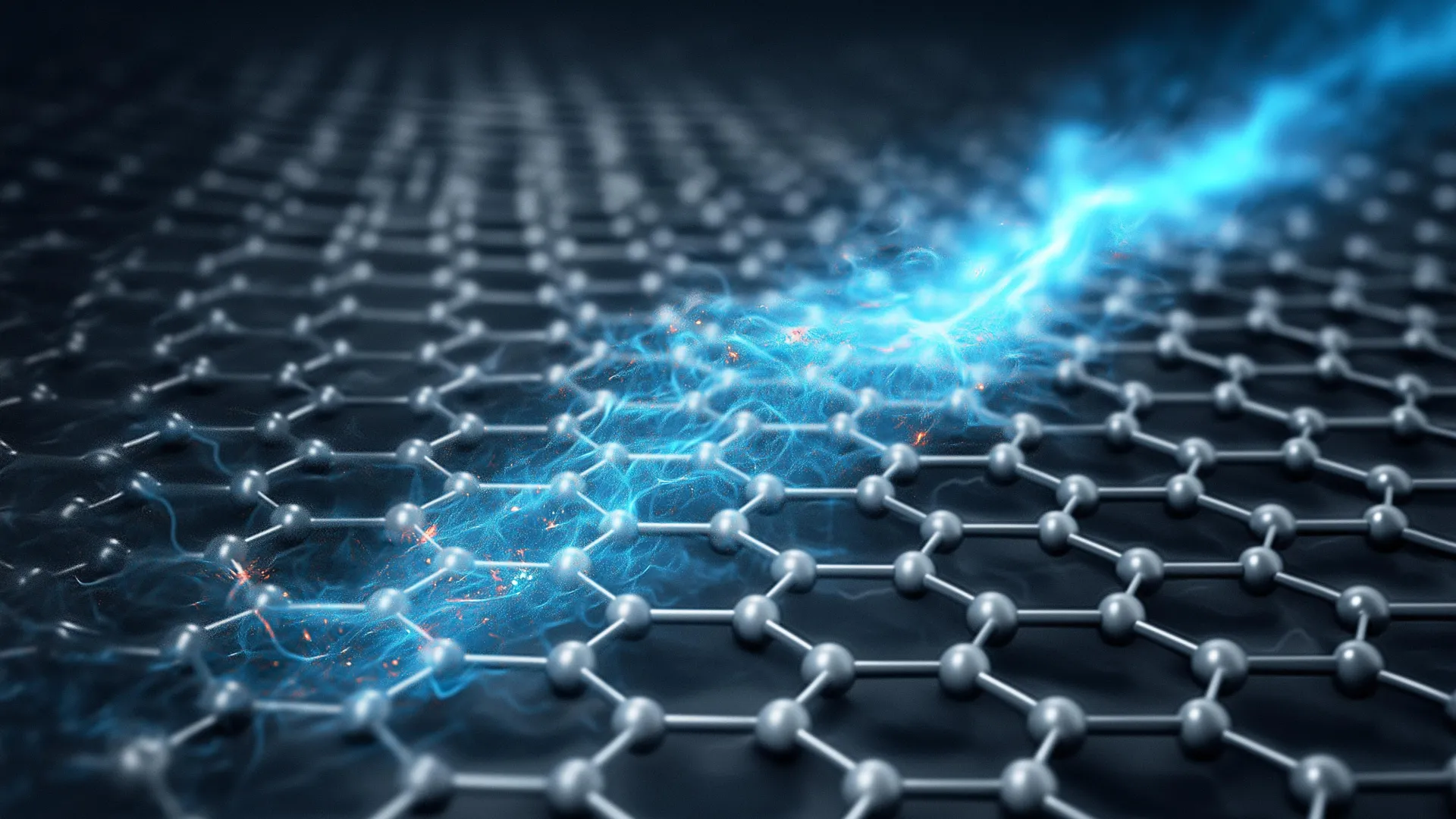
For decades, physicists have been trying to answer a fundamental question: can electrons move like a perfectly smooth, frictionless fluid governed by a universal quantum value? Detecting this unusual behavior has proven extremely challenging. In real materials, tiny imperfections such as atomic defects and impurities tend to disrupt these delicate quantum effects, making them nearly impossible to observe.
Now, researchers at the Department of Physics, Indian Institute of Science (IISc), working with collaborators from the National Institute for Materials Science in Japan, have finally identified this elusive quantum fluid in graphene. This material consists of a single layer of carbon atoms arranged in a flat sheet. Their findings, reported in Nature Physics, open a new path for studying quantum phenomena and position graphene as a powerful platform for exploring effects that were previously out of reach in laboratory settings.
“It is amazing that there is so much to do on just a single layer of graphene even after 20 years of discovery,” says Arindam Ghosh, Professor at the Department of Physics, IISc, and one of the corresponding authors of the study.
Breaking a Fundamental Law of Physics
To uncover this behavior, the team created exceptionally clean graphene samples and carefully measured how they conduct both electricity and heat. What they found was unexpected. Instead of increasing together, the two properties moved in opposite directions. As electrical conductivity rose, thermal conductivity dropped, and vice versa.
This result directly contradicts the Wiedemann-Franz law, a well-established principle that states heat and electrical conduction in metals should be proportional. The researchers observed deviations from this law by more than 200 times at low temperatures, revealing a striking separation between how charge and heat move through the material.
A Universal Quantum Connection
Despite this unusual split, the behavior is not random. Both types of conduction appear to follow a universal constant that does not depend on the material itself. This constant is tied to the quantum of conductance, a fundamental quantity that describes how electrons move at the smallest scales.
The Dirac Fluid and Liquid-Like Electrons
This remarkable effect occurs at a special condition known as the “Dirac point,” where graphene sits at a boundary between being a metal and an insulator. By adjusting the number of electrons, researchers can reach this precise state.
At this point, electrons stop behaving like individual particles. Instead, they move collectively, flowing like a liquid. This fluid-like motion resembles water but with far lower resistance to flow. “Since this water-like behaviour is found near the Dirac point, it is called a Dirac fluid — an exotic state of matter which mimics the quark-gluon plasma, a soup of highly energetic subatomic particles observed in particle accelerators at CERN,” says Aniket Majumdar, first author and PhD student at the Department of Physics. The team also measured how easily this fluid flows and found that its viscosity is extremely low, making it one of the closest realizations of a perfect fluid ever observed.
A New Window Into Extreme Physics
These results establish graphene as an accessible and cost-effective system for exploring ideas that are usually associated with extreme environments. Scientists can now investigate phenomena linked to high-energy physics and astrophysics, including black-hole thermodynamics and entanglement entropy scaling, within a laboratory setting.
Future Applications in Quantum Technology
Beyond its scientific importance, this discovery could have practical implications. The presence of a Dirac fluid in graphene may enable the development of highly sensitive quantum sensors. Such devices could amplify extremely weak electrical signals and detect faint magnetic fields, opening the door to new technologies in sensing and measurement.
